BEIJING (AFP) ― Three people were killed when an SUV vehicle crashed into a crowd in Beijing’s Tiananmen Square on Monday and burst into flames, police said, as a tower of smoke billowed near a giant portrait of Mao Zedong.
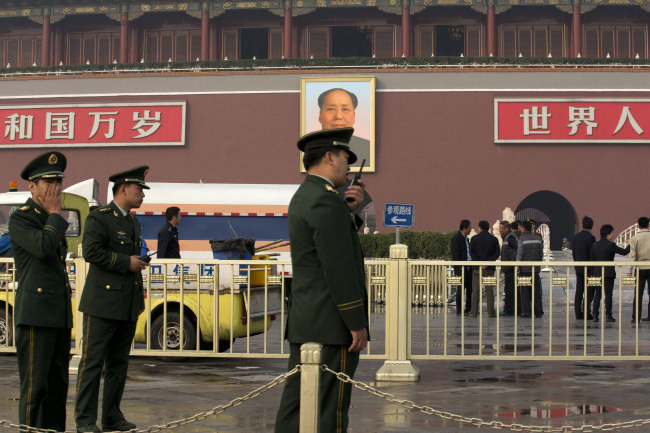
Immediately after the incident a security operation went into effect on the vast square, the site of the Forbidden City and where pro-democracy protests in 1989 were brutally crushed by the authorities.
Pictures posted on Chinese social media sites showed the blazing shell of the SUV and a plume of black smoke rising close to the portrait of communist China’s founder hanging on the towering wall of the former imperial palace.
There were also police vehicles gathered, and crowds looking on.
Several of the pictures were deleted within minutes, streets leading to the square were blocked off, screens were erected and two AFP reporters were forcibly detained close to the site, with images deleted from their digital equipment.
“A jeep crashed into the guardrail on Jinshui Bridge, then caught fire,” the Beijing police said in a statement on their verified social media account.
The Jinshui Bridge passes over the moat around the Forbidden City.
“It is confirmed that the jeep driver and the two other people in the car are dead,” the statement said.
“On its way, it injured many tourists and police officers. Police are currently doing their job by rescuing people on the spot, and the fire has been extinguished,” it added.
Victims were sent to nearby hospitals for treatment, it said.
Beijing transport authorities said via social media that a subway station next to the square had been closed at the request of police.
One 58-year-old Italian tourist said he had been visiting the Forbidden City when officers came in around noon and told everyone to leave.
Tiananmen Square is the symbolic centre of the Chinese state and is generally kept under tight security, with both uniformed and plain-clothes personnel deployed, many of them equipped with fire extinguishers.
Details on a motive were not immediately available, but Chinese social media users speculated that it could have been intentional.
“Is this the 2013 Tiananmen self-immolation incident?” asked one poster.
“There’s still a person inside the car!”
Another poster asked: “Could it be a terrorist attack?”
Around 120 Tibetans have set themselves alight since February 2009 in Tibet itself and adjoining regions of China, in protest against what they see as Chinese oppression.
News of the incident first trickled online Monday afternoon in reports from Chinese social media users on the scene.
Pictures they posted showed the flaming wreck surrounded by several police and emergency vehicles, directly in front of the sign on the Tiananmen gate reading: “May the great unity of the world’s people last for 10,000 years.”
Soon afterwards police erected high curtain-like barricades directly in front of the Mao portrait, blocking passers-by from viewing the scene.
The square is flanked by several of communist China’s key buildings and institutions, with Mao’s mausoleum on the south side, the Great Hall of the People to the west, and China’s national museum to the east.
The imperial Forbidden City, a world heritage site that sees 14 million visitors a year, is on the north side, with the Tiananmen Gate as its entrance, where Mao proclaimed the foundation of the People’s Republic of China in 1949.
A huge flagpole stands at the northern end of the plaza, with a giant national flag fluttering from its top.
Changan Avenue, the main road passing from east to west in front of the Forbidden City, was later reopened to vehicle traffic but no pedestrians were allowed near the site.
koreaherald@heraldcorp.com