RANCHO MIRAGE, California (AFP) ― Barack Obama and Xi Jinping ended their first U.S.-China summit Saturday, forging a rapport and policy understandings, if not breakthroughs, on North Korea, climate and cyber issues.
The presidents spent eight hours together over two days, in intimate groups with staff, over a dinner of lobster and steak, and strolling through the lush gardens of a California desert oasis, in a casual departure for Sino-U.S. ties.
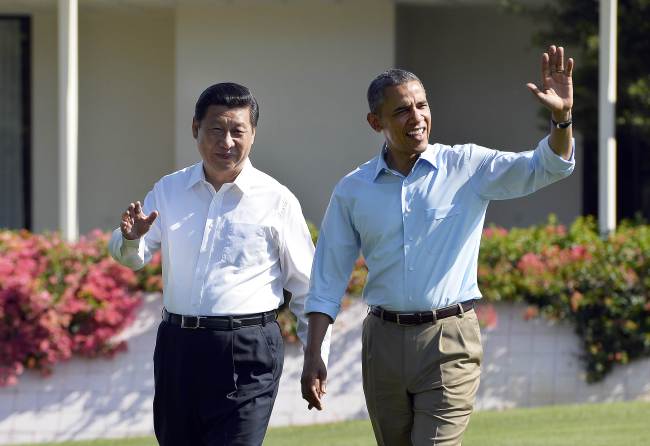
Both sides wanted to loosen the formality of U.S.-China talks ― and appeared to succeed: at one point Obama and Xi, finding common ground as politicians, sketched respective visions for where they hoped to take their nations.
By the time Xi left on Saturday, U.S. officials said, the two men had talked bluntly about a new flashpoint, cybersecurity, chided North Korea’s nuclear grandstanding and agreed a new joint push on climate change.
U.S. National Security Advisor Tom Donilon said the talks were “uniquely informal,” “constructive,” “wide-ranging,” and “positive” for a vital great power relationship which is often prickly and requires constant maintenance.
Obama and Xi agreed to work together for the denuclearization of the Korean peninsula, following nuclear and missile tests and wild warnings of atomic warfare from North Korea, Beijing’s troublesome nominal ally.
They achieved “quite a bit of alignment” on the issue, Donilon said, and praised recent steps by Beijing to quietly rebuke inexperienced North Korean leader Kim Jong-un.
Obama meanwhile made clear that a rash of suspected Chinese cyber attacks on U.S. commercial property and military technology would be an “inhibitor” to relations, and would be a “very difficult” problem to solve.
Donilon said that Xi “acknowledged” how important the issue was to Washington, and left California in no doubt where Obama stood.
The leaders also offered directions to working group officials from both sides due to sit down to discuss cyber issues in July.
On Friday, Obama called for common “rules of the road” on cybersecurity.
“It’s critical, as two of the largest economies and military powers of the world, that China and the United States arrive at a firm understanding.”
Xi said he wanted “good-faith cooperation” on the issue, but stood his ground, saying China was also “a victim of cyberattacks.”
In a more tangible outcome from the talks at the Sunnylands retreat once patronized by Frank Sinatra and Richard Nixon, the White House said Obama and Xi agreed a joint effort to combat climate change, specifically the production of “super greenhouse gases.”
“A global phase down of (hydroflourocarbons) could potentially reduce some 90 gigatons of CO2 equivalent by 2050, equal to roughly two years’ worth of current global greenhouse gas emissions,” a White House statement said.
koreaherald@heraldcorp.com