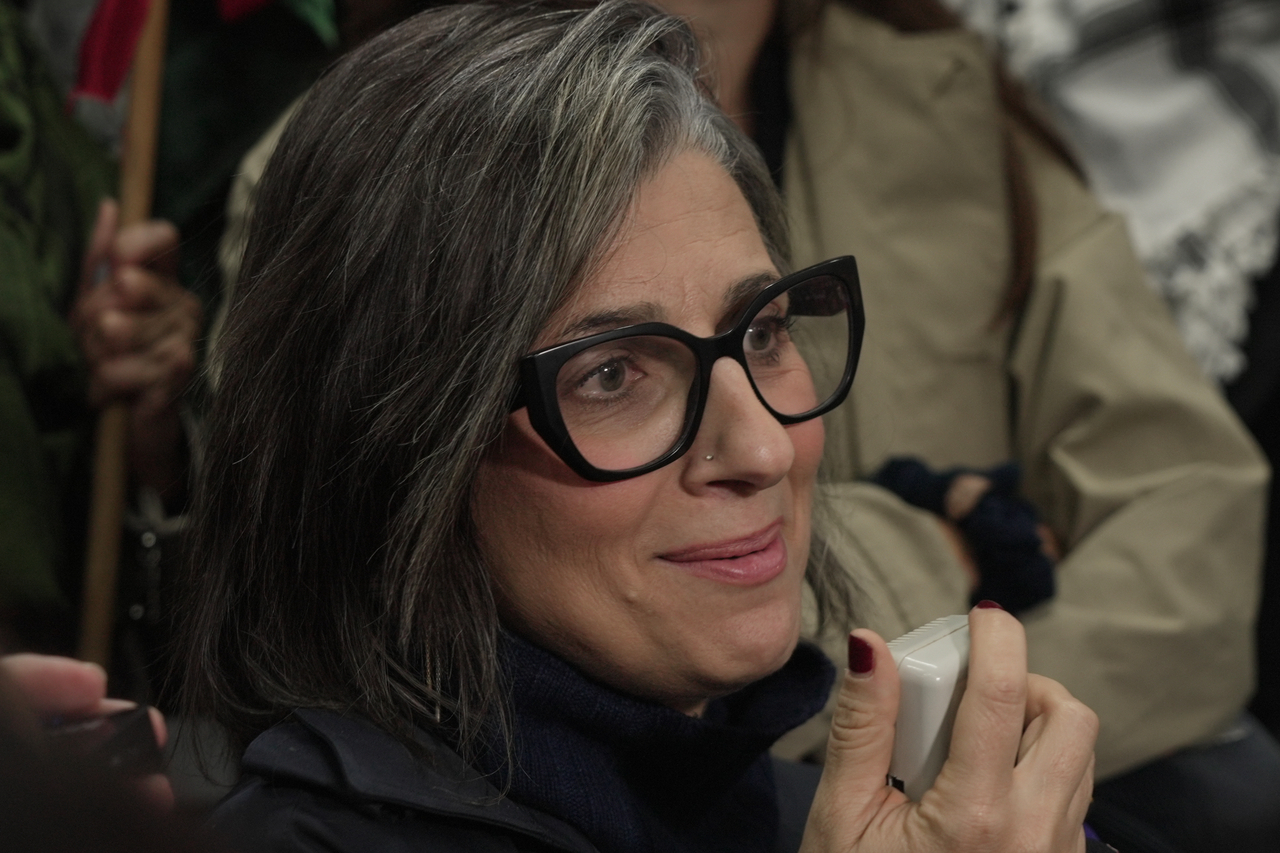
The UN special rapporteur on the Israeli-occupied Palestinian territories arrived in Mexico on Saturday to a hero’s welcome after Costa Rica barred her from entering the country to accept an honorary degree, stranding her at the airport for more than a day and a half.
Francesca Albanese, an Italian lawyer appointed by the UN to independently investigate abuses against Palestinians, is one of Israel’s harshest critics and accuses the Israeli government of committing genocide in Gaza, a charge Israel rejects. Her push to hold Israel and its allies accountable has made her a target of the Trump administration, which has accused her of antisemitism and placed her under the kind of sanctions typically used against terrorists and drug traffickers.
At the arrivals gate in Mexico City, a few dozen activists greeted Albanese with flowers and hand-painted signs, chanting pro-Palestinian slogans, strumming guitars and banging drums. A large Palestinian flag was unfurled at her feet as she emerged from the sliding doors, looking tired but resolute.
She described her treatment in Costa Rica as “disgusting,” saying the government never so much as called her while she was stuck at the airport.
“I know that in this region the pressure from the neighbors is felt strongly, but there is humanity,” she said, in an apparent reference to the US government. “They didn’t show me any of that. But the people did: the lawyers, civil society.”
To her supporters, the episode showed how far Washington’s reach extends in Latin America.
“What they did to her in Costa Rica is a sign of the decadence we live in, of the sadness of this era, which bows to imperial governments,” said Claudio Albertani, a history professor in Mexico City who was among those greeting her at the airport.
Immigration officers stopped Albanese when she flew in from Paris on Thursday, saying she was the subject of an international alert over alleged ties to terrorism and posed a national security risk. They didn’t publicly say who issued the alert or offer evidence.
Albanese called for an investigation into whether the ban was linked to Washington’s sanctions against her, which bar her from entering the US and freeze any assets she has there. The Trump administration imposed the penalties last year over accusations that she was working with the International Criminal Court to pursue cases against Israeli and American citizens.
As officials moved to send her back to Paris, Costa Rica’s Constitutional Court stepped in, ordering a stay of her deportation while it reviewed a legal challenge filed on her behalf. Still unable to leave the airport, she accepted her honorary doctorate from the University of Costa Rica by video call.
Late Friday, the court cleared her to leave the airport for a hotel while it considers the case, sparing her deportation to Paris, though it did not overturn the entry ban. She flew on to Mexico, where she is scheduled to speak at a Palestinian solidarity event, the city’s human rights commission and a university.
The rulings pitted the court against Costa Rica’s right-wing government, which is closely aligned with US President Donald Trump and Israeli Prime Minister Benjamin Netanyahu. Rodrigo Chaves, Costa Rica’s former president and now a powerful Cabinet minister under his handpicked successor, denounced the court’s intervention as “yet another usurpation by an increasingly arbitrary judiciary.”
Albanese urged Costa Ricans to defend their judicial system.
“You have something extremely precious, an effective and independent judiciary,” she said in a video from the plane. “And then you have free academia. Both are valuable, and both are under attack.”
The government’s decision to bar her drew condemnation at home and abroad. Three former Costa Rican presidents, including Nobel Peace Prize laureate Oscar Arias, criticized it, and the country’s ombudsman’s office said holding her at the airport showed officials’ “ignorance” of her immunity from detention and arrest as a UN expert.
“This is difficult to reconcile with Costa Rica’s longstanding commitment to human rights,” said Volker Turk, the UN high commissioner for human rights. Amnesty International called the government’s actions “shameful.”
Israel’s UN ambassador, Danny Danon, praised the move, suggesting on X that Albanese was facing consequences for using her UN mandate to spread “vile propaganda” about Israel. Jeff Bartos, a senior US diplomat at the UN, also welcomed it, saying he was “grateful to Costa Rica for keeping this liar and lunatic out of their beautiful country.”
In Mexico City, Albanese insisted she didn’t want her ordeal to overshadow the suffering in Gaza.
“I’m here to talk about Palestine,” she said. “If I become the news, I’ve failed.” (AP)