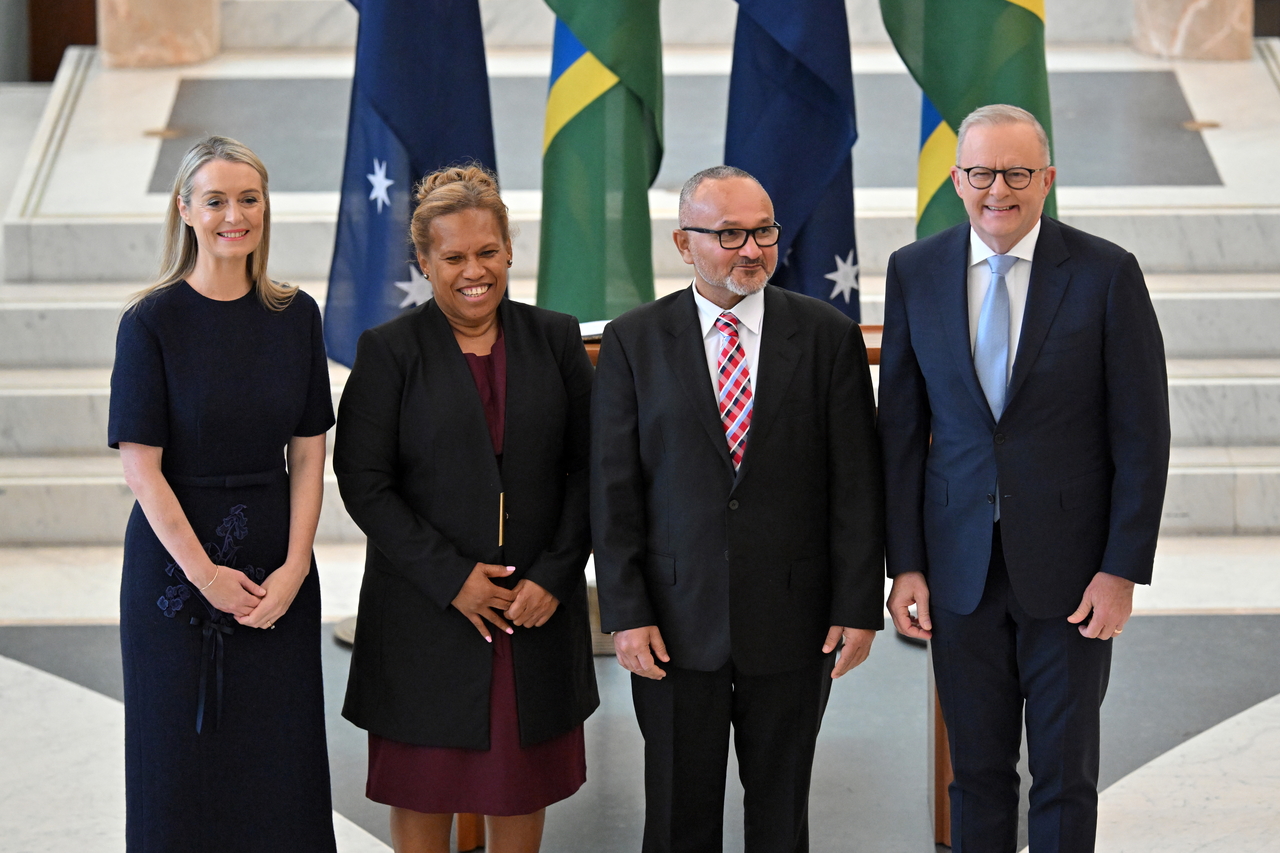
CANBERRA, Australia (AFP) -- Solomon Islands and Australia signed a sweeping treaty on Wednesday, affirming there will no foreign military base in the Pacific nation in a deal seen as stymieing China.
Prime Minister Matthew Wale and 15 ministers are visiting Canberra for talks spanning security, infrastructure, education and health -- and for the formal signing of the Australia-Solomon Islands Treaty.
"Solomon Islands has been for a number of years a source of uncertainty and doubt in the region," Wale told journalists alongside Australian counterpart Anthony Albanese.
"Those days are gone." The treaty cements Australia as the island nation's "primary security partner".
It affirms the "sovereign decision" by the Solomon Islands that there will be no foreign military or security base on its soil, and "that Solomon Islands' sensitive infrastructure will remain free from militarization, foreign interference and unauthorized access."
The treaty text shows that will span airports, ports, energy and telecommunications -- areas where China has built infrastructure under million dollar loans since the island switched ties from Taiwan in 2019.
Albanese said Wale had shown courageous leadership.
"Security in the Pacific is the responsibility of the Pacific," he said.
The Solomon Islands will be required to consult with Australia before making deals with other countries on critical infrastructure or security cooperation outside members of the Pacific Islands Forum regional bloc, he added.
Wale has been in a diplomatic sprint since he was elected leader in May, upending close ties with Beijing built by his predecessor Manasseh Sogavare and travelling to Canberra and Washington to rebuild relationships with traditional partners.
Asked about reports he had ended a secretive security pact with Beijing by giving six months' notice of his country's withdrawal, Wale told journalists that discussions with China were "ongoing."
He said he could not comment further due to a non-disclosure clause in the deal.
China's foreign ministry on Tuesday said its ties with Pacific nations were not matters of "geopolitical contests or bloc confrontation."
Struck in 2022, the pact had "caught Canberra unprepared for a new era of intense geopolitical competition with China in Australia's immediate neighborhood," Mihai Sora, director of research at the Lowy Institute think tank, said.
The Solomons hosted Chinese police, and Australia grew anxious the deal also covered the Chinese navy.
The pact "made real the prospect of a persistent Chinese military presence some 1,600 kilometers off the coast of Australia and was the catalyst for the past four years of frenetic Australian diplomacy in the region in an attempt to stem further strategic damage," Sora, a former Australian diplomat in the Solomons, told Agence France-Presse.
Australia countered by striking security alliances or wide-ranging treaties with another five Pacific island countries.
Wale's election was a "rare and perhaps fleeting opportunity" for Australia to end the prospect of a Chinese military presence in the Solomons, he said.
"At least for as long as the deal holds." Wale adjourned the Solomons parliament indefinitely in September after staring down a no-confidence vote.
He was forced to abruptly leave a Pacific leaders' summit in Palau to stop the attempt to bring down his new coalition government on the eve of a visit by the US Deputy Secretary of State.
Solomons officials told AFP Wednesday the parliament will return in January to approve significant reforms including a pledge for free education.
The treaty commits Australia to boosting education, health, policing, resources, energy and climate resilience and assisting with a sovereign wealth fund.
It also covers road and bridge construction -- areas China has dominated in the islands through its Belt and Road Initiative.
Wale said the decision to approve the Australian treaty was taken by his entire cabinet, many of whom had travelled to Canberra for the signing.
Now the Solomons opposition party leader, Sogavare on Tuesday criticized the "fast-tracking" of the treaty with Australia while the status of China security arrangement remained "unclear."