October equity outflows hit 25.98 trillion won, while bond investments reversed to net inflows of 7.38 trillion won.
Foreign investors are staging a mass exodus from South Korean equities while pouring money into domestic bonds, signaling a sharp shift in investment flows.
Foreign investors sold a net 25.98 trillion won($19.3 billion) worth of South Korean listed stocks in October, according to a report released Friday by the Financial Supervisory Service.
This marked the second straight month of net selling, following 19.12 trillion won in September. Net sales for the January-October period totaled 239.98 trillion won.
In bonds, however, foreign investors reversed course in October, investing a net 7.38 trillion won after withdrawing 4.74 trillion won in August and 7.57 trillion won in September.
The October figure reflects 7.63 trillion won in net bond purchases, less 250 billion won in maturities. Government bonds accounted for nearly all of the net investment, at 7.36 trillion won. Foreign holdings of listed bonds stood at 330.3 trillion won.
US investors led the equity sell-off, accounting for 13.85 trillion won, or 53 percent, of total foreign net sales in October. Their monthly net selling was the heaviest since June.
Foreign holdings of South Korean listed stocks fell to 1,899 trillion won at the end of October, down 396.9 trillion won from a month earlier. Their share of total market capitalization also declined to 34 percent from 34.8 percent.
The drop reflected not only net selling but also valuation losses as stock prices fell.
The sell-off was concentrated in major AI-related semiconductor stocks.
Foreign investors pulled a net 17.2 trillion won from the electrical and electronics sector in October. At the individual-stock level, they sold a net 11.5 trillion won worth of SK hynix shares and 4.2 trillion won worth of Samsung Electronics shares, including preferred stock.
Shin Sul-wi, a deputy research fellow at the Center for International Finance, attributed the selling pressure to concerns over a peak in the memory chip cycle, slowing revenue growth at Anthropic and credit risks facing AI companies.
Foreign selling has continued into November. Korea Exchange data show that foreign investors sold 16.29 trillion won worth of shares over the 15 trading sessions from Nov. 2 to 20.
They were net sellers for six consecutive sessions from Nov. 13 to 20, with net sales totaling 5.90 trillion won over the period.
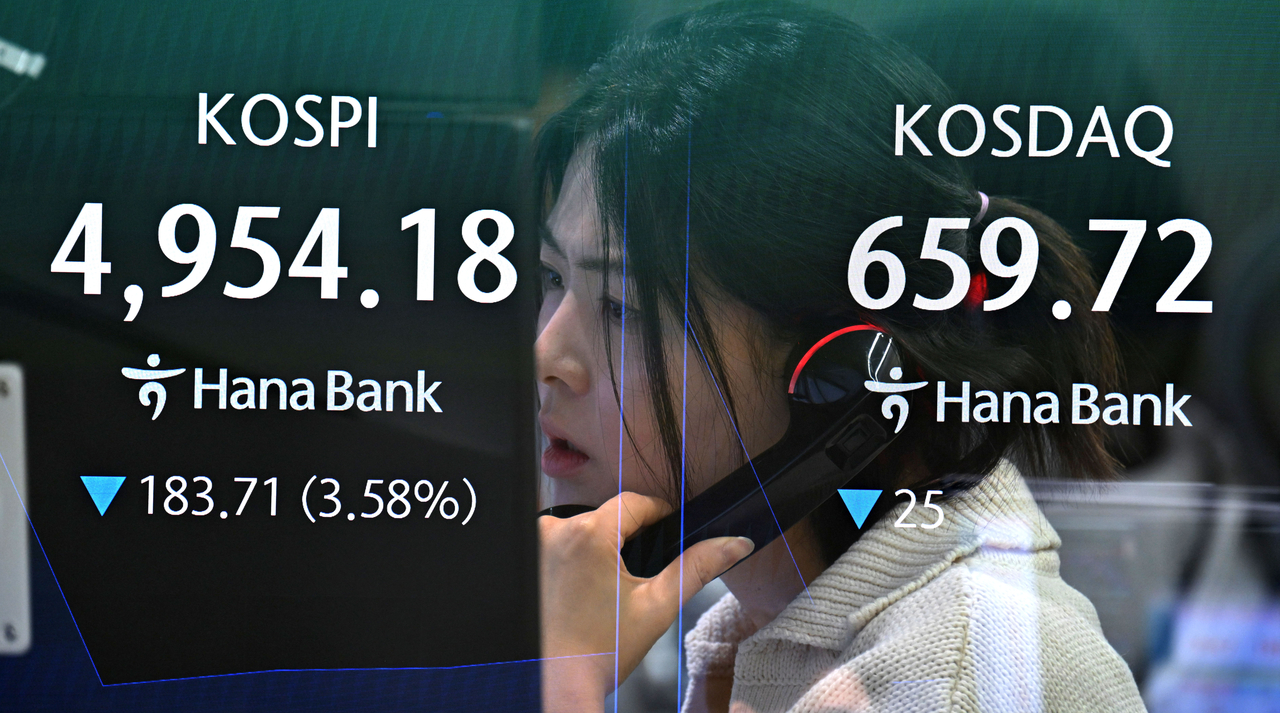
As foreign selling intensified from October, the Kospi tumbled 30.5 percent from its closing high of 7,003.74 on Oct. 2 to 4,869.96 on Nov. 20.
European investors led foreign bond purchases in October, investing a net 4.92 trillion won. Asian and Middle Eastern investors followed with net purchases of 1.65 trillion won and 1.54 trillion won, respectively. Investors in the Americas, by contrast, withdrew a net 700 billion won.
The Center for International Finance cited stronger arbitrage incentives as a key driver of bond inflows. These incentives refer to the additional returns foreign investors can earn by investing in domestic bonds after hedging currency risks through foreign exchange swaps.
In November, foreign investors have been net sellers of Korean Treasury bonds in the cash market but net buyers in the futures market, showing no clear directional bias.
Through Nov. 18, they had sold a net 1.5 trillion won worth of Treasury bonds in the cash market. But on Nov. 19, they bought a net 12,864 three-year Treasury bond futures contracts and 5,724 10-year contracts, highlighting diverging positions in the two markets.
Meanwhile, South Korean investors are stepping up purchases of overseas stocks.
According to the Korea Securities Depository, domestic investors' net purchases of foreign stocks reached $5.34 billion in October, 5.6 times the $954.82 million recorded in September.
ch0221@heraldcorp.com