Third-generation CEO Kim Jung-gyun targets space revenue by 2030 as he seeks to turn ambitious investments into a viable business
When Boryung signed a research cooperation agreement with German aerospace agency DLR last month, the Korean drugmaker gained something its space ambitions had long lacked: a prospective user for its planned research infrastructure outside the Earth’s atmosphere.
Boryung secured another potential customer just days later, signing an agreement with domestic medical device maker Sky Labs to develop astronaut vital-sign monitoring solutions and build a space medicine data platform.
Neither has an immediate commercial impact, but both are an early indication of possible demand for a business that, so far, has been built largely through investments and partnerships.
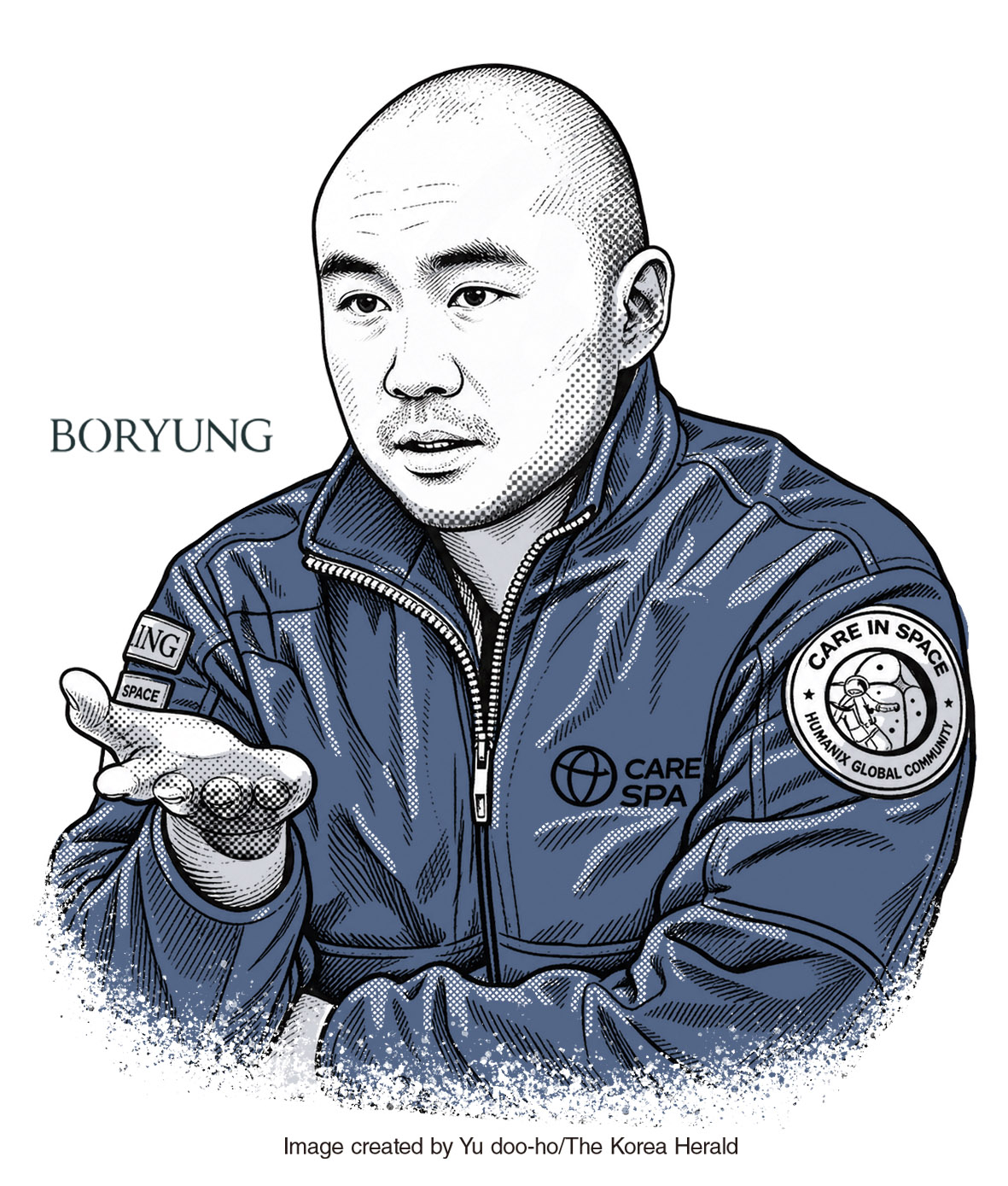
For Boryung CEO Kim Jung-gyun, grandson of the firm’s founder Kim Seung-ho and son of former chair Kim Eun-sun, the task at hand is to turn that foothold into a new growth engine — one that could eventually make a traditional pharmaceutical company an orbital platform provider.
Kim has begun putting a clearer timetable behind the ambition, saying Boryung aims to generate its first meaningful revenue from its space business in 2030 as it expects to have research hardware in space with customers using them for experiments in orbit by then.
Betting on space
The Boryung chief's thesis rests on the scientific potential of microgravity. The space environment can enable experiments that are difficult to conduct on Earth, including research into protein crystallization and the assembly of DNA nanomaterials. For pharmaceutical companies, such work could offer new ways to study biological processes and materials relevant to drug development.
The company began placing its space bets in 2022, investing $60 million in US space infrastructure developer Axiom Space. The drugmaker later established BRAX Space, a joint venture intended to develop commercial opportunities using Axiom's infrastructure. It also expanded its exposure to the sector through a $10 million investment in US lunar services company Intuitive Machines. Boryung’s Humans In Space initiative has helped build a network of researchers, startups and space-industry specialists.
“For Boryung, the road to space commercialization appears to be a long one,” said a space industry official.
“Despite years of investing time and money in the space sector, Boryung is rooted in the pharmaceutical industry. … Whether they can develop the right equipment, secure access to orbital facilities and persuade research organizations to pay for experiments is questionable.”
The space wager reflects a broader ambition that Kim signaled when he dropped the word "Pharmaceutical" from the company's name in 2022. The change from Boryung Pharmaceutical to Boryung was approved at the company's March shareholders' meeting, shortly after Kim became co-CEO.
Kim underlined that the company needed to strengthen its earnings base to finance continuous investment while creating room to pursue opportunities beyond conventional drugmaking. The shorter name was intended to reflect that wider corporate identity.
Holding ground
For now, however, the pharmaceutical business remains the financial foundation of the transformation. Boryung reported consolidated revenue of 1 trillion won ($748 million) and operating profit of 65.1 billion won last year. The firm logged record first-half results this year with sales of 535 billion won and operating profit of 44 billion won, up 8.7 percent and 21.1 percent, respectively, from a year earlier.
Boryung is also preparing to reorganize its pharmaceutical operations. Last month, shareholders approved a plan to spin off the prescription-drug sales division into Boryung Pharma Solution, a wholly owned, unlisted subsidiary scheduled to begin operations in January next year.
Under the new structure, the listed parent will focus on research and development, manufacturing and global business. Boryung Pharma Solution will handle domestic sales, marketing, product introductions and distribution.
The company plans to expand the subsidiary's portfolio with 26 internally developed products and 16 introduced products by 2030. It has said there are no immediate plans to sell or list the unit.
The ownership structure behind the group has also been consolidated. In May this year, Boryung Holdings absorbed affiliate Boryung Partners, which had previously held a 21.1 percent stake in Boryung. Following the consolidation, Boryung Holdings owns a 50.8 percent stake in Boryung. Kim holds a 51.31 percent stake in Boryung Holdings, the family's controlling vehicle, while his direct stake in listed Boryung is 0.95 percent.
The changes give Kim a framework for pursuing businesses with markedly different growth cycles: an established pharmaceutical operation generating cash, a separate subsidiary responsible for domestic commercialization and a space business that may take years to produce meaningful returns.
“Kim’s challenge is to make those parts work together without allowing the long-term space bet to outpace the earnings base that must finance it,” said a pharmaceutical industry official.
“Whether Kim can turn his space vision into a durable business will be a defining test of his career.”
Born in 1985, Kim joined Boryung in 2014 after working at Samjong KPMG. He studied industrial engineering at the University of Michigan and later earned a master's degree in social and administrative pharmacy from Chung-Ang University. He became the company's sole CEO in February last year.
hwkan@heraldcorp.com