
Industry execs stress income generation, liquidity management and shareholder value amid volatile crypto markets
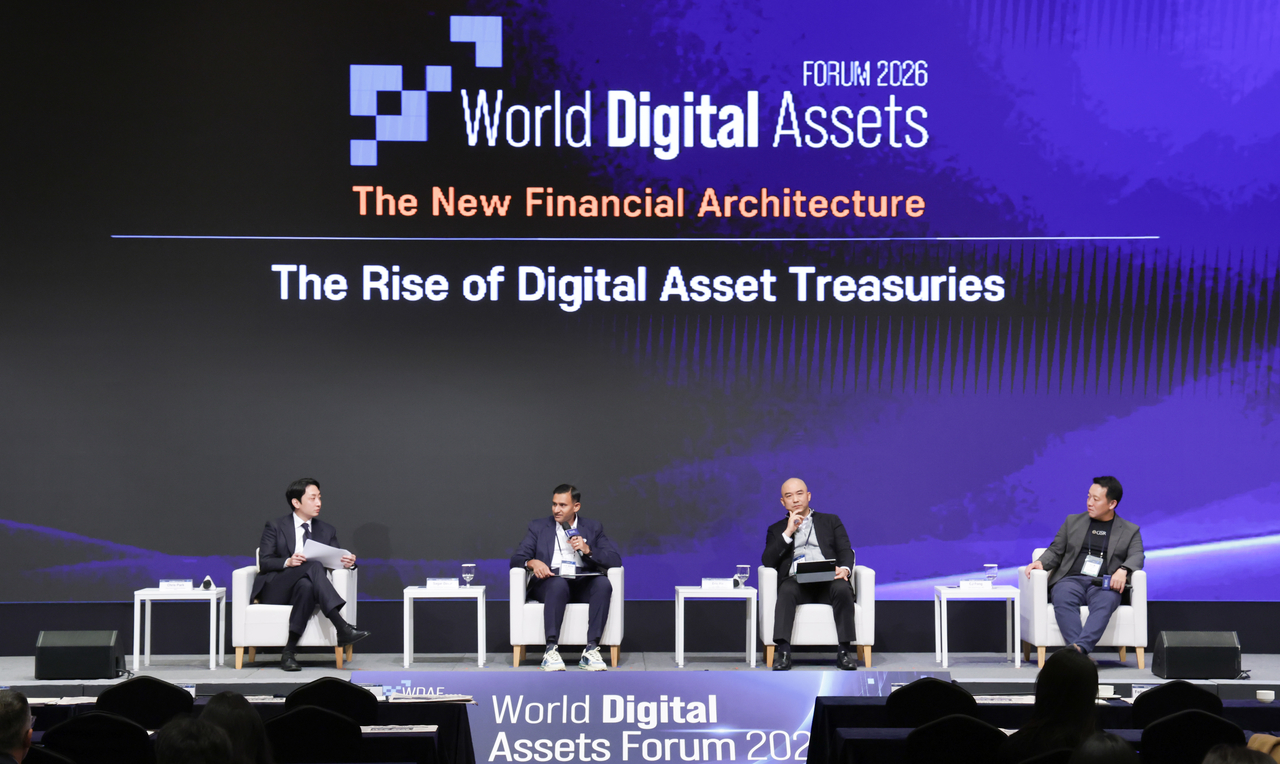
Unlike bitcoin exchange-traded funds, which track cryptocurrency prices, companies that accumulate digital assets must prove they can generate returns on their holdings and cover operating costs without being forced to sell when markets fall, industry executives said Monday.
The challenges facing digital asset treasury companies, or DATs, took center stage at the World Digital Assets Forum 2026 in Seoul during a panel moderated by Chris Park, head of Korea commercial strategy at BitGo, with executives from Coinbase Institutional, GSR and Korea Digital Asset Custody.
Sagar Desai, Asia-Pacific head of wholesale at Coinbase Institutional, compared crypto treasury companies to real estate investment firms, arguing that the value of their assets should extend beyond potential price appreciation.
"A real estate management company may have multiple different assets that it is managing, and the best-performing companies are the ones that are able to make use of those assets in such a way that there are real operating incomes that are coming out of each of the underlying assets," Desai said.
For treasury companies that issue shares to acquire more tokens, generating returns is particularly important. As their digital asset holdings increase, issuing additional shares dilutes existing shareholders' ownership, according to CJ Fong, Asia-Pacific general manager at GSR.
The additional investments must generate sufficient income or gains to offset that dilution, he said.
Early crypto treasury companies largely focused on accumulating tokens and benefiting from rising prices, Fong said. Some are now building investment teams to generate income from their holdings.
Potential strategies include earning staking rewards by committing eligible tokens to help secure blockchain networks. Bitcoin treasury companies could also expand into mining operations.
"Fundamentally speaking, you need to be in a place where you have a diversified strategy, where you don't have a single concentration risk. You already have concentration risk on the asset," Fong said.
For larger holders, staking income can help cover operating expenses, he added.
But such strategies carry risks, particularly when cryptocurrency prices fall and companies face difficulties raising fresh capital.
"So we've talked about yield, and where yield is, there is a downside risk," moderator Park said, raising concerns about the financial pressures treasury companies could face during a market downturn.
Eric Ko, chief strategy officer at Korea Digital Asset Custody, emphasized the importance of maintaining enough liquidity to avoid forced asset sales.
A sharp decline in token prices could trigger margin calls on crypto-backed loans, while interest payments and preferred dividends would still need to be paid regardless of market conditions.
"If the company's only business is holding coins, then salaries and other expenses are also paid by selling coins," Ko said.
Desai also warned against accumulating digital assets at the expense of shareholder value, saying he had recently seen companies continue buying tokens even when the purchases reduced value for existing shareholders.
"So my advice to anybody that is running DATs would be to never accumulate the asset at the cost of shareholder value," Desai said.
jwc@heraldcorp.com