Steelmaker lays out expansion plans spanning advanced materials, critical minerals and LNG as geopolitical tensions threaten global supply chains
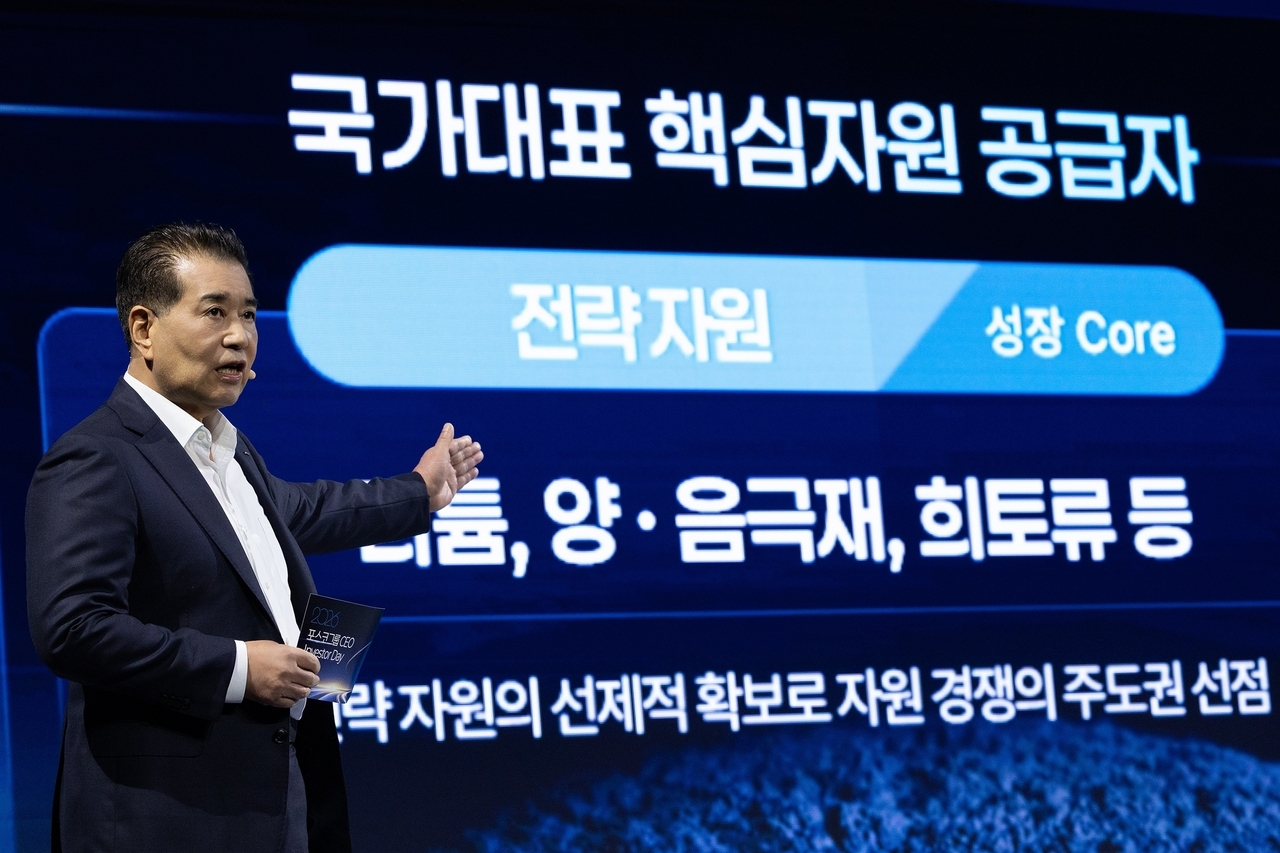
GWANGYANG, South Jeolla Province — Posco Group, the steelmaking giant that helped power South Korea's industrial rise, is seeking a bigger role in securing the country's critical resources, expanding into lithium, rare earths and energy as geopolitical tensions expose vulnerabilities in global supply chains.
The shift is central to the group's "Triple Core" strategy, unveiled by Chairman Chang In-hwa in July, which aims to reshape Posco around three pillars: steel, strategic resources and energy.
Rather than relying primarily on steel and battery materials, Posco plans to build a broader portfolio spanning minerals essential for electric vehicles and robotics, specialty gases used in semiconductor manufacturing and liquefied natural gas.
"With growing protectionism and recent conflict in the Middle East accelerating supply chain fragmentation, industrial security has become critical," Choi Dong-yong, head of the business strategy office at Posco Holdings, said at a media briefing at the group's Gwangyang complex in South Jeolla Province on Nov. 3.
"Just as Posco built the country's economic foundation through steel and laid the groundwork for next-generation mobility with battery materials, we will now take the lead in securing the supply chains for Korea's critical resource industries," he said.
The group plans to invest 16.7 trillion won ($12.4 billion) as part of the strategy, targeting annual revenue of 187 trillion won and operating profit of 13 trillion won by 2035.
Steel shifts toward overseas growth, advanced products
Steel remains Posco's industrial backbone, but the company is adjusting its strategy as sluggish demand and competition from Chinese producers weigh on profitability.
Founded in 1968, Posco grew into one of the world's largest steelmakers by the late 1990s. It ranked eighth globally by crude steel output in 2025.
The group is now targeting higher-margin automotive steel while expanding overseas production capacity from 2.5 million tons this year to 10 million tons by 2031.
India is a major focus. Posco plans to break ground next year on a steel mill in Odisha through its partnership with JSW, with an annual capacity of 6 million tons and completion targeted for 2031.
The investment is aimed at capturing demand in India's expanding automotive and manufacturing sectors. Posco projects the country's steel market will grow from 150 million tons this year to 350 million tons by 2045.
"Leading steel companies in Korea have operating profit margins of 4 to 5 percent, while India and others show margins of over 10 percent," Choi said.
In the US, Posco is taking a 20 percent stake in Hyundai Motor Group's planned Louisiana steel mill. The company will have rights to purchase 540,000 tons annually from the plant's planned 2.7 million-ton capacity, which will support sales of steel supplies to its clients in the US and Mexico.
At home, Posco is repositioning its Pohang operations toward energy-related steel products and its Gwangyang complex toward advanced automotive materials, supported by new electric arc furnaces.
It is also developing specialized steel for data centers, power grids and robotics, aiming to increase the annual sales volume of AI-related steel products from 380,000 tons in 2025 to about 1 million tons by 2030.
Lithium, rare earths emerge as new supply chain priorities
Beyond steel, Posco is broadening its strategic resources business to reduce dependence on concentrated global supply chains.
The group aims to become one of the world's five largest lithium suppliers outside China by 2030, targeting an annual production capacity of 173,000 tons.
Its first lithium production phase in Argentina has already begun generating profits, according to the company, while further expansion is underway.
Posco Future M is also adapting its battery materials business to changing demand. As electric vehicle growth slows in North America, the company is converting some nickel-cobalt-manganese cathode production lines to lithium iron phosphate technology to serve the expanding energy storage market.
In anode materials, Posco is seeking to strengthen its position as an alternative to Chinese suppliers by sourcing natural graphite from Africa and expanding processing and synthetic graphite production in Korea and Vietnam.
Rare earths represent a newer undertaking.
Posco plans to establish a supply chain extending from overseas mineral investments to the production of high-performance permanent magnets used in electric vehicles, robotics and industrial equipment.
The company is exploring mining investments in Southeast Asia, including Malaysia, and aims to establish an annual permanent magnet production capacity approaching 10,000 tons by 2030.
It is also moving into specialty gases used in semiconductor and aerospace manufacturing, seeking to turn byproduct gases from steelmaking into higher-value industrial materials.
The initiatives reflect a broader effort to secure resources and components that have become increasingly important to Korea's advanced manufacturing industries.
LNG expansion strengthens energy business
Energy forms the third pillar of Posco's strategy, with the group seeking to expand its presence across LNG production, trading, storage and power generation.
Building on more than two decades in the energy business, Posco aims to increase annual upstream LNG production from 2.6 million tons to more than 4 million tons by 2031 through operations and investments in Myanmar, Australia, Southeast Asia and the US.
The company also plans to expand LNG trading volume to 6.4 million tons and increase terminal capacity at Gwangyang from 1.3 million tons to 1.8 million tons.
In power generation, Posco is developing Incheon and Gwangyang as domestic energy hubs while pursuing overseas gas-fired power and renewable energy projects, including large-scale solar and storage facilities in North America.
Its total power generation capacity is targeted to rise from 3.5 gigawatts to 6 gigawatts.
Posco expects annual energy revenue to more than double from 4 trillion won in 2025 to 9 trillion won by 2031, with operating profit rising to 1.4 trillion won.
The group is also seeking to apply artificial intelligence and automation technologies developed through decades of steelmaking to energy infrastructure, power grid management and industrial decarbonization.
For Posco, the Triple Core strategy marks an effort to redefine its role in Korea's industrial economy, moving from supplying steel and battery materials toward securing a wider range of resources essential to manufacturing and energy production.
Whether that ambition translates into sustained growth will depend on the group's ability to execute large overseas investments while navigating volatile commodity markets and shifting global demand.
hyejin2@heraldcorp.com