South Korea's Kosdaq has given back nearly all the gains it made after the December 2024 martial law crisis. The index has fallen almost twice as much as the benchmark Kospi since reaching its peak for the year in April.
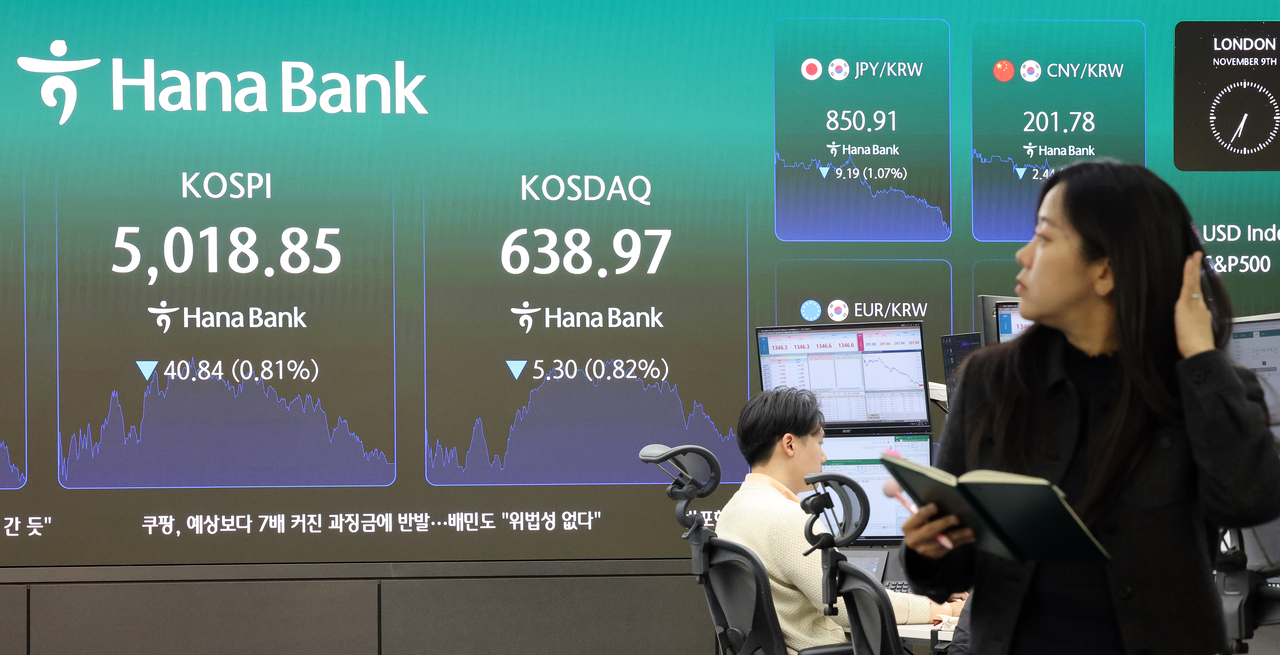
The tech-heavy Kosdaq closed Monday at 638.97, down 0.82 percent on the day and 47.9 percent from its April 27 closing high of 1,226.18, according to Korea Exchange data. The Kospi ended Monday at 5,018.85 points, about 24 percent below its April 27 close.
The Kosdaq now stands 5.6 percent below its Dec. 4, 2024, close of 677.15, recorded on the first trading day after then-President Yoon Suk Yeol declared martial law. Monday's close was less than 12 points above the low of 627.01 reached on Dec. 9 that year.
Alteogen is now the only Kosdaq-listed company worth more than 10 trillion won ($7.4 billion). Its shares fell 16 percent to 168,400 won on Monday as investors weighed the potential impact of US drug pricing rules on its royalties. The decline wiped about 2.2 trillion won off its market value, leaving it at 11.7 trillion won, down from nearly 30 trillion won last November.
Battery materials group EcoPro and its subsidiary EcoPro BM, the Kosdaq's second- and third-largest stocks, respectively, each fell more than 8 percent Monday. Both once topped 10 trillion won in market value, as did drugmakers HLB, ABL Bio and Sam Chun Dang Pharm, robot-maker Rainbow Robotics and semiconductor equipment supplier Jusung Engineering.
The sell-off extends well beyond the market's largest companies. In the first week of November, 572 Kosdaq stocks hit intraday lows for the year. The index fell 11.1 percent across five sessions.
The decline comes as regulators seek to attract more institutional investors to a market dominated by retail trading. Institutions accounted for just 4.5 percent of Kosdaq turnover, less than a third of their share on the Kospi, according to government figures released in December 2025.
In January, the government gave the Kosdaq 150 a 5 percent weight in the benchmark used to assess domestic stock returns at public funds other than the National Pension Fund. In September, as share prices fell, regulators postponed a planned increase in the Kosdaq's minimum market capitalization requirement from 20 billion won to 30 billion won, moving its effective date from January to July 2027.
jwc@heraldcorp.com