Samsung Electronics on Thursday named 10 outstanding researchers from its long-running research funding program, marking the first time the company has presented such honors since launching the 1.2 trillion-won ($893 million) initiative in 2013.
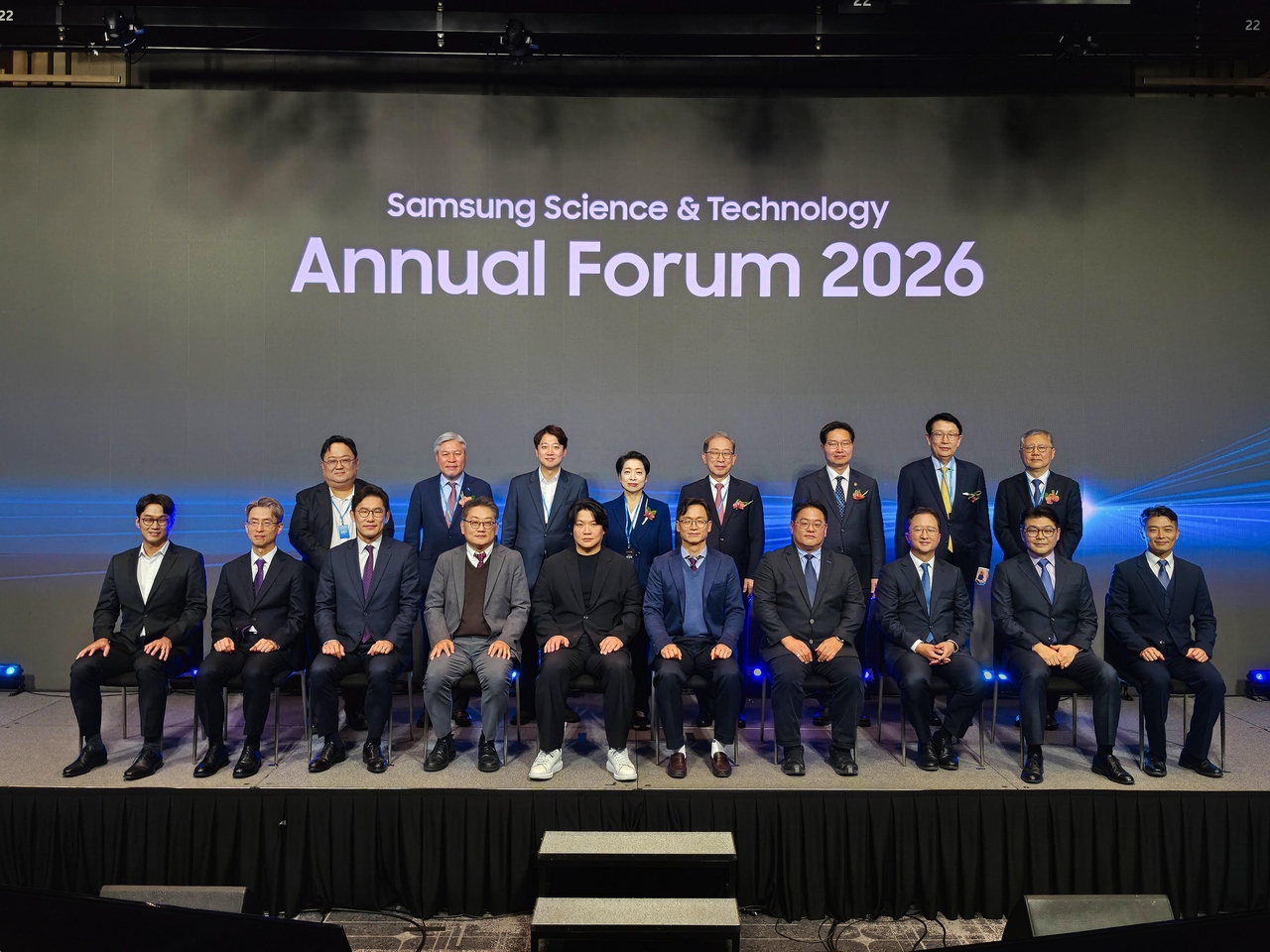
The awards were announced at Samsung's annual research forum at The Westin Seoul Parnas in southern Seoul, where some 450 researchers, industry experts and policymakers gathered to discuss breakthroughs in basic science, next-generation batteries and artificial intelligence infrastructure.
The 10 recipients were selected from 644 completed projects following a four-month evaluation. Four were recognized for achievements in basic science and six in materials and information and communications technology.
Samsung said it would provide the winners with technical guidance, industry networking opportunities, intellectual property support and assistance for follow-up research.
Among the honorees was Oh Sung-jin, a mathematics professor at the University of California, Berkeley, recognized for his work on mathematical problems related to black holes.
Seoul National University professor Choi Jang-wook was honored for his research on water-based batteries, which could offer safer alternatives for large-scale energy storage. Fellow SNU professor Kim Jang-woo was recognized for developing computing systems that shift data-processing tasks away from central processors to ease bottlenecks in AI servers.
All three presented their research at the forum.
Launched in 2013, Samsung's research funding initiative has backed 916 projects involving more than 17,000 researchers across basic science, materials and ICT. The company has committed a total of 1.2 trillion won to the program.
Some of the funded research has also led to commercial ventures. Proteina, an AI-based antibody drug developer, listed on the Kosdaq in July 2025, while MangoBoost, founded by Kim in 2022, is developing technology to improve data processing efficiency at AI data centers.
Park Hong-kun, president and head of Samsung Advanced Institute of Technology, said the initiative had helped nurture young scientists and turn promising research into startups.
"I hope today's gathering marks the beginning of deeper networking and vigorous discussions between academia and industry," Park said.
yeeun@heraldcorp.com