

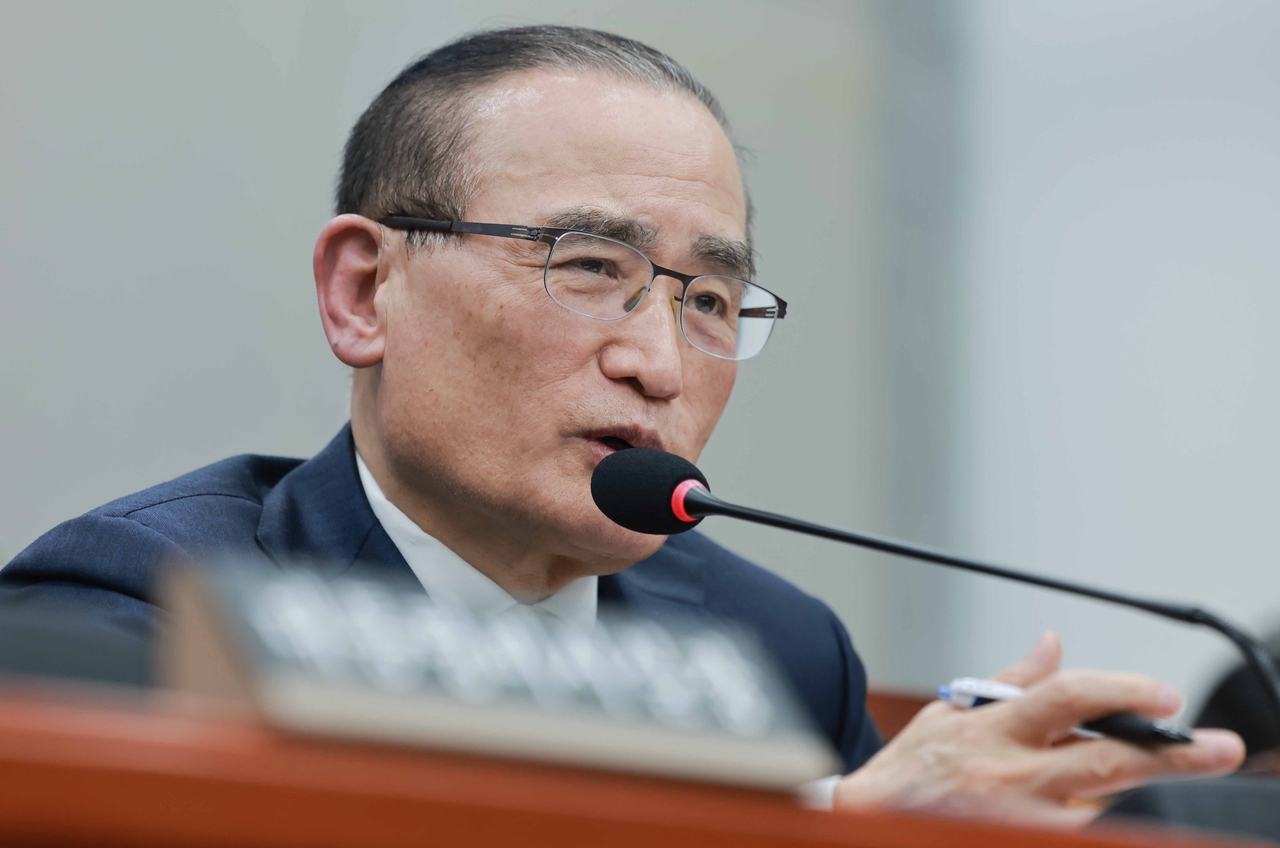
South Korea and the United States are making progress in discussions of wartime operational control, National Security Adviser Wi Sung-lac said Thursday, amid concerns the postponement of a bilateral defense meeting and revised US military requirements could delay the transition.
Speaking during a parliamentary audit of the presidential office by the National Assembly Steering Committee, Wi said Seoul had been consulting with Washington with the goal of completing the OPCON transfer within President Lee Jae Myung's term.
"We will continue advancing the discussions and report back on the results," Wi told lawmakers.
Concerns over a potential delay have intensified after the annual South Korea-US Security Consultative Meeting was postponed to early next year, with some questioning whether the allies can maintain momentum and complete the transfer within President Lee Jae Myung's term.
The uncertainty also follows remarks from Gen. Xavier Brunson, commander of US Forces Korea, who indicated at a Washington seminar on Oct. 14 that changes in the security environment and military planning had created new benchmarks that must be met before the transition can proceed.
His comments raised questions about whether the allies would need to reassess the conditions governing the transfer, potentially complicating Seoul's efforts to accelerate the process.
Addressing those concerns, Wi said the allies had agreed to pursue an early OPCON transfer based on conditions established during the early years of the former Moon Jae-in administration.
"We are working to bring forward the timing of the transfer in accordance with that principle," Wi said.
He noted that discussions had continued recently, including talks between the South Korean and US defense chiefs in the Philippines.
"There has been a convergence of views on the conditions and timing," Wi said, adding that Seoul was currently focused on meeting the necessary requirements and determining the transfer timeline through consultations with Washington.
Meanwhile, Wi said Seoul was considering deploying a maritime patrol aircraft as part of international efforts to safeguard freedom of navigation through the Strait of Hormuz, but stressed that no decision had been made.
"We have reviewed the possibility of deploying a maritime patrol aircraft, but no decision has been made," Wi said, adding that Seoul was consulting with Washington on possible contributions while adhering to President Lee's directive not to participate in combat operations or warfare.
The remarks came as Seoul considers expanding the operational area of its Cheonghae anti-piracy naval unit, currently deployed in the Gulf of Aden, to the Gulf of Oman, which lies just outside the Strait of Hormuz.
Rep. Kim Joon-hyung of the Rebuilding Korea Party raised concerns that such an expansion could effectively amount to a new military mission, potentially exposing South Korean forces to attacks even without direct combat involvement. Wi rejected suggestions that the proposal was intended to accommodate US requests while avoiding a formal military deployment, citing Japan's maritime patrol operations in Djibouti as a precedent.
Wi also dismissed suggestions of a policy rift between Lee and his national security team over North Korea, particularly regarding possible adjustments to joint military exercises with the United States.
Describing the perceived differences as a "misunderstanding," Wi said Lee was outlining the administration's broader diplomatic objectives, while he was explaining the practical challenges involved in achieving them. He added that joint military exercises could be adjusted depending on circumstances but remained necessary.
In his opening remarks, Wi reaffirmed Seoul's commitment to serving as a "pacemaker" for renewed US-North Korea dialogue, citing US President Donald Trump's willingness to engage Pyongyang. He said the government would pursue a phased approach to denuclearization involving a freeze, reduction and eventual dismantlement of North Korea's nuclear capabilities.
Wi also pledged to strengthen South Korea's independent defense capabilities, including through the acquisition of nuclear-powered submarines, while supporting the defense industry's growth as a strategic national industry.
Separately, Wi defended the government's response to a September land mine explosion in the Demilitarized Zone that injured three South Korean soldiers, saying Seoul had raised the incident with the United Nations, including the Security Council.
Asked about apparent differences in North Korea policy between the Foreign Ministry and Unification Ministry, Wi acknowledged that agencies could hold differing views but said they were being coordinated through the National Security Council.
mkjung@heraldcorp.com


