
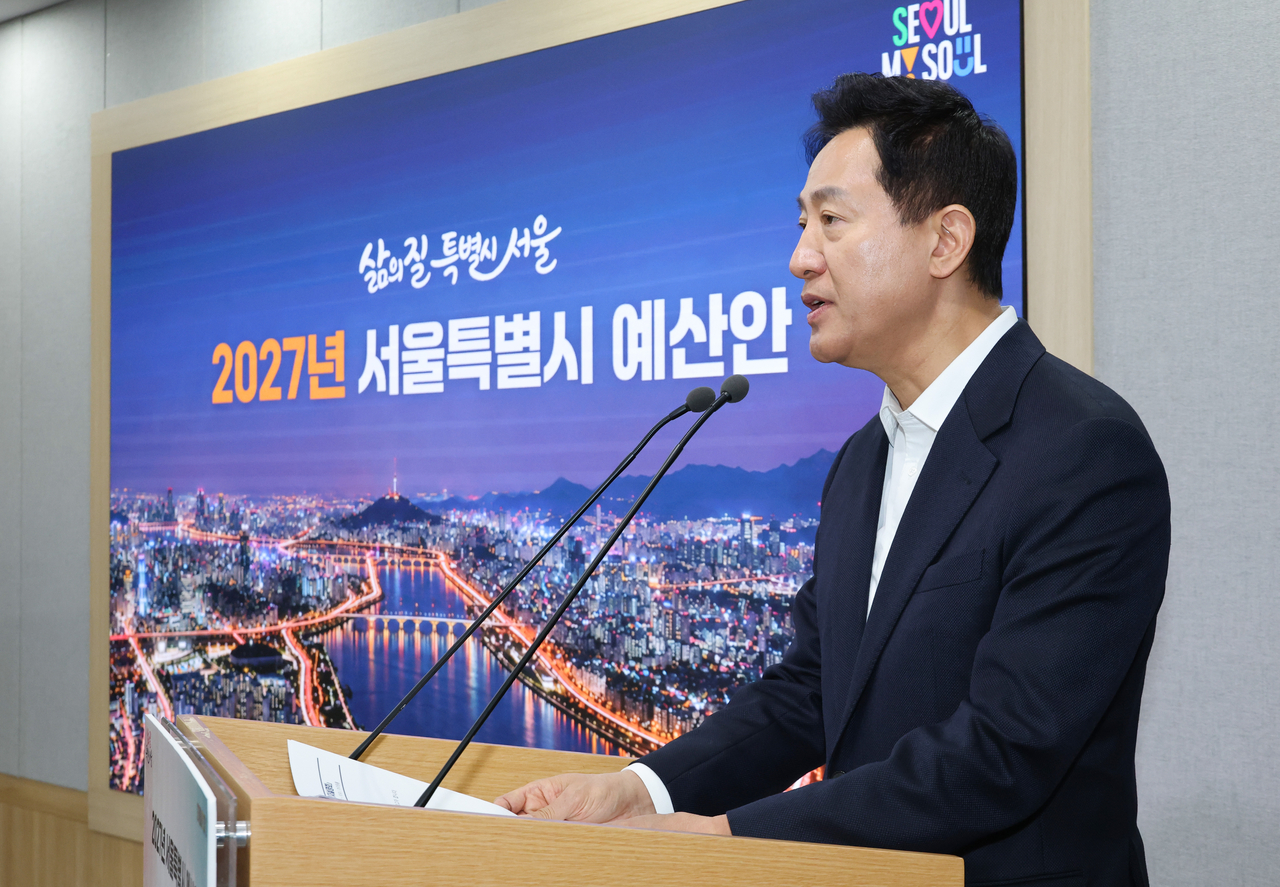
Seoul unveiled a record 55.7 trillion won ($41.8 billion) budget proposal for 2027 on Thursday, prioritizing AI access for young people and housing support through public rental homes and rent subsidies.
“With the job market and workplace changing at lightning speed, even a delay of a few months could make a decisive difference,” Seoul Mayor Oh Se-hoon told reporters.
The city allocated 26.6 billion won to provide generative AI subscriptions and tailored training for 500,000 young residents, reviving a program whose 5.6 billion won allocation was cut from a supplementary budget in September.
Democratic Party council members said they supported its aims but wanted clearer eligibility and service delivery plans.
Speaking Tuesday, Oh said Seoul had negotiated a price of $2.50 per user with AI providers before the funding cut. Local reports described it as a monthly rate.
“Even if it is included in next year’s budget, we’ve received feedback that they can no longer offer that price,” he said. “We are working hard to persuade them, but negotiations are not going the way we want.”
The program targets Seoul residents aged 19 to 29, prioritizing disadvantaged applicants before offering remaining subscriptions to other eligible residents.
The budget proposal is 8.3 percent larger than this year’s original budget and will be submitted to the Seoul Metropolitan Council on Friday.
“Despite rising mandatory spending and other fixed costs, and unfavorable treatment in central government financial support, we have expanded investment in citizens’ daily lives without increasing debt,” Oh said.
Housing measures include 1.12 trillion won to supply 27,200 public rental homes through purchases, leases and construction. Monthly rent assistance will expand to 32,000 young people from 23,000 this year, with 126.2 billion won allocated.
Seoul also plans to spend 10.5 billion won to expand neighborhood outdoor dining and cultural events from six locations to 16.
Cultural investments include 28.9 billion won for Yeouido Park and the second Sejong Center for the Performing Arts, and 53.3 billion won to develop Nodeul Island as an arts destination.
Support for multicultural families
Oh also said he had ordered a review of support policies for multicultural families after President Lee Jae Myung called attention to preferential admission at postpartum care centers. Korean law defines multicultural families as households formed by a Korean national and an individual from a different cultural background.
Lee shared a post from the conservative online community FM Korea that questioned admission priorities outlined in Seoul’s subsidized program. He said possible changes included abolishing preferential provisions.
The presidential office said Thursday that the review aimed to make admission priorities fairer while continuing to support multicultural families facing difficulties.
At participating private postpartum care centers, mothers from multicultural families receive second-priority admission alongside groups including mothers with disabilities and single parents. Basic livelihood benefit recipients and people in the near-poverty category are given priority.
Oh acknowledged that preferential admission could leave other applicants feeling unfairly disadvantaged.
“In such cases, we need a more carefully calibrated approach,” he said. “Finding that balance is not easy.”
He said senior officials were refining the policies, but maintained that support remained necessary.
“As a broad principle, policy investment and support for multicultural families are necessary,” Oh said.
Citing European countries with longer histories of immigration, he warned of the costs of inadequate childhood support.
“Failing to provide adequate consideration and investment while children grow up, including in childcare and education, could increase future burdens involving public order and welfare,” he said.
yunapark@heraldcorp.com


