

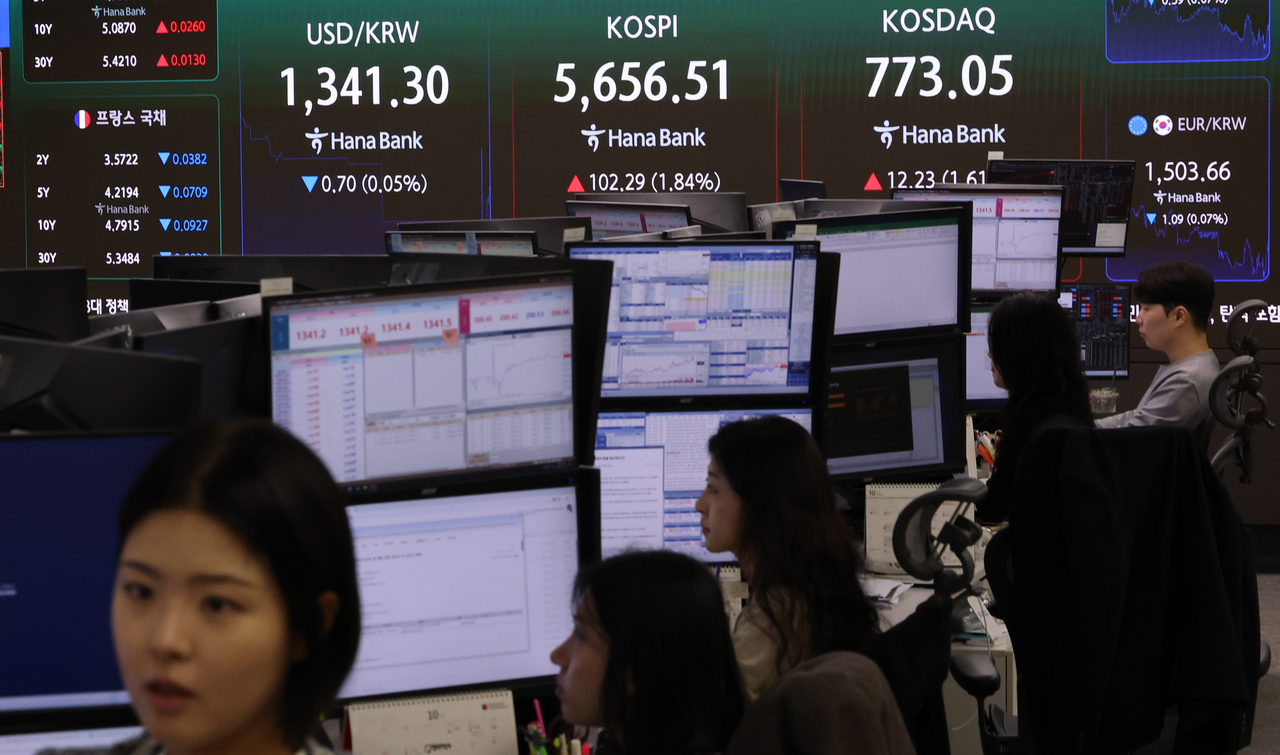
South Korean chip giants Samsung Electronics and SK hynix suffered their steepest weekly share declines since the 2008 global financial crisis, battered by record foreign selling amid concerns over US interest rates, an AI investment bubble and intensifying competition from Chinese memory chipmakers.
According to the Korea Exchange, Samsung Electronics shares plunged 17.8 percent from Monday to Friday, falling from 262,000 won to 215,500 won ($195 to $160). It was the stock's sharpest weekly drop since the fourth week of October 2008, when it lost 19.3 percent during the global financial crisis.
SK hynix fared worse, tumbling 24.3 percent to 1.272 million won from 1.681 million won. The decline was its steepest since the third week of November 2008, when shares plunged 31.9 percent.
Foreign investors led the selloff, dumping a net 11.21 trillion won worth of Kospi-listed stocks over the week. Samsung Electronics accounted for 3.47 trillion won and SK hynix for 5.35 trillion won, together representing 78.8 percent of total net foreign selling.
The exodus pushed foreign ownership of Samsung Electronics down to 45.98 percent as of Friday, its lowest level since July 2009. Foreign ownership of SK hynix fell to 48.85 percent, the lowest since December 2021.
Despite strong earnings at both chipmakers, investors focused on mounting external risks, including uncertainty over US interest rates, doubts about returns on massive AI investments and growing competition from China.
Adding to market concerns, China's largest DRAM maker, ChangXin Memory Technologies, recently announced plans to introduce next-generation server memory using a denser 4F-squared cell architecture by the end of 2026, signaling its ambition to challenge Korean chipmakers in advanced memory.
The announcement raised questions about the long-term competitive position of Samsung and SK hynix, although CXMT has yet to demonstrate that the technology can be mass-produced economically. The Chinese chipmaker has not disclosed detailed product specifications or manufacturing yields.
SK hynix faced additional uncertainty over a potential US listing of its NAND flash subsidiary Solidigm, amid concerns that a separate listing could weigh on the parent company's valuation.
"The concerns are unlikely to ease in the short term amid an unfavorable macroeconomic environment. Heightened market volatility could persist for some time," said Park Jae-hwan, an analyst at Eugene Investment & Securities.
silverstar@heraldcorp.com


![[World Class] HUFS bets on Songdo, AI to redefine what a global university can do](https://wimg.heraldcorp.com/news/cms/2026/10/18/news-p.v1.20260930.7e4dbeacfc1d4d16848c0e2a441c04e6_R.jpg?type=h&h=120)
