

Statements by South Korea's top diplomats in Washington and New York in recent days have added to questions over intelligence cooperation with the US, and the handling of a North Korean mine incident in the Demilitarized Zone, with some of them at odds with positions set out by other officials.
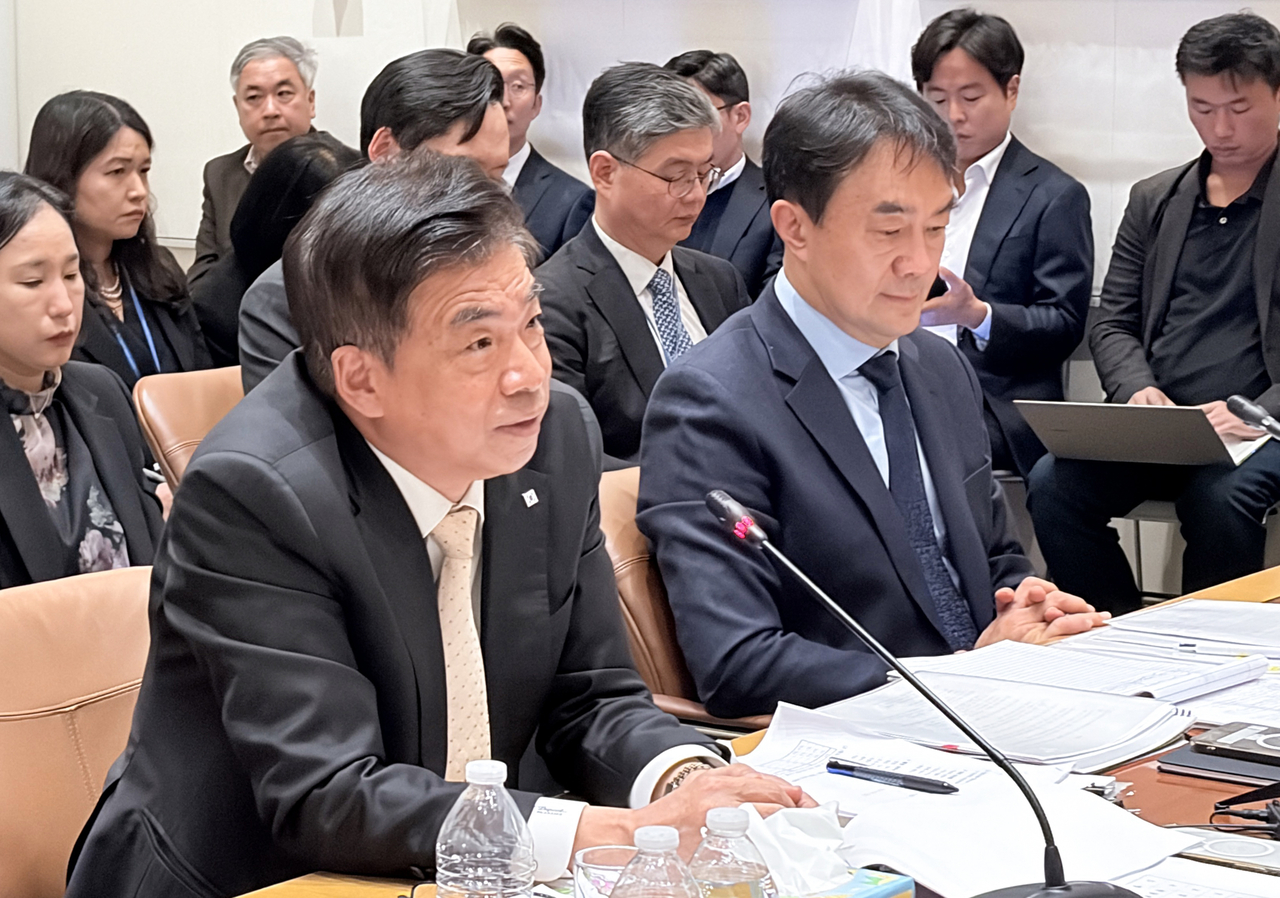
During the National Assembly audit of the South Korean mission to the United Nations in New York on Tuesday, opposition lawmakers accused Ambassador to the UN Cha Ji-hoon of responding insufficiently to the land mine explosion, which injured three South Korean soldiers in the DMZ last month.
During an Oct. 8 address at a UN General Assembly committee, Cha said North Korea had deliberately planted the land mine, calling the incident a clear violation of the Korean Armistice Agreement and demanding an apology.
But Rep. Kim Gunn of the main opposition People Power Party questioned why he had not done more to consult with members of the UN Security Council.
Cha said the Foreign Ministry was considering bringing the issue before the council and defended his earlier remarks at the General Assembly as a meaningful step.
However, he acknowledged that he had not held preliminary discussions with the US ambassador to the UN or representatives of other permanent Security Council members.
Lawmakers also questioned the mission's handling of North Korea's rebuttal at the General Assembly, in which Pyongyang cited Unification Minister Chung Dong-young's earlier remarks that the explosion was difficult to characterize as a deliberate attack.
Cha said the mission had exercised its right of reply to clarify Seoul's position, but acknowledged that he had not specifically addressed whether Chung's remarks reflected the government's official assessment.
Independent lawmaker Rep. Han Dong-hoon also pressed Cha to clarify his position after South Korean Ambassador to the US Kang Kyung-wha told Korean lawmakers in Washington, in a separate parliamentary audit Monday, that the DMZ explosion was "clearly not an accidental incident."
Cha initially characterized the apparent discrepancy as a matter of wording, before stating that the mines were determined to have been planted by North Korea through investigations by South Korea's Defense Ministry and the United Nations Command.
Even ruling Democratic Party of Korea lawmaker Rep. Park Sung-joon urged Cha to communicate the government's position more clearly at the United Nations.
"The government's position has now been clearly established. It would be better to state that position unequivocally at the United Nations as well," Park said.
The exchanges underscored concerns among lawmakers over the consistency of Seoul's messaging on North Korea, as the administration navigates sensitive relations with Washington while seeking to manage tensions with Pyongyang.
Cha also faced questions about his qualifications and personal ties to President Lee Jae Myung.
The ambassador, who attended the same class as Lee at the Judicial Research and Training Institute, declined to comment on the president's authority to appoint him, but noted that noncareer diplomats frequently serve as UN ambassadors for other countries.
A day earlier, Ambassador Kang Kyung-hwa identified intelligence cooperation as one of the most challenging issues in bilateral relations, acknowledging that Washington's concerns had yet to be fully addressed.
Kang also acknowledged difficulties in securing high-level consultations with the White House, saying communication had fallen short of her expectations.
Her remarks came after Seoul and Washington last month designated a $22.3 billion gas-fired power plant project in Encinal, Texas, as the first undertaking under South Korea's $350 billion investment commitment to the United States.
The agreement had raised expectations in Seoul that resolving economic differences would help accelerate negotiations on major security initiatives, including South Korea's pursuit of nuclear-powered submarines, revisions to the bilateral nuclear cooperation agreement and the transfer of wartime operational control of the military.
However, Kang disclosed that the US side had raised concerns about intelligence cooperation during a Sept. 18 meeting between Foreign Minister Cho Hyun and US Secretary of State Marco Rubio.
The precise nature of those concerns remains unclear, including whether they involve reported restrictions on intelligence sharing related to North Korea or other disagreements between the two countries' intelligence agencies.
Her assessment appeared to contrast with the position of South Korea's National Intelligence Service, which said on Oct. 8 that earlier misunderstandings with Washington had been resolved and that communication between the intelligence agencies was proceeding without problems.
Unification Minister Chung also dismissed reports of friction between the allies' intelligence agencies as "fake news" during a news conference Monday, criticizing what he described as inappropriate US restrictions on intelligence sharing following his earlier remarks about North Korea's Kusong nuclear facility.
The differing public assessments have raised questions about the government's approach to managing sensitive alliance issues.
Diplomatic sources in Seoul say the uncertainty surrounding intelligence cooperation could complicate negotiations requiring close coordination and mutual trust.
Working-level defense consultations began last week ahead of the annual Security Consultative Meeting, expected in November, but the timetable for broader bilateral security negotiations remains unclear.
mkjung@heraldcorp.com

![[Exclusive] Gangnam goes all out to attract AMD AI research center](https://wimg.heraldcorp.com/news/cms/2026/10/14/news-p.v1.20261014.a0d0c169c5854e51bef87ae027df336a_R.jpg?type=h&h=120)