Korean companies expanding in the US need to plan for staffing, regulatory requirements and local partnerships alongside capital investment, business leaders and industry experts said at a seminar in Seoul on Wednesday.
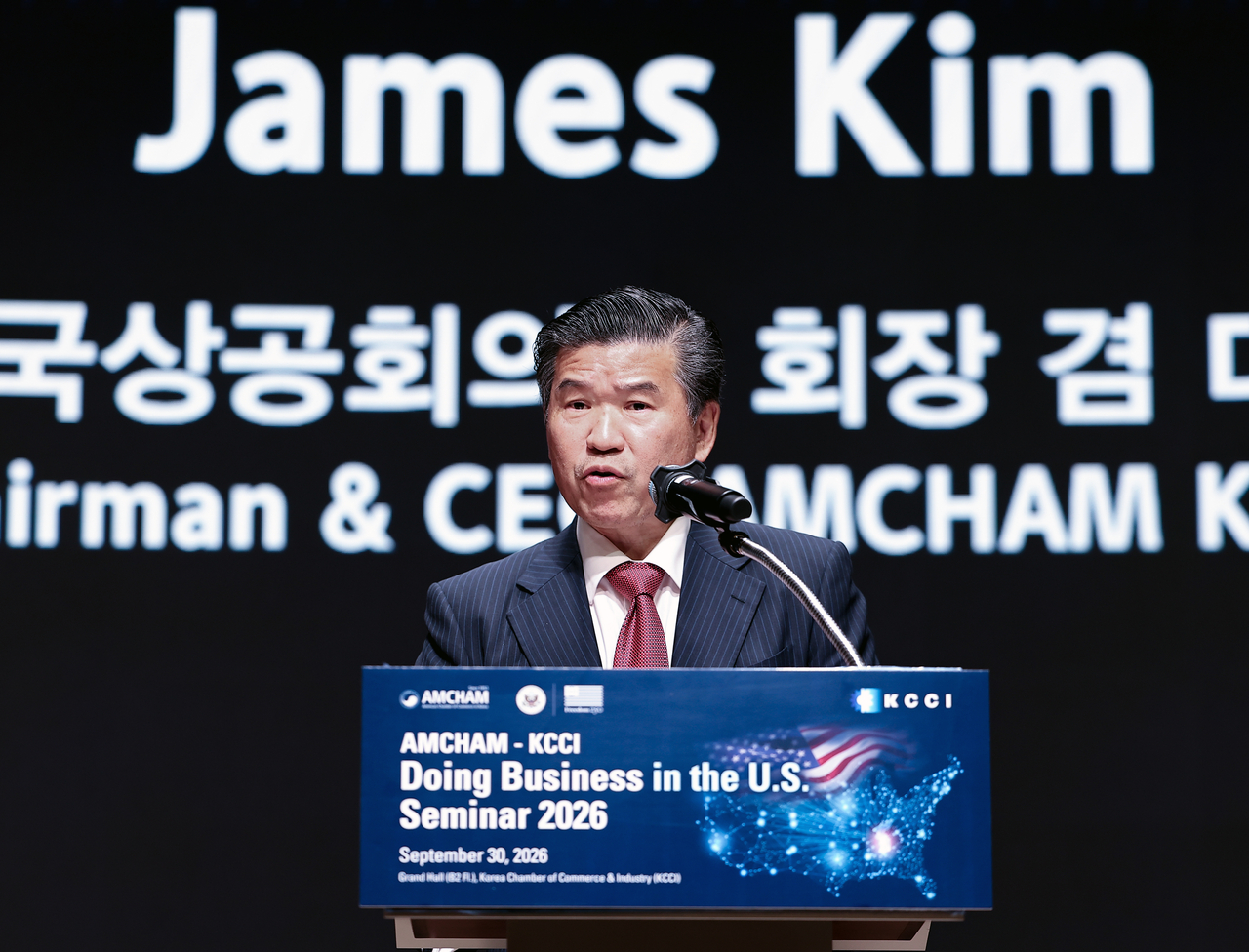
The American Chamber of Commerce in Korea and the Korea Chamber of Commerce and Industry hosted the eighth annual Doing Business in the US Seminar at the KCCI headquarters, drawing more than 300 government officials, business leaders and investment professionals.
Held under the theme “Korean Companies in America: Driving Growth, Innovation and Investment in the United States,” the event examined companies’ experiences in the US and offered guidance on visas, real estate, cross-border finance and recruitment. This year’s seminar also marked the 250th anniversary of US independence.
AmCham Chairman and CEO James Kim said investment and industrial cooperation were increasingly shaping the bilateral economic relationship.
“The US-Korea economic relationship now extends far beyond trade. It is increasingly defined by investment, technology, innovation, and supply-chain resilience,” Kim said.
He cited SPC and Mirae Asset as examples of AmCham members building their US businesses, adding that helping Korean companies establish and expand operations there was a core part of the chamber’s role.
KCCI Executive Vice Chairman Kim Jeong-il said competitive products and technology must be supported by a thorough understanding of local regulations and business conditions.
“KCCI will continue to provide the information and networks Korean companies need to identify new opportunities and achieve sustainable growth in the US market,” he said.
Rep. Cho Jung-hun, vice chair of the Korea-US Parliamentary Union, called US investment a national priority that should deliver benefits to both countries, while US Ambassador to South Korea Michelle Steel highlighted Korean companies’ contributions to American jobs and innovation.
In virtual remarks, US Sen. Todd Young, a Republican representing Indiana and co-chair of the Senate Korea Caucus, pointed to SK hynix’s investment of more than $4 billion in an advanced chip packaging and research facility in West Lafayette, Indiana, as an example of deepening industrial ties.
Young also identified shipbuilding as an area for closer cooperation, saying Korean investment, technical expertise and workforce development could help improve productivity and expand US shipyard capacity.
Park Jong-won, president and CEO of the Korea-US Strategic Investment Corp., delivered a keynote address on the status and plans for bilateral strategic investment.
A business panel brought together Paris Croissant Executive Vice President and head of global business Choi Han-do, Mirae Asset Securities CEO and Vice Chairman Kim Mi-seob and SK Biopharmaceuticals Vice President and Chief Strategy Officer Yu Chang-ho. The executives discussed their US expansion decisions, operational challenges and the importance of local partnerships.
A second session focused on practical requirements for market entry, including deploying staff, securing premises, managing payments and hiring local talent.
Jung Yoo-joo, a US attorney at Daeyang Immigration Law Group, urged companies to incorporate visa planning into investment decisions from the outset.
“Capital can build a factory, but the success of a US operation ultimately depends on whether the right people can be legally deployed on site when they are needed,” Jung said.
Newmark Korea managing director John Pritchard discussed aligning property decisions with staffing and supply-chain needs. Airwallex country lead Yuna Kwon addressed cross-border financial operations, while HRCap managing director Seo Jae-won outlined strategies for recruiting and building US teams.
minmin@heraldcorp.com