
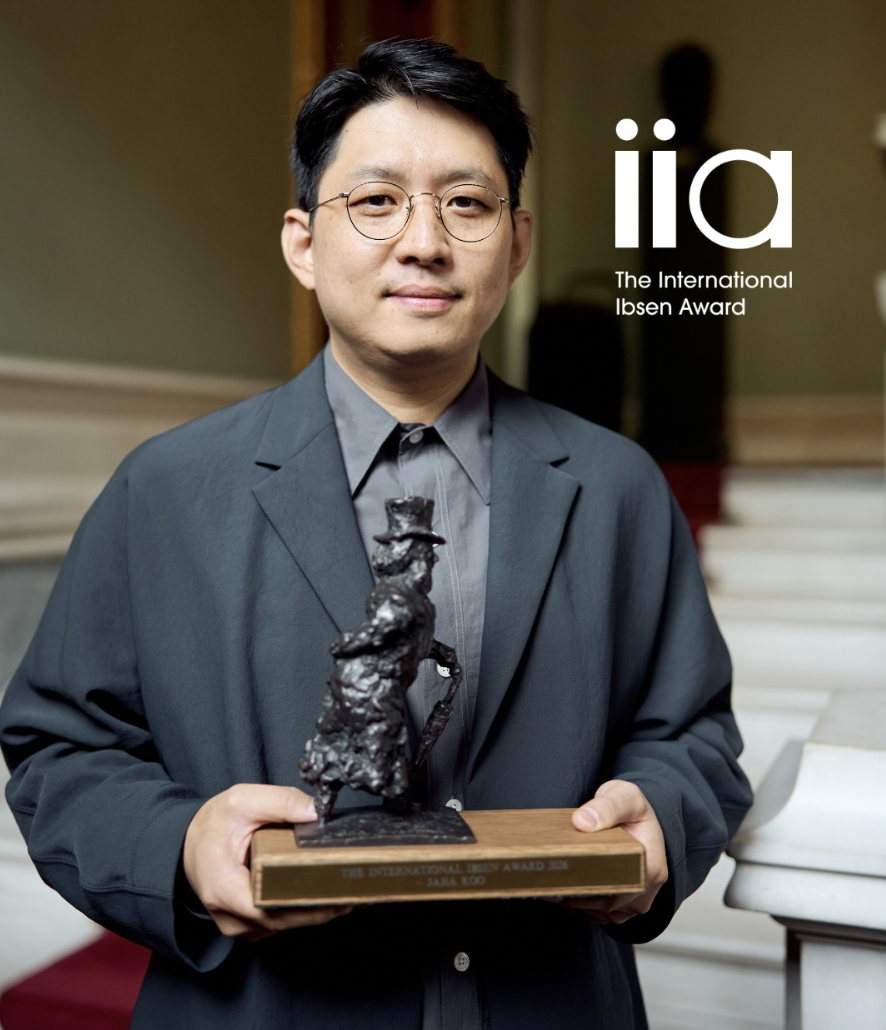
Korean theater-maker Koo Jaha received the International Ibsen Award at the National Theatre in Oslo, Norway, on Saturday. He is the first Asian artist and the youngest person to win what is often regarded as the Nobel Prize of theater.
Koo, 42, accepted the award and its 2.5 million Norwegian kroner ($263,000) in prize money from the Norwegian government before an audience of about 700 people.
Established in 2007 in honor of Norwegian playwright Henrik Ibsen (1828-1906), the award has been presented every two years since 2010. Unlike prizes such as the Olivier Awards, which honor a single season's productions, the Ibsen Award recognizes an artist's or company's body of work. Two past winners, Jon Fosse (2010) and Peter Handke (2014), later received the Nobel Prize in Literature.
This year's jury said it sought an imagination that, "in a world too often divided into for and against," conceives of theater as a space in between, where people gather to imagine and be inspired by what they do not yet know.
Norway's Culture and Equality Minister Lubna Jaffery, who presented the award, said Koo's work explored "cultural identity, economic inequality, displacement and belonging" through "generosity, empathy and humor."
A graduate of the Korea National University of Arts' School of Drama, Koo has lived and worked in Europe since 2011. He briefly made electronic music in Berlin clubs before earning a master's degree in contemporary theater from the Amsterdam University of the Arts. He is now an associate artist at CAMPO, a performing arts center in Ghent, Belgium. He is developing a new work, "Born to be K to be POP," with LOD muziektheater, a Ghent-based music theater company.
His work draws on music, video, text and robotic objects to break away from theater built around human actors. He is best known for "The Hamartia Trilogy" (2014-2020), which stems from personal experience and examines linguistic, economic and cultural imperialism in Korean society. His most recent work, "Haribo Kimchi" (2024), puts a robotic eel and a pojangmacha, a Korean street food tent, on stage.
gypark@heraldcorp.com


