Anyone old enough to remember the Cold War will also remember an imagined place called the “free world.” It was where Westerners believed they lived, while Eastern Europeans, Russians and Chinese lived behind barbed wire.
The description was partly true, insofar as there was barbed wire, and there was a kind of freedom outside the Communist world. But the overall story was a lie. After all, the free world included the Shah’s Iran, Augusto Pinochet’s Chile, and Francisco Franco’s Spain. These countries were anything but free, yet because they were anti-Communist, they were granted membership in the club. Meanwhile, the club’s leader, the United States, regularly proclaimed how free it was, even though its own Black citizens were denied the vote in the American South until 1965.
The free world, in other words, was a noble lie. It helped us imagine the world we wanted to live in, and it helped US presidents from John F. Kennedy to Ronald Reagan articulate important truths. They told us that the Berlin Wall was a moral abomination, not a fact of life that we would just have to accept, and they were right. The free world helped the best people on “our” side create bonds of solidarity with the best people on the “other side,” from Soviet dissidents and the heroes of Polish Solidarity to those behind Charter 77 in Czechoslovakia. When Vaclav Havel said he wanted Czechoslovakia to become a “normal” place, he was alluding to the ordinary, everyday freedoms enjoyed on the other side of the barbed wire.
In the 1970s and 1980s, the people of Portugal, Spain and Greece knew that the free world was a lie, because NATO and the Americans had colluded with their own regimes to deny them liberty. When they overthrew those tyrannies, they did so, in part, to join the free world they had been promised but denied. Likewise, the Taiwanese, South Koreans and Filipinos who overthrew their US-supported tyrants turned the ideological joke played against them into something serious. And when the Berlin Wall finally came down in 1989, the free world no longer felt like a distant dream. The people themselves, tears on their faces as they streamed through the breaches, had suddenly made it real.
Those euphoric days are now a distant memory. Today we are like mourners at an excruciatingly long funeral. The death of the free world began not long after 1989. The Balkan peoples longed to join it, but when the chance came in the 1990s, their nationalist elites gave them a mix of ethnic majoritarian rule and ethnic minority cleansing.
Similarly, Russia’s elites in the early 1990s used the unruly collapse of the Soviet empire to enrich themselves. Democracy died in chaos, institutional disintegration, and rampant corruption. When Vladimir Putin came to power, he extinguished the flame of freedom. A quarter-century later, he is throwing young Russians into the furnace of war to prevent Ukraine from joining the free world.
As these democratic projects faltered and gave way to chaos or tyranny, US presidents — from George H.W. Bush to Joe Biden — and their European allies continued to act as if they believed they led the free world. American rhetoric led many Iraqis and Afghans to believe that, with outside help, they, too, might join the free world. But that dream ended in the collapse of order in Iraq, and in the chaotic American abandonment of Afghanistan.
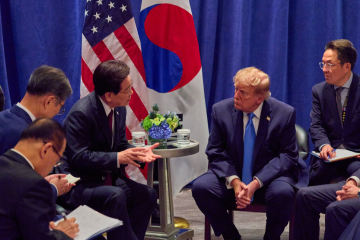
Now, the free world is on its deathbed, with a US president having dealt the fatal blow. There is hardly a tyrant or autocrat alive today whom Donald Trump will not praise, nor any US allies whom he will not try to extort. He plays up his friendship with North Korea’s odious tyrant, while downgrading US military exercises with America’s erstwhile democratic ally in South Korea. He openly scorns the leader of a democratic Ukraine that is fighting for its life, even denying it missile defenses that would protect its civilian population from nightly attack.
If such political vandalism were the work of one man, we could imagine a safe return to the ideals of the free world sometime after 2028. But the reality is bleaker than that. The idea that America should stand up for free peoples is so degraded in US public opinion that Trump’s flagrant betrayal of allies provokes hardly a peep of outrage from Congress or voters. The midterm elections in November will be decided by gasoline prices, not by America’s betrayal of the ideals that were supposed to sustain its foreign policy since World War II.
Where does that leave middle powers such as Canada and the Europeans? They still support freedom beyond their borders, and they are upholding their commitment to Ukraine while America walks away. But their overriding priority now must be to ensure their own survival in a world of unprincipled predators.
When allies no longer share a common identity as belonging to the free world, the only question that remains is who will prevail and who will submit. Canada is the first of America’s allies to learn this unwelcome truth. Prime Minister Mark Carney walked away from trade negotiations with the Trump administration rather than submit to aligning Canada’s external economic policy with the US. Europeans have been praising Canada’s courage, but courage is sometimes just the ability to recognize reality.
In this new reality, every state is on its own. Each must protect its core industries from external competition, while investing massive state resources in the infrastructure necessary to remain globally competitive. All forms of dependence can be weaponized, and so all supply-chain and resource dependencies are vulnerabilities.
Trump has killed the free world for the sake of a protectionist idee fixe that will accelerate, not halt, America’s imperial decline. Europe, Canada and the democracies of Africa, Asia and Latin America are what is left of the old ideal. It is they who have the burden of keeping it alive. In the Cold War, a similar challenge enabled us to imagine a better world. It can do so again, reminding us that we have values in common — freedom and democracy — not just economic interests.
- - -
Michael Ignatieff
Michael Ignatieff is rector emeritus of Central European University. The views expressed here are the writer’s own. — Ed.
(Project Syndicate)
khnews@heraldcorp.com