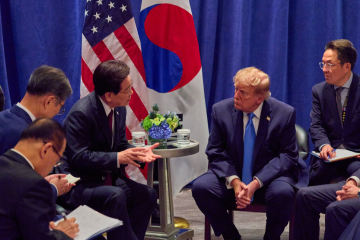
President Lee Jae Myung is facing one of the most difficult moments of his presidency. His approval ratings have fallen into the 30s after exceeding 50 percent several months ago. At the same time, the democratic and progressive coalition that helped bring him to power has become increasingly divided since the June local elections, with rival groups sometimes exchanging bitter attacks.
Against this backdrop, Lee held an unusual news conference last week and offered striking self-restraint in his assessment of his own performance. He said he had not been sufficiently considerate, attentive or communicative and may have failed to show enough respect for the public. He also expressed regret over divisions among his supporters. The political pressure did not end there. His nominee for justice minister withdrew from consideration, and his presidential chief of staff offered to resign Monday.
Lee deserves credit for looking inward rather than simply blaming political opponents or an unfavorable environment. Yet his diagnosis may be addressing specific policy issues while missing a key structural issue: responsibility overload.
Lee has rejected the suggestion that he micromanages the government. He said he had neither the time nor the capacity to do so. Ministries should handle their routine affairs, he said, while presidential aides should concentrate on identifying new problems and policy ideas. That is a reasonable principle. But micromanagement and responsibility overload are not the same thing. The important question is not whether Lee personally makes every decision, but whether too many policy outcomes become his responsibility.
There are two dimensions to responsibility overload. The first is quantitative. When a president repeatedly initiates, explains or defends individual policies, they tend to become identified with the president. Their successes become presidential achievements, but their failures also become presidential failures. The problem may therefore not be an unusually large number of policy failures, but an unusually high rate at which policy failures are converted into presidential failures.
The second dimension is hierarchical. Governments have different levels of responsibility for a reason. Ministers should be responsible for designing, implementing and explaining policies in their fields. The president bears a qualitatively different responsibility: choosing the right people, setting national priorities, coordinating ministries, resolving major conflicts and making decisions only the president can make.
If responsibilities that should remain with ministers and senior officials constantly travel upward, the president eventually becomes responsible for almost everything. Ironically, the more responsibility the president absorbs, the less meaningful ministerial responsibility becomes. Delegation is not merely the distribution of work. It is also the distribution of responsibility. This brings me to what I would call the 100 CEOs Theory.
Suppose, purely as a thought experiment, that a president is ultimately responsible for 10,000 matters of state, while one person can properly manage only 100 tasks. The president can devote himself to 100 tasks and leave insufficient attention for the other 9,900. Or he can find 100 outstanding people, each capable of managing 100 tasks, and entrust them with substantial areas of government. One hundred CEOs managing 100 tasks each make 10,000 tasks manageable.
In this model, the president is not the 101st CEO. He is closer to the chairman. A country is obviously not a corporation, but the analogy helps clarify the division of labor. A chairman should not do the CEOs' jobs. The chairman finds the best CEOs, sets the overall direction, gives them sufficient authority, evaluates their performance and replaces them when necessary. The same principle can apply to presidential leadership. Cabinet ministers, senior presidential aides, agency heads and other top officials should operate as CEOs of their respective domains.
That requires something particularly difficult in politics: trust. Once the president has chosen them, he must trust their judgment and give them genuine room to act. They, in turn, must accept responsibility for their decisions and results. The president and appointees should share trust, responsibility and credit.
They should also understand themselves as sharing a common destiny. Trust cannot flow only downward, nor can responsibility flow only upward. The president should stand behind officials who exercise delegated authority in good faith, while those officials must accept responsibility for their decisions. If the president expects them to share the risks of governing, he should also be willing to share the credit for success.
A president who appoints a CEO but constantly second-guesses that person's decisions eventually becomes the CEO himself. Once authority moves upward, responsibility follows. That is how responsibility overload begins. The logic of the 100 CEOs Theory is simple: The president must trust 100 people in order to govern 10,000 tasks.
This does not mean a president should blindly trust subordinates or escape ultimate responsibility. Choosing the 100 CEOs, monitoring their performance, correcting mistakes and replacing those who cannot do their jobs are themselves among the president's most important responsibilities.
A knowledgeable and energetic president may be particularly tempted to step in when ministries hesitate. Indeed, Lee argued at his news conference that presidential intervention is sometimes necessary when ministries avoid difficult decisions. He is right that some decisions can only be made by the president. But precisely for that reason, presidential attention is an exceptionally scarce national resource. Every hour spent on a matter that a minister could resolve is an hour unavailable for something only the president can resolve.
Lee's current political difficulties therefore offer an opportunity to reconsider not merely personnel or communication, but the architecture of responsibility inside his government. He does not need to become a less active president. He may need to work at a different level. A president should not try to do 10,000 jobs himself. His job is to find 100 CEOs who can get those jobs done, trust them enough to give them real authority, hold them accountable for the results and share credit when they succeed. That is not an escape from presidential responsibility. It is how a president fulfills it.
- - -
Wang Son-taek
Wang Son-taek is an adjunct professor at Sogang University. He is a former diplomatic correspondent at YTN and a former research associate at Yeosijae. The views expressed here are the writer’s own. — Ed.
khnews@heraldcorp.com