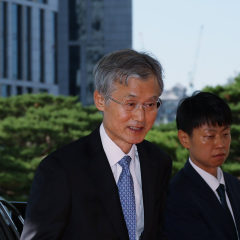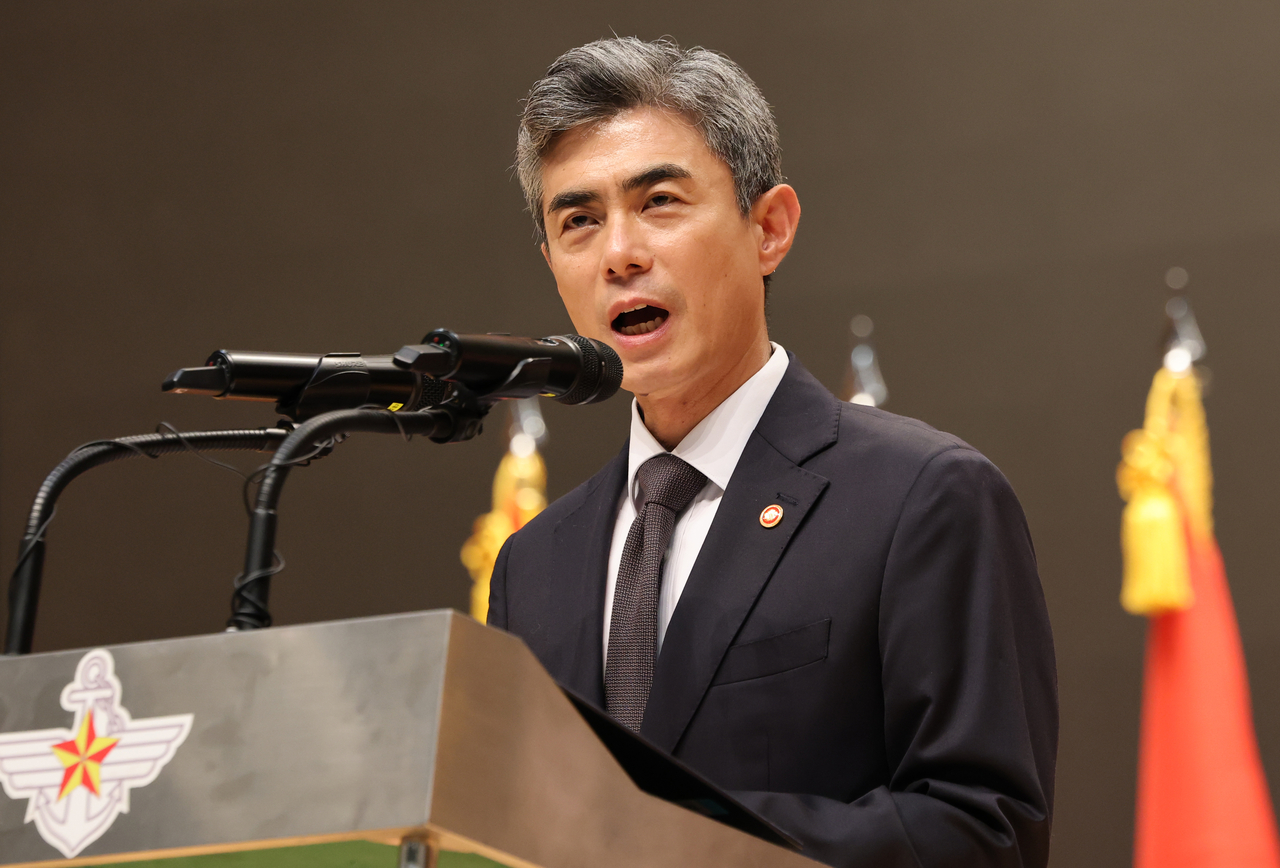
New Defense Minister Kang Shin-chul urged North Korea on Tuesday to cease its border-hardening measures along the inter-Korean border, vowing that South Korea will not tip-toe around Pyongyang's actions.
Kang made the remarks during a press availability following his inauguration, after a suspected landmine blast south of the Military Demarcation Line (MDL) on the western inter-Korean border injured three South Korean military officers Monday.
An investigation is under way to determine the exact cause of the blast, but speculation is growing that it may have been triggered by a landmine illegally planted by the North on the South Korean side of the Demilitarized Zone (DMZ).
"(North Korea) must cease its border fortification. Of course, we need to speak out," Kang said, when asked about the explosion.
"There are secondary effects that stem from North Korea's border-hardening, and this (explosion) could be one of them," he said.
Kang said he "agrees," when asked whether he would issue a firm warning to Pyongyang about its fencing and mine-laying activities in his new capacity.
"You keep bringing up that we walk on eggshells when it comes to North Korea, but we do not," he said. "I explicitly stated that the North's military is our enemy (during my confirmation hearing)."
Kang also revealed that the South's military has yet to confirm whether the suspected mine blast occurred at a site where North Korea is suspected of illegally laying mines across the border.
"Frankly, what is at issue is whether the minefield area you are referring to, the patrol route our personnel had entered and the exact site of the explosion all match up," Kang told reporters.
"The problem is that we cannot confirm this at this point. That is precisely what the investigation must determine," he said.
Kang noted that the military has not yet obtained clear footage of the explosion site, citing difficult terrain within the buffer zone hindering visibility.
"Ideally, we would rely on the memory of the personnel involved and could ask them directly where they entered, but the current situation obviously makes that difficult," he said. "As of now, nothing is clearly visible and it remains difficult to confirm that these three locations align."
The explosion occurred inside the DMZ, a buffer zone covering the MDL separating the two Koreas, severely injuring the commander of an Army battalion unit, while another officer sustained a leg fracture. A third officer was also injured, though less severely.
The Joint Chiefs of Staff (JCS) said during a press briefing Tuesday that the officers were clearing a path for an upcoming U.N. Command (UNC) field inspection to examine sites on the southern side of the DMZ where North Korean troops are suspected of planting mines in potential violation of the armistice agreement.
Kang, a former deputy commander of the South Korea-U.S. Combined Forces Command (CFC), reiterated the importance of "mutual trust" with the United States regarding the ongoing transition of wartime operational control (OPCON) from Washington to Seoul.
"An alliance, by its very nature, involves a counterpart, which means it may not always go according to one side's wishes," he said. "What is more important than the conditions (for the OPCON transfer) is mutual trust (between Korea and the U.S.)."
Kang described the technical conditions for the OPCON transition as the "science" that may already have been met, but noted that satisfaction with meeting those conditions depends on the "art," suggesting political consultations.
"These aspects are vital, which is why I place an emphasis on trust," he added.
Kang suggested he may plan a visit to Washington even before the upcoming ministerial defense dialogue, likely scheduled for early November.
"We are taking all of these factors into account," he said. "In-person meetings aren't the only way to communicate, but I could make a trip to the U.S. if necessary. We will need to coordinate various details."
Kang, a retired four-star Army general, was nominated by President Lee Jae Myung on Aug. 30.
Kang began his official schedule as minister by visiting Seoul National Cemetery earlier in the day to pay respects to fallen soldiers.
Kang later presided over his first meeting with top military commanders, including the chiefs of the armed forces.
Kang called for a "firm response" to enemy provocations as he addressed the recent explosion in the DMZ area, instructing the military to focus "relentlessly" on tough training to "win in competition," according to the defense ministry.
He also ordered the military to conduct a thorough investigation to determine the exact cause of the suspected mine blast while keeping "all possibilities open," calling on the military to stand ready to take any necessary measures based on the findings.