
Retail investors dominate four-hour evening session as thin liquidity amplifies price swings
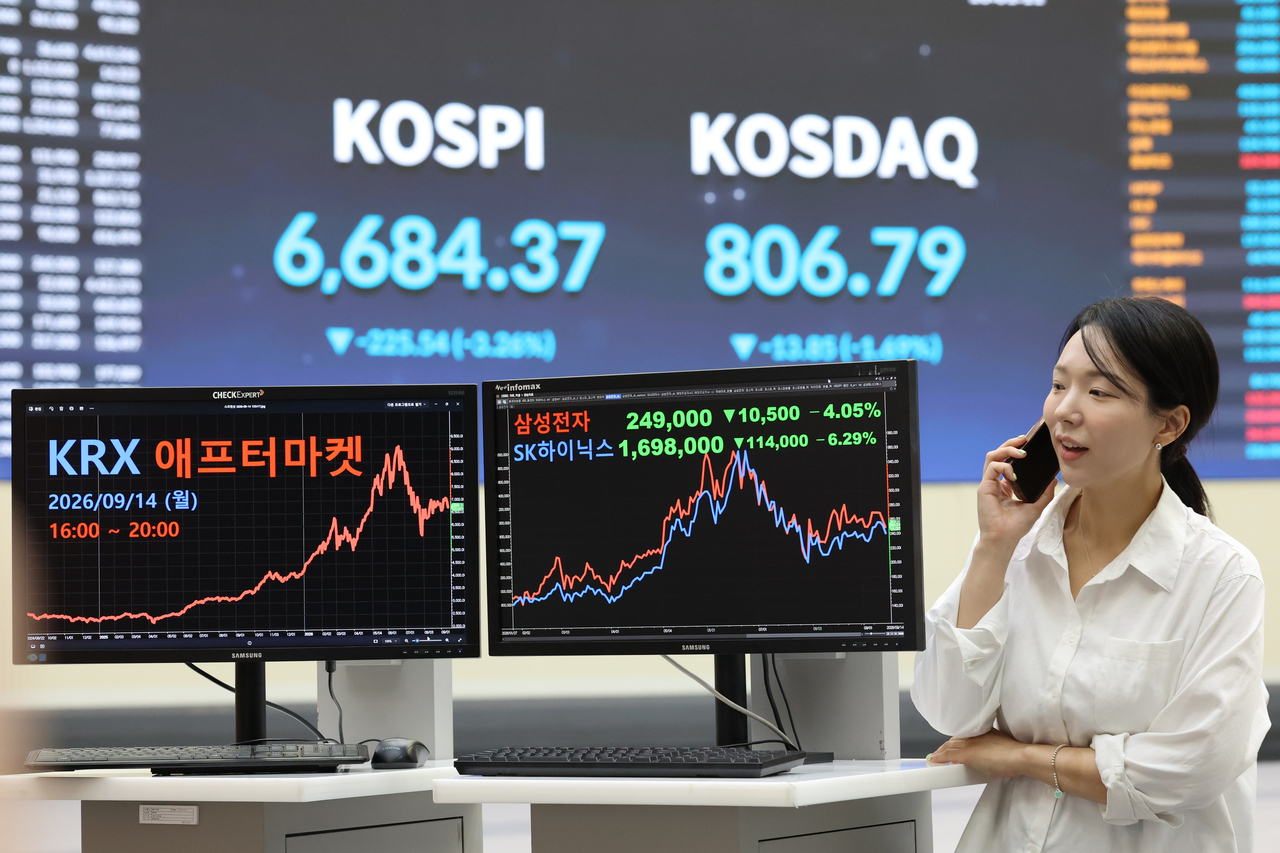
The Korea Exchange's newly launched after-hours market has seen high levels of volatility in its first week, amid relatively thin liquidity and a high concentration of retail investors.
According to the KRX, an average of 54.85 million shares, worth 1.1 trillion won ($811 million), changed hands each day in during the 4-8 p.m. after-hours market from Sept. 14 to Friday, accounting for 4.6 percent of total market trading value.
During the period, a total of 5,354 volatility interruptions — measures designed to buffer against excessive price swings during trading — were triggered in the after-hours market, accounting for 77.17 percent of the total.
The high number of volatility interruptions in the after-hours market is attributed in part to the heavy concentration of retail investors.
Price swings can be more pronounced in the after-hours market due to a lack of diversity in the type of investor. Participation by institutional investors and other large market players, including pension funds, remains limited, with over 90 percent of trading by retail investors.
Foreign and institutional investors accounted for less than 10 percent combined, at 6.7 percent and 2.6 percent, respectively.
Small- and mid-cap stocks listed on the Kosdaq market are also seeing low levels of liquidity in the after-hours market, which is cited as another factor behind the heightened volatility.
On Sept. 14, Pony Link, a Kosdaq-listed company, closed at 2,400 won during regular trading but suddenly hit the daily upper price limit in the after-hours market, trading at 3,150 won.
Its after-hours trading volume stood at just 1,417 shares, about one-tenth of its total volume of 15,641 shares that day. The stock's regular-session closing price fell sharply to 2,365 won the following day.
The bourse operator cautioned that volatility interruptions do not necessarily indicate heightened market volatility. Furthermore, the measures were triggered 1,112 times on the first day of after-hours trading, but the number declined steadily to 553 by Friday.
"The number of volatility interruptions should not necessarily be interpreted as an indicator of market volatility, as the measures help curb excessive price movements by preventing trades at abnormal prices and facilitating price discovery through single-price auctions," the KRX explained.
The KRX plans to address concerns over potential unfair trading activities by operating a market monitoring task force through the end of the year.
silverstar@heraldcorp.com