
Record earnings offer no guarantees as five major lenders review CEO tenures
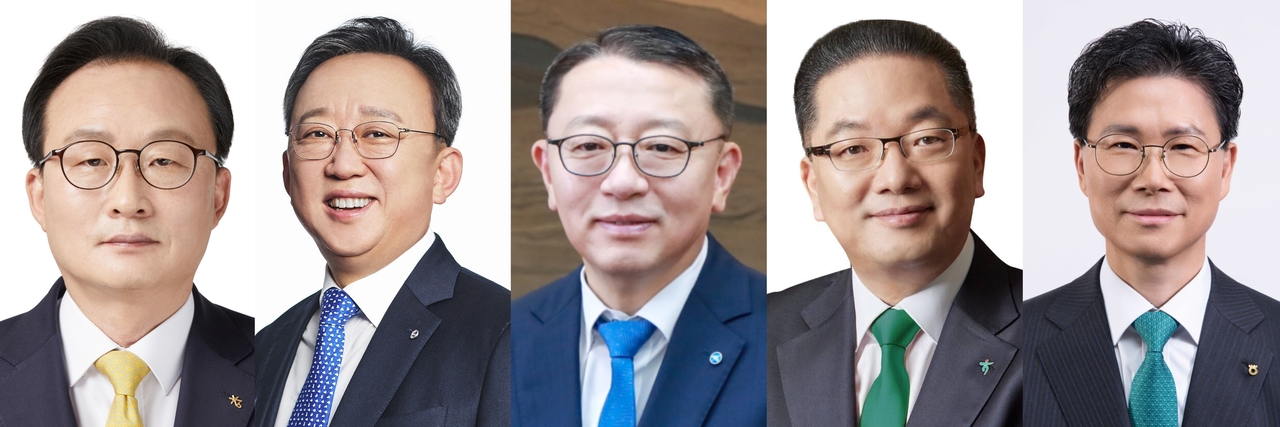
KB Financial Group’s surprise decision to pass over incumbent Chair Yang Jong-hee despite record earnings is reshaping expectations for year-end leadership changes across Korea’s financial industry and raising a broader question: Is strong performance still enough to win another term?
The chief executives of the country’s five major commercial banks — KB Kookmin Bank, Shinhan Bank, Hana Bank, Woori Bank and NH NongHyup Bank — all see their terms expire Dec. 31.
While the succession of a financial holding company chair is not directly comparable with the appointment of a banking subsidiary’s CEO, KB’s decision carries symbolic weight as the industry prepares for a wider year-end reshuffle.
Attention intensified after KB last week selected Lee Jae-keun as its next chair nominee over Yang, who remained in contention until the final stage. The board cited the need for “bold change and a generational transition” and new growth engines, even as KB retained its position as the country’s most profitable financial group.
Kim Sang-bong, an economics professor at Hansung University, said governance and changing business needs are gaining weight alongside earnings in leadership decisions.
“I expected Yang’s reappointment bid to face hurdles in that environment,” Kim said. “His earnings were strong, but governance reform has been under discussion for some time, and the new guidelines have yet to be finalized. This was the first major succession process in which those changes could potentially come into play.”
Kim said strong earnings alone should not justify reappointment, particularly in banking, where profits are also shaped by loan growth and regulation.
“Bank profits are affected not only by management but also by continued loan growth and regulation,” he said. “You cannot judge a bank CEO simply by strong earnings.”
Regulatory scrutiny is also extending to subsidiary CEOs, including bank chiefs. Financial Supervisory Service Gov. Lee Chan-jin said Tuesday that succession procedures for subsidiary CEOs at most financial holding companies remained inadequate, pointing to vague qualification requirements, insufficient vetting periods and perfunctory management of candidate pools.
“Financial firms should strengthen transparency and fairness throughout the CEO succession process,” Lee said, adding that appointments should not be driven by internal factions or personal ties.
That leaves each bank facing a different leadership calculation.
KB Kookmin Bank CEO Lee Hwan-ju is completing his first two-year term just as a new group chair prepares to take office. He has delivered solid earnings and shares an overlapping career path with chair nominee Lee Jae-keun through key strategy and management positions.
Still, the incoming chair, himself selected under a mandate for change, will have an early opportunity to reshape the group’s management lineup.
Shinhan Bank CEO Jung Sang-hyuk may have the strongest financial case. Shinhan posted 2.46 trillion won ($1.8 billion) in first-half net profit, the highest among the major banks.
Jung, however, has already been reappointed once, making another extension a more consequential governance decision. No Shinhan Bank CEO has secured a third term since the integrated bank was launched in 2006.
Hana Bank CEO Lee Ho-sung also enters the process with strong results. The bank earned 2.12 trillion won in the first half after posting record annual profit last year.
A veteran sales executive, Lee was appointed under Hana Financial Group Chair Ham Young-joo and is seen as closely aligned with the group’s sales-focused strategy. Hana, however, has frequently rotated bank chiefs in recent years, with Lee’s three immediate predecessors each leaving after a single term.
The outlook is more mixed for Woori Bank CEO Jung Jin-wan. First-half profit declined from a year earlier, although the bank strengthened its capital position under his leadership.
Jung was personally selected by Woori Financial Group Chair Yim Jong-yong, whose second-term appointments have so far favored continuity across much of the group’s management.
NH NongHyup Bank CEO Kang Tae-young faces a different institutional dynamic. Reappointment has historically been rare, while personnel decisions are influenced not only by NongHyup Financial Group but also by the broader National Agricultural Cooperative Federation.
An industry official said leadership decisions are more nuanced than they may appear from outside, with nomination committees weighing multiple factors alongside the views of group chairs.
“The chair’s view naturally carries some weight, but the decision is not made on that alone,” the official said. “The committee looks at the group’s situation and considers who is the best fit at that moment, which can sometimes produce an outcome different from what the market expects.”
The five banks have yet to formally begin their year-end CEO selection processes, which typically start about three months before an incumbent’s term expires. Detailed schedules have not been set, according to industry officials.
The coming decisions will show whether the emphasis on change and governance demonstrated in KB’s chairmanship selection spreads across the industry — or whether performance and continuity remain the decisive factors at individual banks.
jwc@heraldcorp.com

![[Room Tone] Monopoly’s less famous cousin](https://wimg.heraldcorp.com/news/cms/2026/09/15/news-p.v1.20260427.66c40f4b14054f6a8c036bfc20e046c9_R.jpg?type=h&h=120)