The Ministry of Employment and Labor earlier in September issued guidelines stating that labor union demands for companies to pay a preset percentage of corporate profits as bonuses do not legally constitute matters subject to mandatory bargaining or labor disputes.
According to the “Implementation Guidelines on Matters Subject to Labor Disputes, Including Management Performance Bonuses,” management decisions — such as factory relocations, business sales and the introduction of artificial intelligence — are also excluded from mandatory bargaining.
It is welcome that the guidelines were prepared to clarify the criteria for determining matters subject to labor disputes, as demands for the payment of a certain percentage of operating profit as performance bonuses and corporate investment decisions have emerged as major issues in labor-management negotiations.
The ministry first determined that management performance bonuses concerning working conditions such as employees’ wages, welfare and other treatment are, in principle, subject to mandatory bargaining, taking into account past practices under which labor and management have discussed whether such bonuses should be paid and under what conditions.
However, it made clear that demands for performance bonuses linked at a fixed ratio to corporate earnings are difficult to regard as matters subject to mandatory bargaining.
Demands to withdraw or oppose the construction of new factories, overseas investment and the relocation of production bases, as well as decisions concerning sites, scale, relocation areas and timing, are not subject to bargaining.
Demands to withdraw or oppose the sale of a business, intervene in the terms of a sale, change the buyer or oppose the introduction itself of AI and automated equipment are also excluded from mandatory bargaining.
In contrast, once such management decisions reach a stage where changes in working conditions can objectively be expected, related matters may become subject to bargaining, according to the guidelines.
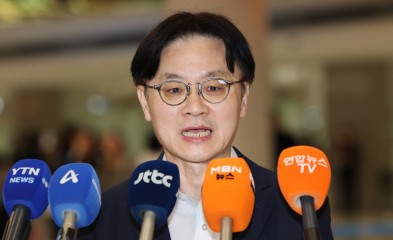
Employment and Labor Minister Kim Young-hoon said the guidelines were prepared to improve workplace predictability, prevent labor-management disputes and promote dialogue.
However, there have been growing calls for the prompt revision of the so-called "Yellow Envelope Act" — officially the amendment to the Trade Union and Labor Relations Adjustment Act — because the law has become a source of many problems since it was finalized before sufficient deliberation.
President Lee Jae Myung has also repeatedly instructed officials to move quickly with subordinate legislation, including an enforcement decree, to address these problems, and Kim has responded that he would positively consider doing so.
Nevertheless, the ministry ultimately decided to provide additional explanations in the form of “guidelines,” which have no binding force, instead of an enforcement decree that could have a binding effect on both labor and management and eventually in court.
The main reason the ministry did not choose an enforcement decree despite President Lee’s instruction appears to be that the act does not explicitly delegate authority to prescribe such matters through an enforcement decree.
In other words, if the government were to do so even though the parent law does not state that matters subject to labor disputes should be prescribed by an enforcement decree, it could later provoke controversy over whether the government acted unconstitutionally or exceeded its authority.
An enforcement decree formally takes at least three months to go through various procedures and obtain Cabinet approval, and guidelines can be applied immediately upon announcement, making them far more efficient in terms of speed.
However, while an enforcement decree has externally binding force within the scope of the parent law, guidelines are merely internal administrative standards that cannot bind labor and management, the Labor Relations Commission or the courts.
Some businesses even suspect that the government has effectively sided with labor groups that opposed limiting the scope of labor disputes through an enforcement decree while outwardly acting as though it had made an effort to eliminate potential problems as businesses had requested.
At this moment, companies must make critical decisions that could determine their success or failure.
Considering this reality, there is little point in continuing to debate whether the government should choose an enforcement decree or guidelines. It is time to examine why this situation has arisen and address the fundamental problem.
The reason for saying this is that concerns raised by many academics and experts when a former head of the Korean Confederation of Trade Unions was appointed minister of employment and labor for the first time in history and during the process in which the Yellow Envelope Act was proposed, debated in the National Assembly and finalized, are now becoming reality.
In other words, many people were concerned that a minister of employment and labor who had previously headed the Korean Confederation of Trade Unions might fail to pursue policies from a neutral position that puts the national interest first. Many also pointed to problems that could arise if the ruling party, which holds an overwhelming majority in the National Assembly, gave excessive consideration to labor groups and passed the Yellow Envelope Act hastily without sufficient scrutiny.
Both of these concerns now appear to be materializing. The government should humbly acknowledge that the Yellow Envelope Act contains problems serious enough that they cannot be resolved through either an enforcement decree or guidelines and begin a public discussion on revising the law again before it is too late.
The government should also stop letting itself get carried away by the explosive growth in exports resulting from a semiconductor supercycle that may occur only once in several generations, spectacular earnings at some companies and the resulting strength in some economic indicators.
Otherwise, it risks undermining the country’s capacity to cope with the harsh reality that the South Korean economy and its industries as a whole may inevitably face soon.
- - -
Yoo Choon-sik
Yoo Choon-sik is a senior AI correspondent covering Korea for MLex Market Insight. He has worked for international media organizations for about 30 years, including as Reuters’ chief economics correspondent in Korea. The views expressed here are the writer’s own. — Ed.
khnews@heraldcorp.com