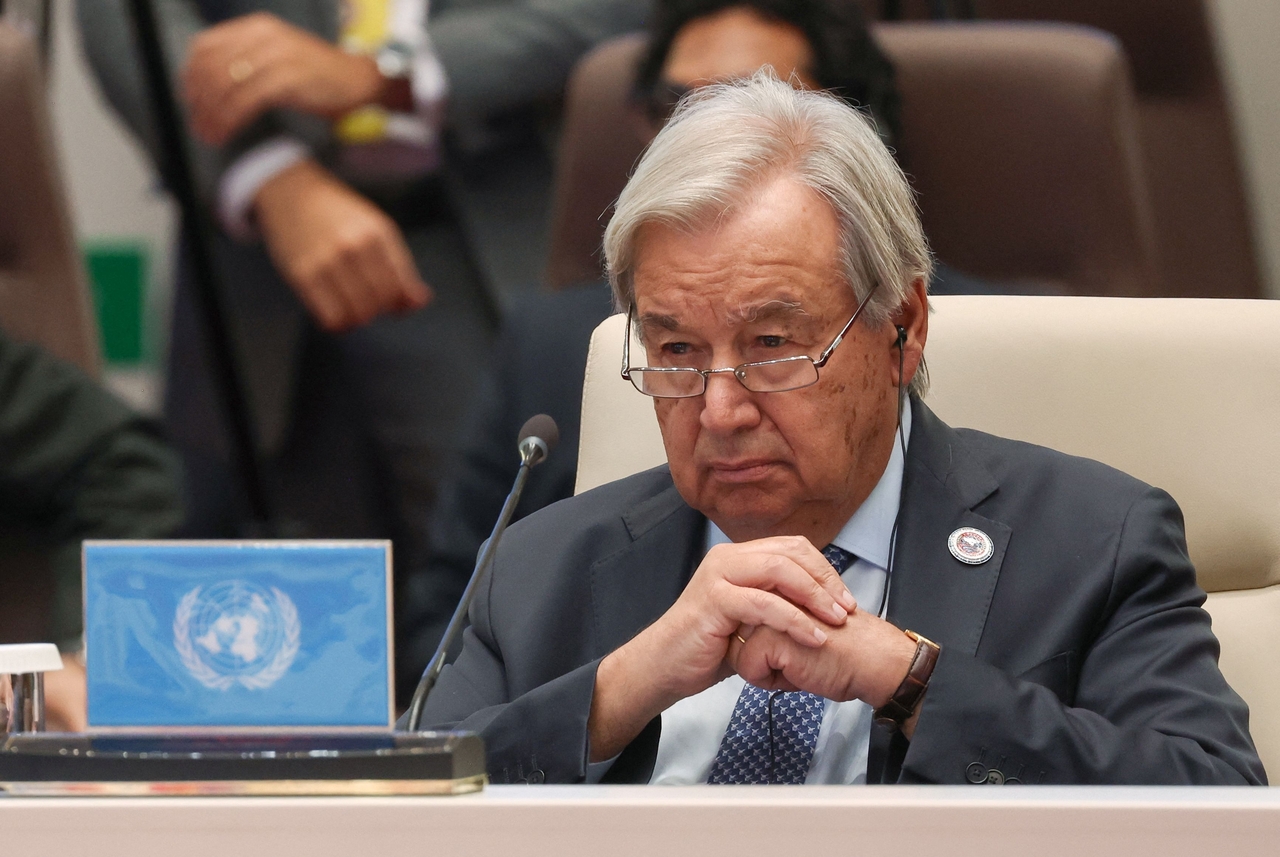
North Korea’s unusual decision on Saturday to disclose the full text of a congratulatory message from United Nations Secretary-General Antonio Guterres may signal tentative efforts by both sides to revive engagement after years of limited contact, while falling short of indicating a broader diplomatic breakthrough, an expert in Seoul said.
The Korean Central News Agency reported Saturday that Guterres sent North Korean leader Kim Jong-un a message on Sept. 9, congratulating the country the 78th anniversary of its founding.
While the UN has sent such messages to Pyongyang on its founding anniversary for years, North Korea’s publication of the full text is relatively unusual, drawing attention to the timing as contacts between Pyongyang and UN officials show signs of resuming, Yang Moo-jin, professor emeritus at the University of North Korean Studies said.
“The message can be seen as an expression of Secretary-General Guterres’ willingness to improve UN-North Korea relations, which had been severed since the COVID-19 pandemic,” Yang said.
He pointed in particular to Guterres’ reference to the July visit by Joe Colombano, the UN resident coordinator for North Korea, who traveled to Pyongyang from July 13-18, the first visit by a UN resident coordinator in over six years.
“In this connection, I would like to express my appreciation to the Government of the Democratic People’s Republic of Korea for the hospitality extended to the Resident Coordinator for the Democratic People’s Republic of Korea, Mr. Joe Colombano, during his visit in July 2026,” Guterres said in the message, according to the full English text released by KCNA.
During his trip, Colombano visited offices of UN agencies in Pyongyang, including UNICEF and the World Health Organization, and held discussions on UN activities in the country.
Yang also noted that Guterres avoided directly raising North Korea’s nuclear weapons and missile programs, instead emphasizing broader global challenges and the need for multilateral cooperation.
“The emphasis on multilateral cooperation is intended to keep North Korea within the UN framework,” Yang said. “It can therefore be interpreted as a message expressing hope for the resumption of contact and dialogue on the occasion of the national anniversary.”
In his message, Guterres said national days “remind us of the value of dialogue and solidarity in addressing global challenges,” according to the KCNA.
“The world today faces urgent tests: ending wars and preventing new ones; confronting the climate emergency; narrowing inequalities; and guiding powerful technologies responsibly,” Guterres said.
“Meeting these and other challenges requires renewed engagement and a commitment to multilateral cooperation to deliver peace and security, advance the Sustainable Development Goals and uphold human rights,” he added.
Yang said Pyongyang’s decision to release the message in full could have its own political purpose, allowing North Korea to portray the UN secretary-general’s greetings as further recognition of its statehood.
“North Korea disclosed the message to emphasize that the UN also recognizes its push to establish itself as an independent and normalized state,” Yang said.
The two Koreas joined the UN simultaneously in September 1991. Yang said Pyongyang could use that history, together with the secretary-general’s message marking its founding anniversary, to bolster its argument that the international community recognizes North and South Korea as separate states.
The interpretation is particularly notable against the backdrop of North Korea’s shift in its approach toward Seoul. Pyongyang has increasingly rejected the long-standing concept of inter-Korean reunification and characterized the two Koreas as separate and hostile states.
Yang said North Korea could also seek to portray renewed contact with the UN, alongside its increasingly close relations with China and Russia, as evidence of its growing international standing.
“After expanding its points of contact with China and Russia, North Korea is likely to tout its widening engagement with the UN as an elevation of its strategic status,” he said.
Yang cautioned, however, against interpreting the exchange as evidence that a broader diplomatic opening — particularly between Pyongyang and Washington — is imminent.
“It would be premature to link this message to an improvement in North Korea-US relations,” Yang said, pointing to the Trump administration’s skepticism toward the role of the United Nations.
He also noted that Pyongyang’s attitude toward the organization could change if the UN again puts greater emphasis on its nuclear and missile programs.
“For now, this should be viewed as the UN and North Korea testing the waters with each other ahead of any improvement in their relationship,” Yang said.
KCNA separately disclosed anniversary messages from a number of foreign leaders, including Indonesian President Prabowo Subianto, Thailand’s King Maha Vajiralongkorn, Britain’s King Charles III, Cuban President Miguel Diaz-Canel and Indian President Droupadi Murmu.
Diaz-Canel, meanwhile, reaffirmed Cuba’s commitment to further strengthening its longstanding ties of friendship, cooperation and solidarity with North Korea.
North Korea also marked the anniversary through events abroad. Its Embassy in Beijing hosted a reception Sept. 8 attended by North Korean Ambassador to China Ri Ryong Nam and senior Chinese officials, according to the North's Rodong Sinmun newspaper.
mkjung@heraldcorp.com