Embattled Gender Equality and Family Minister nominee Rep. Yong Hye-in withdrew her nomination Sunday amid mounting opposition to her appointment, including from within the ruling bloc.
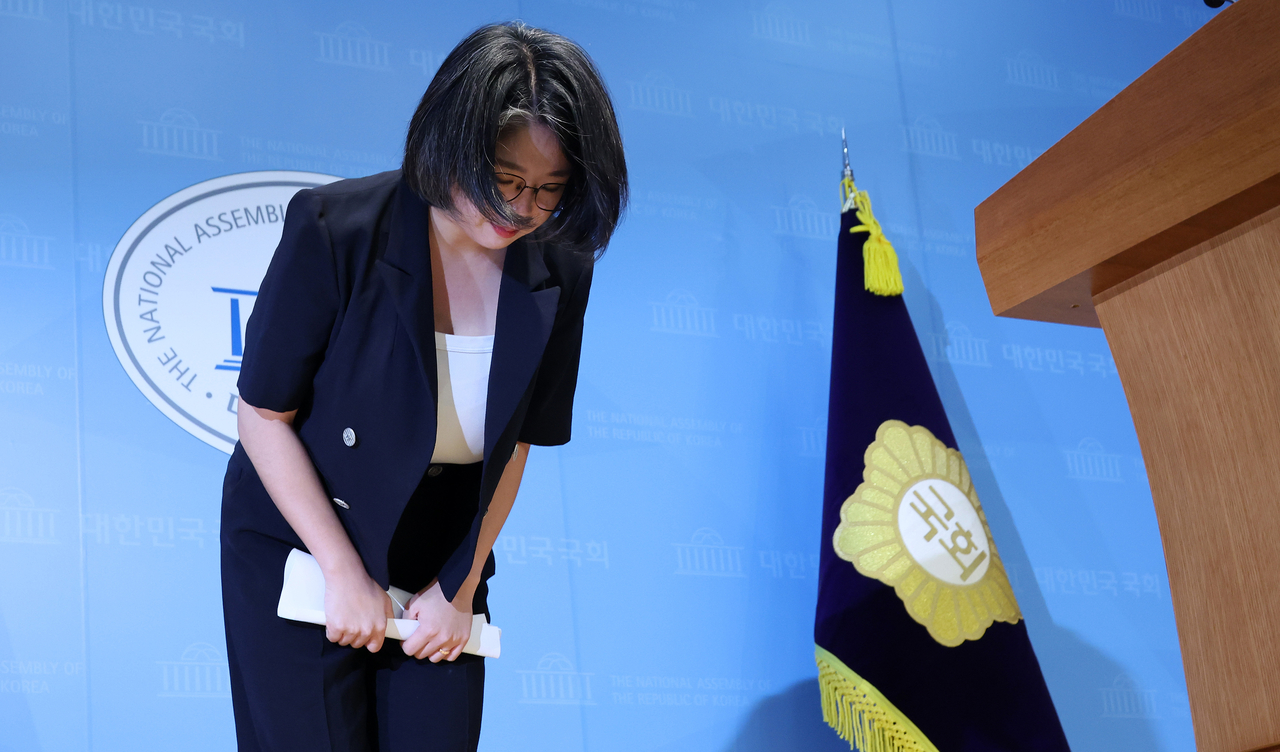
Yong, the sole lawmaker of the minor Basic Income Party, announced her decision at an emergency news conference at the National Assembly, just two weeks after President Lee Jae Myung nominated her for the post.
The decision came on the eve of a packed week of confirmation hearings at the National Assembly, with the ruling Democratic Party of Korea and the main opposition People Power Party having failed to agree on a date for her confirmation hearing.
“As the Lee Jae Myung administration’s nominee for minister of gender equality and family, I am stepping down from my nomination as of today, along with the determination I had to build a gender-equal society for everyone," Yong said during the press conference.
“I am grateful to the president for placing his trust in me and entrusting me with such an important responsibility, and I also want to express my apologies for being unable to fully carry out that responsibility.”
Yong cited the Democratic Party’s request that she decide her future as a nominee as a key reason for her withdrawal.
Yong explained that the growing concerns within the ruling party would make it difficult for her to fulfill a Cabinet member’s role of bridging the National Assembly and the government and fostering cooperation between them.
“I concluded that it would be realistically difficult to carry out the role when even the ruling party was expressing concerns,” Yong said.
“I also determined that stopping here was necessary to preserve the spirit of solidarity among the Democratic Party, the Basic Income Party and the broader liberal and progressive camp.”
Her withdrawal comes as scrutiny has intensified after she clarified her intent to retain her proportional-representation seat in the National Assembly if appointed minister, during a hastily called news conference on Thursday.
Yong also dismissed criticism over the operation of her Basic Income Party, particularly questions surrounding the role of her husband, Park Ki-hong, who was elected to the party’s supreme council and had been receiving a salary as a party official. Yong claimed that there were “no procedural or substantive flaws” in the arrangement.
The Democratic Party has grown increasingly critical of Yong since her news conference Thursday, when she publicly expressed frustration that even some within the ruling party were, in her words, being “swept up in speculation and malicious agitation” surrounding her nomination.
Her remarks were followed by a notably tougher tone from the Democratic Party.
“We will take a serious view of the matter from the public’s perspective,” senior spokesperson Rep. Park Sung-joon said Friday. Park said the “party leadership was urgently canvassing views and assessments from both inside and outside the party.”
The criticism intensified Saturday. Spokesperson Rep. Cho Gye-won told reporters that “Public sentiment among the younger generation is boiling over because of this issue.”
“We cannot simply stand by. Some form of response is necessary.”
Signs of a shift in tone have also emerged at Cheong Wa Dae.
The presidential office had initially maintained that ministerial nominees should be given an opportunity to address controversies surrounding them through confirmation hearings at the National Assembly.
But its tone grew more cautious after Yong held a hastily announced news conference Thursday without prior consultation with Cheong Wa Dae. At a briefing Friday, senior presidential spokesperson Kang Yu-jung said the presidential office was “listening closely to the diverse voices of the public,” suggesting that it was weighing the growing criticism surrounding Yong’s nomination.
The growing controversy over Lee’s personnel choices has also coincided with a slide in his approval rating. Lee’s job approval fell 2 percentage points from the previous week to 38 percent, according to a Gallup Korea poll released Friday, the lowest level since he took office.
Personnel appointments have also emerged as a rapidly growing source of dissatisfaction with the president. Among those who disapproved of Lee’s performance, 24 percent cited his real estate policies, followed by personnel appointments at 16 percent and the economy and people’s livelihoods at 10 percent.
In particular, the share of respondents citing personnel appointments as a reason for disapproving of Lee’s performance surged from 1 percent two weeks earlier to 9 percent last week and 16 percent in the latest survey.
The backlash was particularly pronounced over Yong. Sixty-one percent of respondents said she was unfit to serve as gender equality and family minister, more than four times the 13 percent who viewed her as fit for the post. Even among supporters of the ruling Democratic Party, 51 percent considered her unfit, compared with 26 percent who said she was suitable for the job.
dagyumji@heraldcorp.com