
Officials compare approaches to working-level autonomy, accountability, AI in personnel management
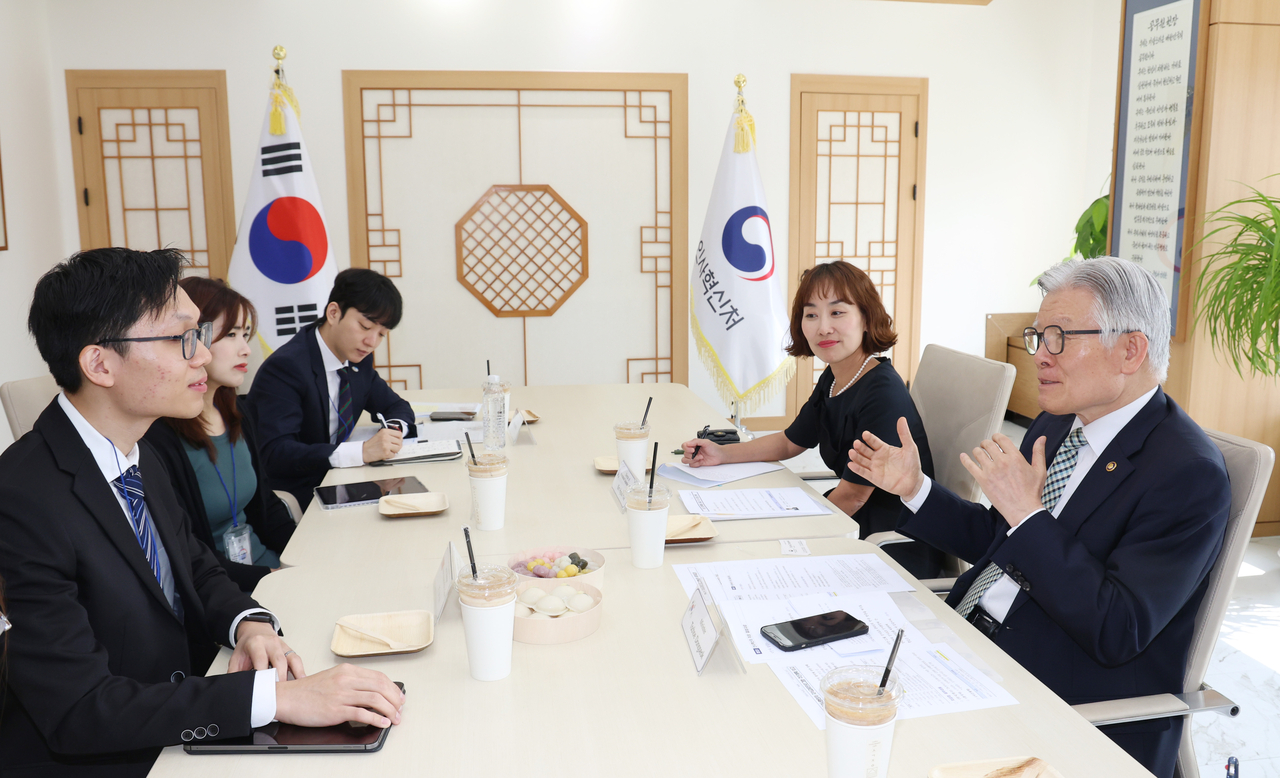
SEJONG — A delegation of Singaporean civil service officials visited South Korea on Wednesday to learn about the country’s performance management, digital personnel systems and use of artificial intelligence in public administration, while exchanging views on working-level autonomy and accountability.
The Ministry of Personnel Management said officials from Singapore’s Public Service Division under the Prime Minister’s Office visited the Government Complex Sejong to meet Personnel Management Minister Tschoe Dong-seok as part of a bilateral knowledge exchange program.
The visit followed a memorandum of understanding signed by the two countries in 2025 to strengthen cooperation in public personnel administration.
Briefings for the delegation covered Korea’s performance management system, the governmentwide electronic personnel management platform e-Saram and efforts to incorporate AI into personnel administration.
The delegation was also scheduled to visit the National Human Resources Development Institute and the Ministry of the Interior and Safety to learn about civil servant training and Korea’s digital government policies.
During the meeting, Tschoe said Korea seeks to give greater decision-making authority to working-level civil servants, and to move away from its traditionally top-down administrative culture as the government adapts to the AI era.
“Ultimately, what we want is to enable the working-level officials closest to the public to exercise authority based on their own judgment,” Tschoe said.
Singaporean officials said their civil service similarly sought to incorporate input from working-level officials into policymaking, describing its decision-making process as largely bottom-up.
Asked how Singapore handles mistakes when greater authority is given to working-level officials, a Singaporean official said the government generally seeks to correct the problem and treat it as a learning opportunity rather than immediately blame the individual involved.
Serious mistakes, however, may result in corrective measures aimed at preventing a recurrence, the official added.
“Continued policy exchanges and cooperation between the two countries are important,” Tschoe said. “I hope this visit will promote exchanges in personnel administration and deepen mutual understanding and cooperation.”
The visit marked the second personnel policy exchange between the two countries since the agreement was signed. Korean officials visited Singapore in June to exchange policy experiences, including on data-driven personnel management.
seungku99@heraldcorp.com