
South Korea’s rival parties are set to clash over the administration's economic, housing, foreign and security policies in the coming days, during the government interpellation session and confirmation hearings for minister nominees.
The interpellation session will begin Wednesday with political affairs, followed by foreign affairs, unification and security Thursday, economic affairs Friday and education, social and cultural affairs on Sept. 14.
The sessions will come after the ruling Democratic Party of Korea leader Kim Min-seok and main opposition People Power Party Floor Leader Jeong Jeom-sig deliver parliamentary speeches Monday and Tuesday, respectively, setting out their priorities for the regular session, which began Sept. 1 and runs through Dec. 9.
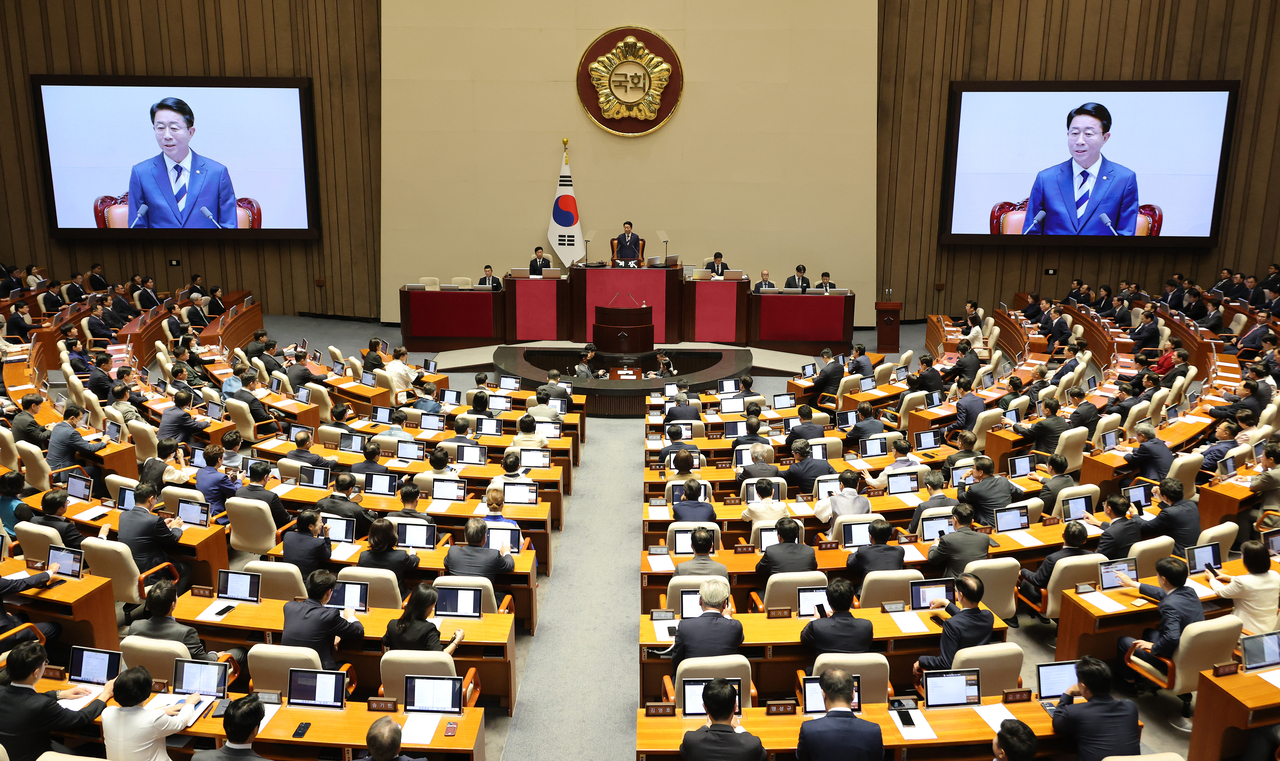
The Democratic Party is expected to use the questioning largely to review the administration’s achievements and push for policies aimed at improving economic growth and advancing its reform agenda.
The People Power Party, meanwhile, is expected to concentrate its attacks on the cost of housing, the government’s proposal to hike public spending by 12.8 percent to 821 trillion won ($610 billion) for next year.
Foreign and security issues are also expected to draw attention, particularly the government’s consideration of a military contribution to efforts to secure freedom of navigation in the Strait of Hormuz, amid pressure from US President Donald Trump.
The issue could also be a source of pressure on the government from within the ruling bloc. Democratic Party Rep. Lee Ki-heon, who is scheduled to question the government Thursday, has opposed a deployment, saying even noncombat forces would amount to participation in a war.
Lee’s approval rating has fallen and support for the People Power Party has risen in recent weeks, after the conservative party struggled for months with the political fallout from former President Yoon Suk Yeol’s martial law declaration in December 2024.
A Gallup Korea survey released Friday showed Lee’s approval rating at 40 percent, down 2 percentage points from the previous week and at its lowest since he took office in June 2025. Support for the Democratic Party stood at 38 percent, while the People Power Party rose 5 percentage points to 30 percent, substantially narrowing the gap.
Housing policy was the most frequently cited reason for negative assessments of Lee, followed by the economy and personnel appointments.
Confirmation hearings
The battle is expected to continue into the following week with a series of confirmation hearings for nominees unveiled in Lee’s Aug. 30 Cabinet reshuffle.
Supreme Court Justice nominee Kim Seong-su is scheduled to appear before lawmakers on Sept. 14, amid an escalating dispute between President Lee and Chief Justice Jo Hee-de over Supreme Court appointments.
Jo nominated Kim and Judge Son Bong-gi on Aug. 18, but Lee submitted only Kim’s nomination to parliament and asked Jo to replace Son, with the presidential office citing a lack of prior consultation.
The dispute comes amid lingering tensions between Lee and the judiciary. The Supreme Court, just a month before last year’s presidential election, overturned his acquittal on charges of making false statements during the 2022 presidential campaign about a former city official of Seongnam, Gyeonggi Province, and a controversial land development project.
A final conviction carrying a fine of at least 1 million won could have barred Lee from running for public office for five years.
Justice Minister nominee Rep. Kim Seung-won of the Democratic Party, one of six Cabinet nominees named by Lee in an Aug. 30 reshuffle, is scheduled for a confirmation hearing on Sept. 15.
Kim is expected to face questions over allegations he sought expedited regulatory approval for a COVID-19 drug trial in 2021.
He is also likely to face scrutiny over whether he could remain impartial in handling criminal cases involving Lee, as he served as the joint leader of a group of Democratic Party lawmakers formed in February that called on prosecutors to withdraw all charges against the president.
Kim has said he would not direct prosecutors to drop the cases if appointed.
Finance Minister nominee Lee Hyoung-il and SMEs and Startups Minister nominee Rep. Lee So-young of the Democratic Party are also scheduled for hearings Sept. 15, followed by Defense Minister nominee Kang Shin-chul and Land Minister nominee Hong Ji-sun on Sept. 16.
A hearing date has yet to be set for Gender Equality and Family Minister nominee Rep. Yong Hye-in of the minor left-wing Basic Income Party.
flylikekite@heraldcorp.com