
Possibility of South Korean involvement in Hormuz may surface during talks
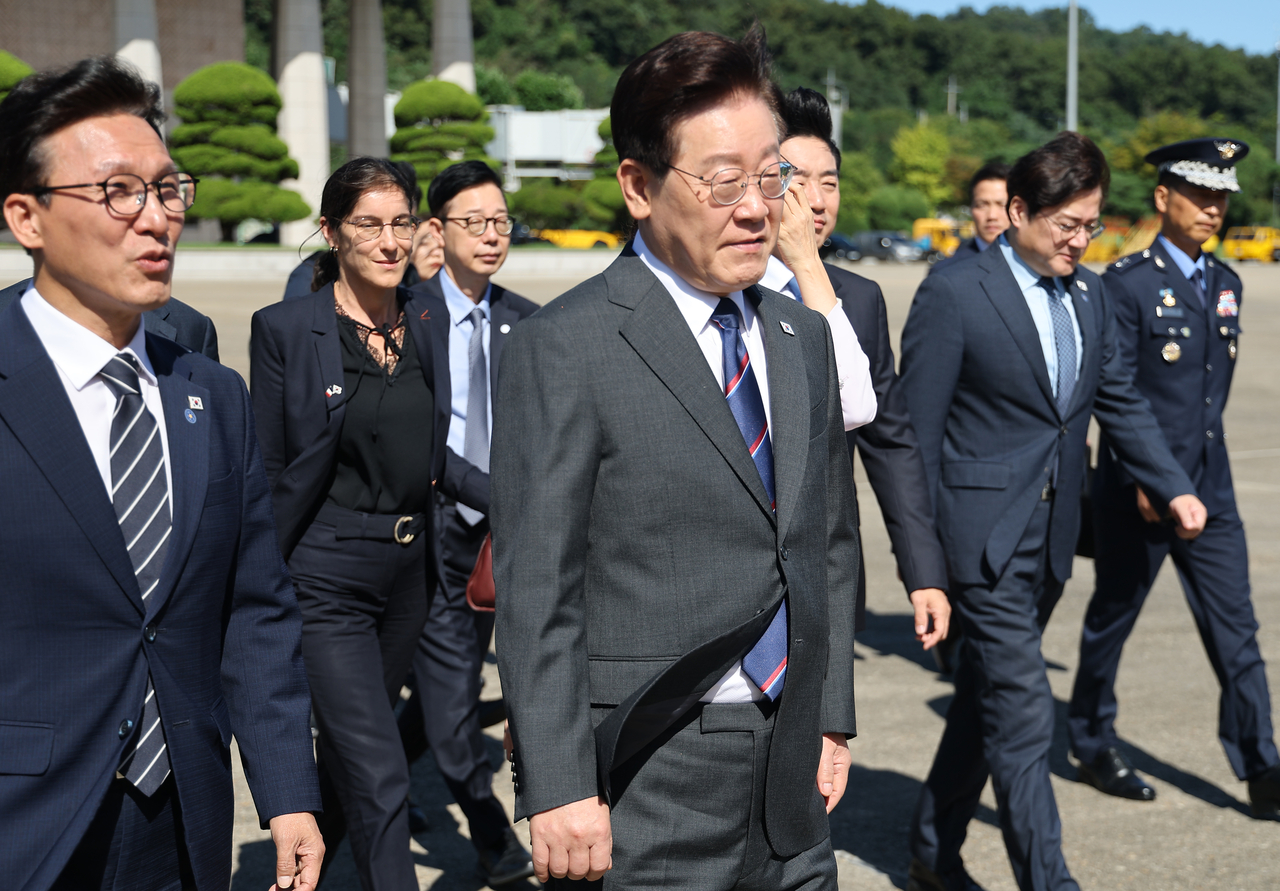
President Lee Jae Myung departed for France on Sunday for a four-day state visit that will begin with an international film and audiovisual gathering, followed by summit talks with French President Emmanuel Macron on expanding bilateral cooperation, with the Strait of Hormuz also emerging as a potential issue.
Lee is scheduled to co-chair the Lumiere Summit with Macron on Monday in Saint-Paul-de-Vence in southern France, according to Cheong Wa Dae.
Macron invited Lee to co-chair the event during his state visit to Seoul in April and proposed that Lee make a state visit to France on the occasion, the presidential office said.
The gathering is expected to bring together about 150 participants from more than 30 countries, including representatives from the film, audiovisual and video game industries.
Lee is to move onward to Paris for the formal state visit Tuesday, beginning with a wreath-laying ceremony at the Arc de Triomphe and an official welcoming ceremony.
Lee and Macron will hold a luncheon followed by summit talks at the Elysee Palace. Lee will also attend a business roundtable involving South Korean and French companies before attending a state dinner hosted by Macron.
The president will wrap up his visit Wednesday after meeting French National Assembly President Yael Braun-Pivet and Organization for Economic Cooperation and Development Secretary-General Mathias Cormann.
Cheong Wa Dae said the visit is expected to produce "concrete outcomes" in areas including security, the economy, science and technology, culture and people-to-people exchanges, building on Macron's visit to Seoul in April.
During the April visit, the two countries upgraded their ties to a "global strategic partnership."
At the time, Lee and Macron agreed to expand cooperation in defense and civilian nuclear energy, while strengthening ties in advanced technologies including artificial intelligence, semiconductors and quantum technology. Their agreements also covered defense industry cooperation, space and biotechnology.
The state visit comes as South Korea and France mark 140 years of diplomatic relations.

Hormuz deployment
Lee's meeting with Macron is also drawing attention over whether the two leaders will discuss South Korea's possible military contribution to efforts to restore freedom of navigation through the Strait of Hormuz.
France has been at the forefront of multinational efforts to prepare for the reopening and protection of the strategically vital waterway.
In March, France convened senior military officials from 35 countries to discuss possible cooperation to restore safe navigation once hostilities subside. South Korean Joint Chiefs of Staff Chair Gen. Jin Yong-sung took part in the March 26 videoconference chaired by French Armed Forces Chief Gen. Fabien Mandon.
Seoul has been facing growing pressure from US President Donald Trump to contribute to security efforts in the strait, with Trump repeatedly accusing South Korea of turning down his request for military support.
Last week, local media reported that the government was reviewing options including the deployment of P-8A Poseidon maritime patrol aircraft, the Navy's 11,000-ton Soyang-class fast combat support ship and explosive ordnance disposal teams.
Cheong Wa Dae denied that a deployment had been decided but acknowledged that military contributions remain among the options under review.
"We are reviewing various options, but nothing has been decided," a presidential official said Friday, adding that Seoul could consider a contribution as long as it does not significantly undermine military readiness on the Korean Peninsula.
The official added that discussions had not yet reached the stage of consultations with the National Assembly.
The Defense Ministry has similarly said it was discussing possible contributions with the US and other countries, while stressing that no specific deployment had been decided.
Since the early 2000s, South Korea has carried out several overseas deployments, including missions to waters off Somalia, Afghanistan, the United Arab Emirates and South Sudan, largely for anti-piracy, reconstruction, training or peacekeeping operations.
The 2004 dispatch of the Zaytun contingent to Iraq under President Roh Moo-hyun was particularly controversial because it involved sending a large contingent of South Korean troops following a direct US request for additional forces during the US-led Iraq War.
The deployment nevertheless won National Assembly approval, and the contingent was sent to Irbil in northern Iraq for reconstruction and peace-support operations, reaching about 3,600 personnel at its peak.
flylikekite@heraldcorp.com