

New guidelines take effect immediately but do not bind courts, leaving businesses to call for supplementary legislation
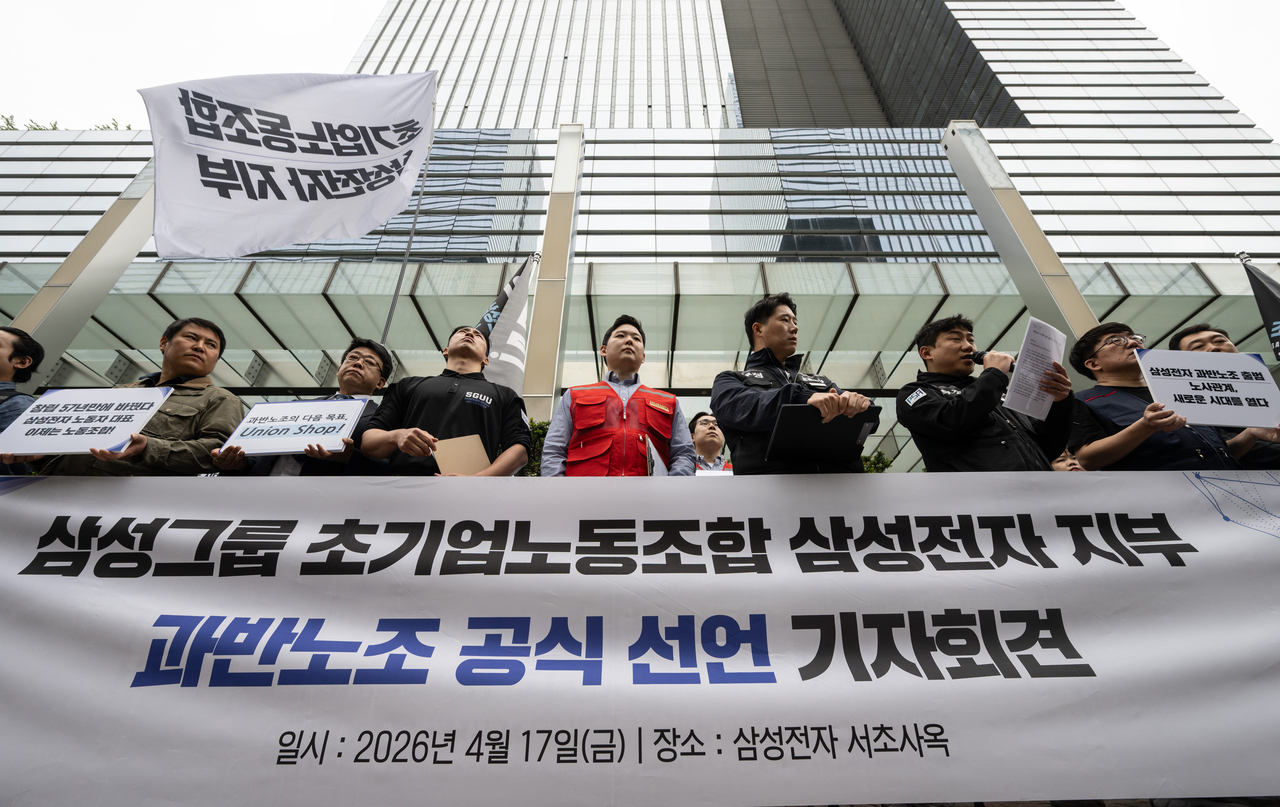
The South Korean government moved Thursday to keep union demands for a fixed share of corporate profits — the formula at the heart of recent bonus disputes at Samsung Electronics and other major companies — outside the scope of mandatory bargaining.
The Ministry of Employment and Labor issued new guidelines on the Trade Union and Labor Relations Adjustment Act, drawing clearer boundaries around which disputes can lawfully lead to industrial action.
“Performance incentives linked to a certain percentage of corporate profits are difficult to regard as mandatory bargaining issues under the labor union law,” Vice Minister of Employment and Labor Kwon Chang-jun said at a briefing Thursday.
Such demands gained prominence at Samsung Electronics late last year as the chipmaker’s profits surged amid an artificial intelligence-driven semiconductor boom.
Similar calls have since spread to automakers, shipbuilders and other major companies.
“Operating profit serves as a source of funds for various legal rights held by third parties, including shareholders and creditors, so its disposal or reduction could potentially infringe upon their interests,” Kwon said.
The guidelines also state that decisions to introduce robots or AI, sell or acquire businesses, establish overseas facilities or relocate operations do not by themselves constitute mandatory bargaining issues.
The ministry said the clarification is intended to preserve companies’ ability to respond to rapid technological and industrial changes while providing clearer standards for determining whether industrial action is lawful.
Corporate investment and relocation have drawn particular attention amid the government’s push for balanced regional development and a semiconductor cluster in the southwestern Jeonnam-Gwangju region.
The treatment of overseas investment has also emerged as a contentious issue following Korea’s pledge to invest in the United States as part of tariff negotiations.
Management decisions can still give rise to mandatory bargaining when a concrete plan or decision involving workforce adjustments has been made or communicated and changes in working conditions can be objectively anticipated, according to the guidelines.
Kwon said management-related issues could also be discussed through mutual agreement. However, an employer’s refusal to negotiate an issue that falls outside the scope of mandatory bargaining would not constitute an unfair labor practice.
“We are not trying to restrict workers’ legal rights, but simply hope to enhance predictability by providing more concrete standards for resolving disputes,” Kwon said.
The clarification follows calls from businesses concerned that the revised labor union law, widely known as the "Yellow Envelope Act," has increased the risk of industrial disputes interfering with management decisions.
The law, which took effect in March, expanded the definition of labor disputes to include certain management decisions affecting working conditions. It also broadened the range of companies required to bargain with subcontracted workers.
President Lee Jae Myung has also called for clearer boundaries.
During a Cabinet meeting on July 21, Lee said the construction of a semiconductor plant in the Jeonnam-Gwangju region should not become a subject of industrial action after a Samsung Electronics union sought to raise the project in collective bargaining.
Lee also questioned whether demands to allocate a fixed share of operating profit to performance bonuses could provide lawful grounds for industrial action.
Businesses, however, remain concerned because the new standards were issued as administrative guidelines rather than an enforcement decree and therefore do not directly bind courts.
The ministry said it chose guidelines because revising an enforcement decree would take at least three months, while the new standards could be applied immediately.
“The guidelines themselves also have limitations,” Kwon said. “For example, if administrative guidance is issued regarding a union’s industrial action based on the guidelines, procedures such as mediation must still be completed before a strike can take place.”
Legal experts said supplementary legislation would ultimately be necessary to remove the uncertainty.
“Among business management decisions, there are only a very small number that are made completely unrelated to workers’ interests,” Park Ji-soon, a professor at Korea University School of Law, told local media.
“To eliminate uncertainty, supplementary legislation delegating authority to set detailed standards through an enforcement decree is essential.”
forestjs@heraldcorp.com