Forum sees Korea’s growth strengthening to 2.6% this year, but warns costs of aging population require new revenue sources

South Korea needs stronger fiscal rules, a broader tax base and deeper structural reforms to prevent rapid aging from pushing public debt onto an unsustainable path, the Organization for Economic Cooperation and Development said Thursday.
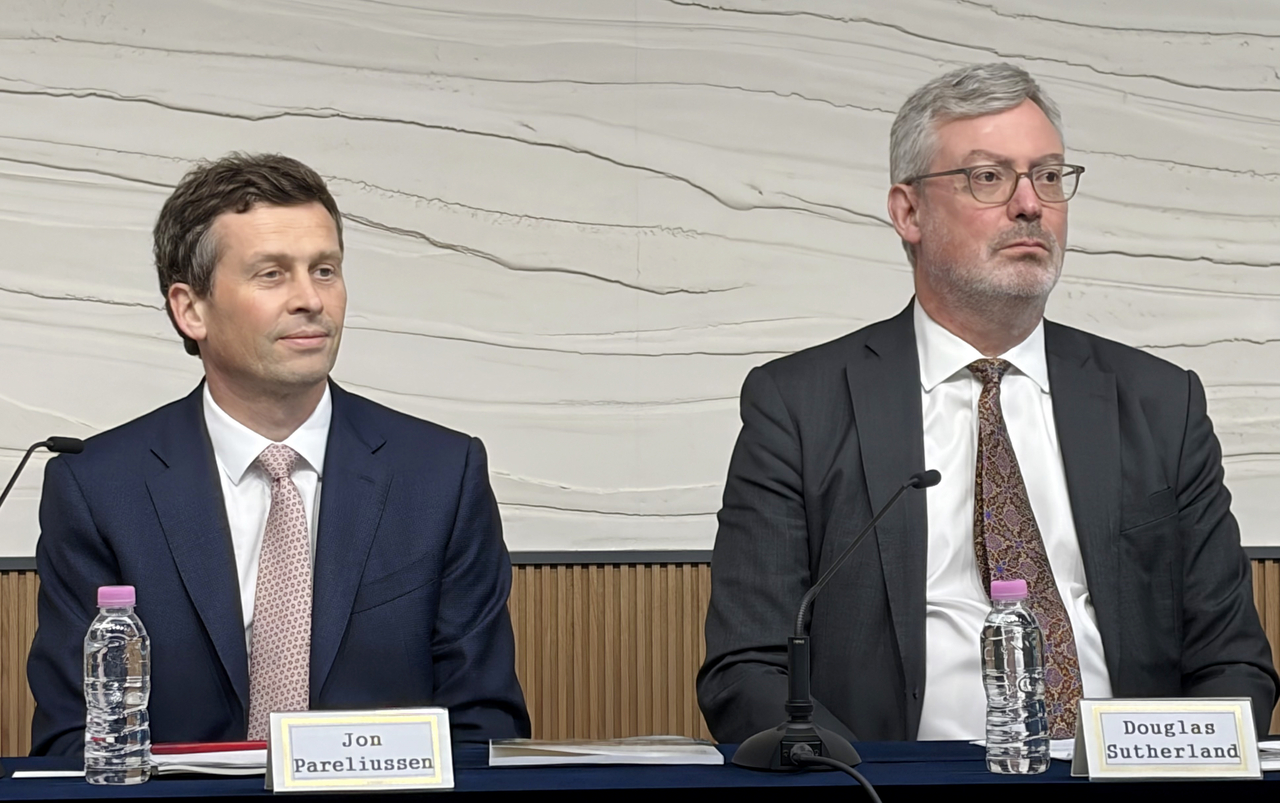
"Without action, the cost of aging will put debt onto an unsustainable path," Douglas Sutherland, head of country studies in the OECD Economics Department, said at a press briefing in Sejong. "This is not our projection — it reveals the risks of aging pressures."
The warning, delivered in the OECD's 2026 Economic Survey of Korea, casts the country's tax and welfare debates as part of the broader challenge of how to finance rising age-related spending while keeping the economy productive as the workforce shrinks.
Under a current-policy risk scenario, gross government debt could approach 200 percent of gross domestic product by around 2050 if aging-related spending pressures are financed through borrowing, according to the OECD's long-term simulation. With structural reforms, the ratio would remain far lower and broadly stable.
Sutherland said the challenge was political as much as fiscal. "Forging a broad political consensus on a strengthened fiscal framework will be required to meet these challenges," he said.
Near-term resilience
The biennial report projected Korea's economy would grow 2.6 percent this year before slowing to 1.9 percent in 2027, saying the recovery has regained momentum following the political turmoil triggered by the December 2024 martial law declaration, supported by fiscal stimulus and strong semiconductor exports. However, it warned that geopolitical tensions in the Middle East and higher energy prices continue to cloud the outlook.
Sutherland struck a positive note on Korea's near-term resilience. "The Korean economy has been resilient to several shocks over the last couple of years," he said, adding that the beginning of 2026 had been "very robust," largely driven by semiconductor production and exports.
But the report said the bigger challenge lies beyond the near-term cycle. Korea's pensionable age is 63, one of the lowest in the OECD, and is set to rise more slowly than in many peer economies. Sutherland said Korea should link the pensionable age to life expectancy and encourage longer pension contributions.
A broader tax base
To move onto a prudent fiscal path, the OECD said Korea would need revenue and spending measures equivalent to fiscal-balance improvements of 2.9 percent of GDP by 2032 and 8.2 percent by 2060.
The OECD identified broadening the value-added tax base and eventually raising the rate as the biggest potential source of additional revenue. It also called for a wider personal income tax base, a gradual move toward a single corporate tax rate and a shift away from property transaction taxes.
Property taxation was another key area. Although Korea collects relatively high property tax revenues by OECD standards, the report said the system relies heavily on transaction taxes rather than recurrent property taxes. It recommended a gradual, revenue-neutral shift toward recurrent levies once housing market conditions stabilize to improve residential mobility, boost labor market efficiency and reduce housing market distortions.
Reshaping skills and regional opportunity
The tax recommendations form part of a broader reform agenda aimed at lifting Korea's long-term growth potential as its population ages.The OECD said Korea also needs to make better use of its human capital as demographic pressure intensifies, warning that adult skills are below the OECD average and decline rapidly with age despite Korea’s high educational attainment.
Sutherland said increasing school hours and care before and after school could "help educational outcomes," reduce demand for private tutoring and support working parents. The report said regular instruction time in Korean primary schools is 655 hours a year, compared with the OECD average of 804.
The OECD also warned that while 70 percent of young Korean adults have completed tertiary education, many struggle to enter employment, and the earnings premium associated with a university degree has declined. To keep workers productive for longer, it called for stronger work-based training and lifelong learning, alongside labor market reforms to reduce dualism and shift wages and career progression away from seniority toward job characteristics and performance.
The OECD said Korea should also reshape the geography of opportunity by strengthening flagship universities outside the Seoul metropolitan area and linking them more closely with local economies to create job pathways for graduates.
jwc@heraldcorp.com


![[Breaking] North Korea fires unidentified projectile toward East Sea: JCS](https://wimg.heraldcorp.com/news/cms/2026/10/03/news-p.v1.20261003.564ea705b579475d93d29c31ecbdb757_R.png?type=h&h=120)