Foreign investors snap monthlong selling streak as reopening of Strait of Hormuz eases concerns over oil supplies, inflation
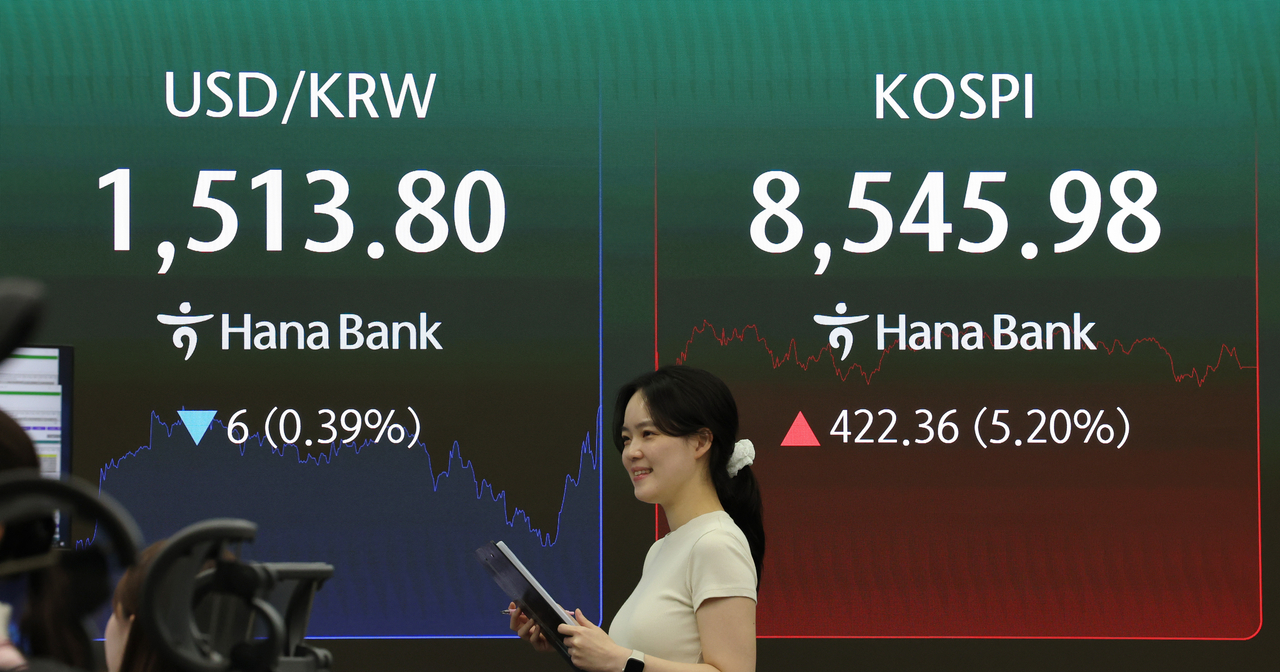
The South Korean benchmark Kospi surged over 5 percent Monday after the US and Iran announced an interim deal to end the war, easing concerns over disruptions to global energy supplies.
Following the announcement, which included provisions for reopening the Strait of Hormuz, the Kospi surged 4.95 percent at the open, triggering a buy-side sidecar, a five-minute trading curb. The index gradually extended gains throughout the day as normal trading resumed, closing 5.2 percent higher at 8,545.98.
With uncertainty easing, foreign investors turned net buyers for the first time in more than a month, purchasing a net 985.6 billion won ($653 million) worth of shares on the main board after 25 consecutive trading sessions of net selling. Institutional investors also added to the net buying move, purchasing shares amounting to 539.2 billion won.
Retail investors were the sole net sellers, offloading 1.48 trillion won, locking in profits after recent gains.
Large-cap shares led the rally. Market heavyweights Samsung Electronics climbed 4.5 percent to 337,000 won, while SK hynix surged 6.42 percent to 2.288 million won.
SK Square gained 4.05 percent to 1.413 million won and Samsung Electro-Mechanics jumped 16.63 percent to 1.999 million won.
"Corporate earnings will once again be the main driver of the domestic stock market, with memory semiconductors at the center. The market will once again focus on who holds the upper hand in the AI supply chain," Kim Du-eon, an analyst at Hana Securities, said.
The peace deal between the US and Iran is expected to support the broader Korean economy, which has been weighed down in recent months by geopolitical uncertainty due to its heavy reliance on energy imports.
In its revised economic outlook released last month, the Bank of Korea estimated that a US-Iran peace deal and the swift reopening of shipping through the Strait of Hormuz would lift the country's economic growth by 0.1 percentage point and lower inflation by 0.2 percentage point this year. The central bank had projected in May that the economy would grow 2.6 percent and inflation would reach 2.7 percent in 2026.
Easing inflationary pressures could give the central bank greater flexibility in setting monetary policy. However, despite the ceasefire, a full recovery in global energy supply chains is likely to take time.
Reflecting the improved outlook, the Korean won posted a modest gain against the dollar. The currency settled at 1,511.1 won per dollar in daytime trading. Although it strengthened by 8.7 won from the previous session, it remained above the psychologically important 1,500-won threshold.
The won's valuation per dollar also remains weaker than before the war, based on the Feb. 26 closing rate of 1,425.8 won per dollar.
"Despite the decline in oil prices, supply concerns are likely to keep them above prewar levels, while the prolonged conflict has tempered expectations for further dollar weakness," said KB Securities analyst Oh Jae-young.
With geopolitical uncertainty largely easing, Oh pointed out foreign investors' equity flows would become a key determinant of the won's direction. According to Bank of Korea, foreign investors have posted a net withdrawal of $77.8 billion from Korean equities this year.
"A key variable for the won's longer-term trajectory in the second half of the year will be how long foreign investors continue to sell Korean equities and how much additional selling pressure remains."
silverstar@heraldcorp.com