The ruling Democratic Party and the government on Wednesday vowed measures to curb inflationary pressure and stabilize the foreign exchange market as the country continues to be buffeted by the war in the Middle East.
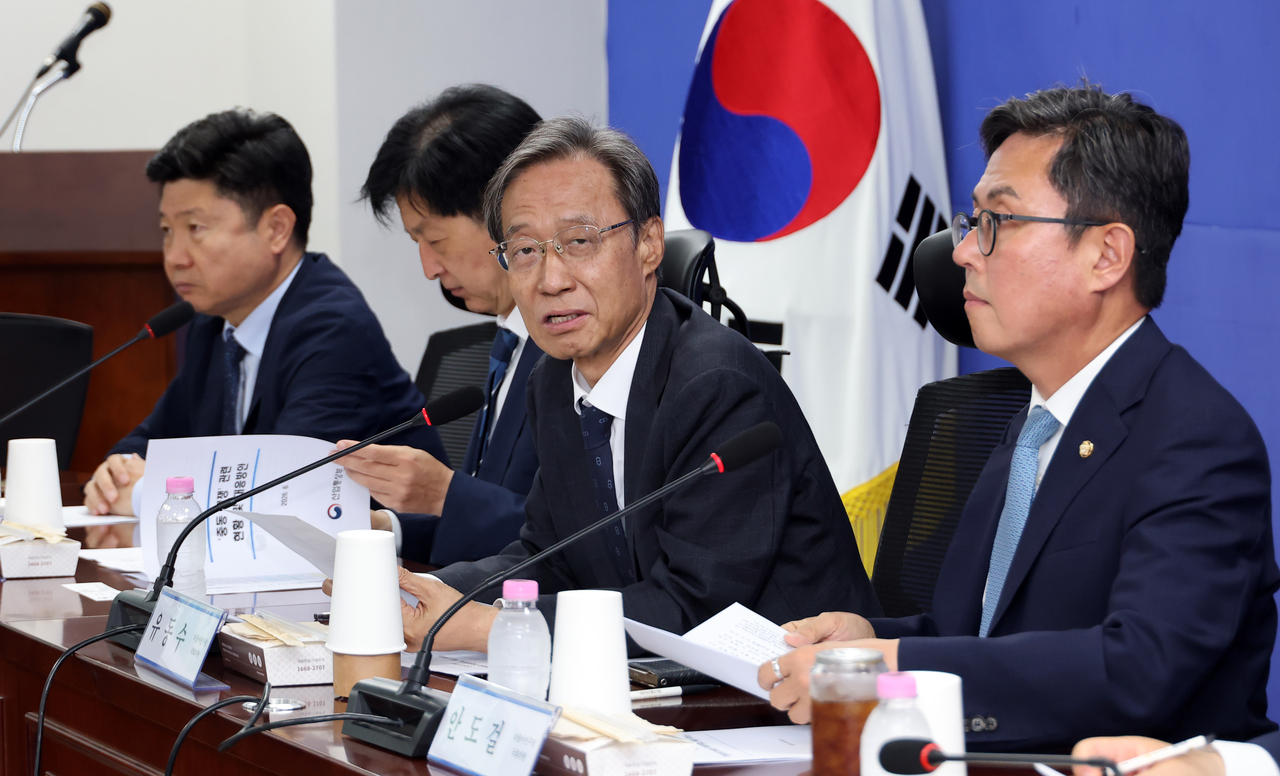
Following a meeting of ruling Democratic Party lawmakers and high-ranking government officials on Wednesday, Rep. Ahn Do-geol of the Democratic Party said that as pressure on the country dwarfs economic growth momentum, the government will consider "all available" measures to address the situation.
The won-to-dollar exchange rate has hit its highest level in nearly two decades on Friday, in part affected by the fluctuation in South Korea's stock market following its record bull run.
Seoul will toughen its pangovernmental crackdown on speculative trading of foreign currencies, Ahn said.
Also among the measures on the table are the extension of the exemption period for macro-prudential stability levies on private-sector financial companies in South Korea under the Foreign Exchange Transactions Act, as well as the easing of foreign currency liquidity stress testing requirements.
Regarding consumer price hikes, South Korea is set to implement measures to temporarily lower the import tariffs on food products such as eggs in the second half.
"We will make all-out efforts to prevent the burden on the consumer economy from increasing due to the weakening local currency (against the dollar) and consumer price instability," Ahn said.
"The government and the ruling party will make stabilizing the foreign exchange rate and consumer prices our top priority."
The lawmaker noted that South Korea has shown economic resilience in terms of its fundamentals, with nominal economic growth in the first quarter of this year of 17.1 percent, or the highest in three decades.
But the inflationary pressure due to oil price hikes — with the consumer inflation rate surpassing the 3-percent mark for the first time in 14 months — combined with the foreign exchange market volatility, will lead to a drawdown in the recovery of the domestic economy, he said.
"We recognize that inflationary pressures due to the high currency exchange rate and high oil prices are gradually becoming a reality," Ahn said, adding that the liberal bloc sees the moment as "a critical time for stabilizing the economy."
Also during the meeting, Rep. Yoo Dong-soo proposed easing a restrictive odd-even parking system in the public sector, amid announcements that South Korea had secured roughly 90 percent of crude oil despite the war in the Middle East.
Ahn said the government is reviewing the easing of the parking system.
consnow@heraldcorp.com