
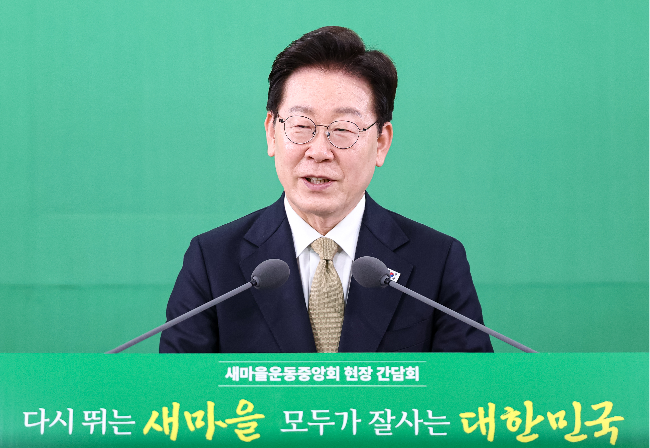
President Lee Jae Myung on Thursday called for a “significant expansion” overseas of the Saemaul Movement, the state-led campaign for national development and rural modernization set up under former President Park Chung-hee.
Lee pitched the Saemaul Movement as a model for providing more “effective and efficient” support to developing countries in ways that better meet their needs.
“As I travel around the world, especially in developing countries, I often find myself thinking how wonderful it would be if those countries also had something like the Saemaul Movement,” Lee said during a visit to the Korea Saemaul Undong Center in Seongnam, Gyeonggi Province.
According to Cheong Wa Dae, he is the first president from the liberal bloc to visit the headquarters of the independent organization tasked with supporting and fostering the Saemaul Movement.
Meaning “New Village Movement,” Saemaul Undong was built on the principles of diligence, self-help and cooperation, and is widely credited with helping transform South Korea’s rural economy during the country’s rapid industrialization period.
“If we can help improve conditions in those countries by sharing our experiences, it could strengthen ties between the Republic of Korea and those nations,” Lee said during a meeting with officials of the organization, using South Korea’s official name.
Lee added that such efforts could contribute to broader humanitarian goals.
“Perhaps this sounds too grand, but couldn’t we also help create a better environment for universal human rights and a better world overall?” he said.
In recent decades, South Korea has promoted variations of the Saemaul model abroad through official development assistance programs.
However, Lee called for further expansion of Samuel Movement abroad as the way to help devleopng coutnries.
“Saemaul organizations are already carrying out quite a lot of international volunteer activities, right? You are running many agricultural support projects as well,” Lee said. “The reason I wanted to meet with you today is because I came to think that this part should be expanded significantly.”
Lee underlined that the Saemaul Movement could offer an effective and efficient way to deliver foreign aid.
“We provide a great deal of foreign aid and support projects, but what matters is whether they actually help the countries receiving them,” he added. “As I thought about how we could provide assistance in the most effective and efficient way possible, I came to believe that sharing the Saemaul Movement itself would be truly helpful.”
Lee also described the Saemaul Movement as one of South Korea’s signature success stories from its industrialization era under Park.
“As all of you take pride in it, the Saemaul Movement was clearly a campaign launched by President Park Chung-hee during the industrialization era to improve the Republic of Korea’s cultural, economic and social environment,” Lee said. “And it is clear that it was a movement that achieved quite significant achievements. Even in this era today, it is very useful.”
Lee framed the push as part of South Korea’s broader responsibility to contribute more actively to the international community.
“Moreover, as a globally responsible country, We also have certain responsibilities to fulfill in the international community,” he added. “One of those responsibilities is helping people around the world live happier lives in better conditions.”
At the same time, Lee repeatedly emphasized that civic organizations such as the Saemaul Movement should avoid political alignment.
Recalling his time as mayor of Seongnam, Lee said he had urged civic groups not to become politically affiliated, take sides or be “swayed by politics.”
“People may think politicians appreciate organizations that follow them around, but in reality they end up looking down on them,” Lee said. “If you confidently fulfill your role and earn public respect, politicians will come looking for you instead.”
dagyumji@heraldcorp.com