

Major roads in central Seoul will be closed this weekend as the city hosts the 2026 Lotus Lantern Festival, a traditional Buddhist celebration inscribed on the UNESCO Intangible Cultural Heritage list, city officials said Wednesday.
The traffic restrictions will take effect Saturday and Sunday around Jogyesa, Ujeongguk-ro and the Jongno district to accommodate the festival’s signature events, including a massive lantern parade.
The Seoul Metropolitan Government will implement phased closures on primary arteries beginning Saturday afternoon.
From Jonggak Station to Heunginjimun, all lanes will be closed in both directions from 1 p.m. Saturday until 3 a.m. Sunday.
The section between Dongguk University and Heunginjimun will also be closed from 6 p.m. to 8:30 p.m. on Saturday.
From Sejong-daero to Jonggak, both directions will be closed from 6 p.m. Saturday until midnight. Stretching from Anguk Station to Jonggak, this section will be closed from 6 p.m. to midnight on Saturday, and again from 9 a.m. to midnight on Sunday.
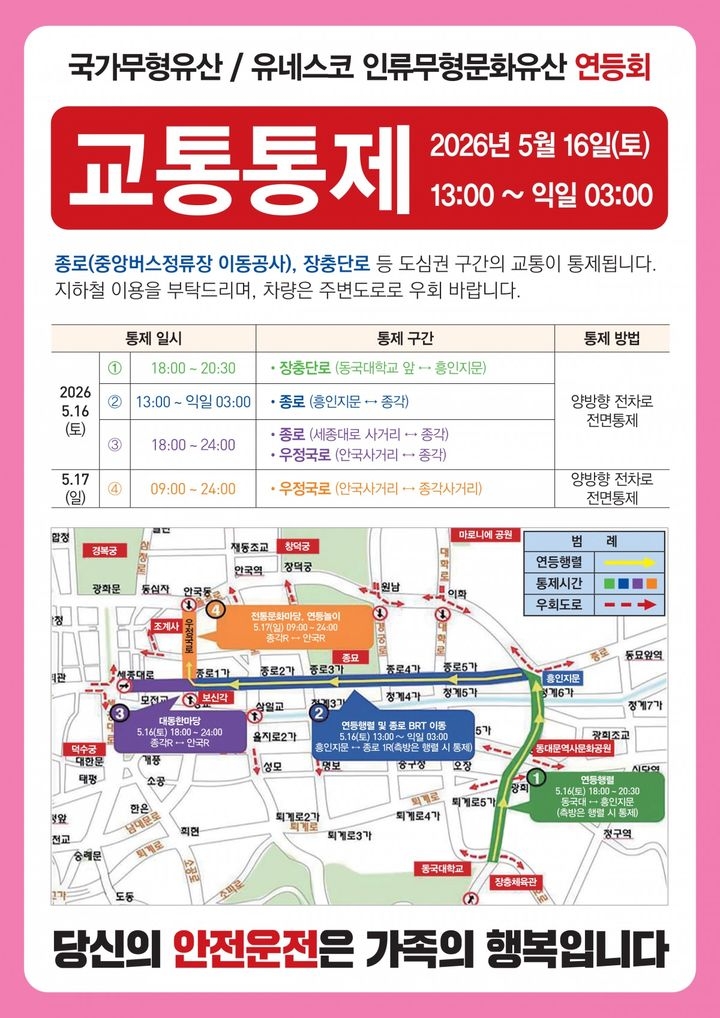
Buses normally passing through the Jongno area will be rerouted, and bus stops within the controlled zones will be temporarily closed. To assist commuters, 10 central bus stations along the parade route will be moved to temporary roadside locations.
City officials advised residents and visitors to use the subway system or walk from nearby accessible stations during the festivities.
The parade is scheduled for Saturday from 7 p.m. to 9:30 p.m. Approximately 20,000 participants from 60 organizations are expected to march from Dongguk University through Heunginjimun and Jongno toward Jogyesa.
With large crowds expected, the city plans to deploy safety personnel in coordination with the police, fire departments, and local district offices.
"We ask citizens and tourists to check traffic information in advance," said Kim Tae-hee, head of the Seoul Culture Headquarters. "We will do our best to manage the site so that everyone can enjoy the beautiful Lotus Lantern Festival safely."
The Lotus Lantern Festival is a tradition dating back 1,200 years to the Unified Silla Kingdom. It was designated as South Korea’s National Intangible Cultural Heritage No. 122 in 2012 and earned UNESCO status in 2020.
jychoi@heraldcorp.com



![[Exclusive] Ateez to return in November](https://wimg.heraldcorp.com/news/cms/2026/09/02/news-p.v1.20260902.76162fb0ba55493aad1c076f240d0750_R.jpg?type=h&h=120)