

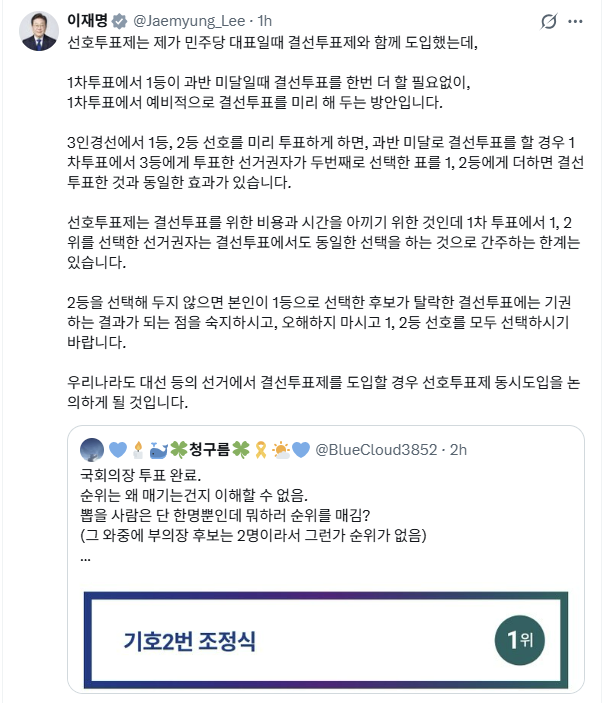
South Korean President Lee Jae Myung on Monday raised the prospect of introducing a preferential voting system alongside runoff elections for presidential and other major races.
Lee thrust ranked-choice voting into the spotlight as the ruling Democratic Party of Korea kicked off internal voting to choose its National Assembly speaker nominee through a preferential runoff process.
“If South Korea introduces a runoff voting system for presidential and other elections, discussions will likely follow on simultaneously adopting a preferential voting system,” Lee said in a post on his official X account.
South Korea’s major elections — including presidential, National Assembly and local elections — currently operate under a simple plurality system, known as "first past the post." Under the system, candidate who receives more votes than others wins the election regardless of whether they secure a majority.
Lee outlined the logic behind the system in the post, responding to a user who questioned why candidates are ranked in the Assembly speaker election.
Lee explained that he concurrently introduced ranked-choice voting together with a runoff voting system when he served as chair of the Democratic Party as a way to eliminate the need to hold a separate runoff vote if the top candidate failed to secure a majority.
“The preferential voting system is intended to save the cost and time required for a runoff election,” Lee explained. “But it has the limitation of assuming that voters who selected the first- and second-place candidates in the first round would make the same choice in the runoff election as well.”
The three-way speaker race among Democratic Party lawmakers Reps. Park Jie-won, Cho Jeong-sik and Kim Tae-nyeon is drawing heightened attention as it marks the first time rank-and-file party members will account for 20 percent of the vote following revisions to party rules.
Under the system, the party will combine online voting by party members through Tuesday with lawmakers’ in-person voting on Wednedsay.which will account for the remaining 80 percent. If no candidate wins an outright majority, the winner will effectively be decided through a preferential voting-based runoff.
In response to questions about why Lee cited a post by a user who said they had voted for Cho, Cheong Wa Dae said the post was unrelated to any specific candidate and was intended only to explain the preferential voting system.
dagyumji@heraldcorp.com