Pianist's third Deutsche Grammophon album reframes Liszt as a singer

In middle school, Sunwoo Yekwon could play almost any Liszt piece thrown at him.
He picked up the Hungarian Rhapsody and tossed off the impossible tempos without a slip; he learned Balakirev's "Islamey" in two weeks. Then, somewhere in his 20s, he stopped playing Liszt entirely.
"I had a great deal of ambition toward Liszt growing up," the pianist, who in 2017 became the first Korean to win gold at the Van Cliburn International Piano Competition, said at a Seoul press conference Thursday for his new album. "But after I went abroad, I didn't touch his music at all. I didn't even think I should be playing him."
"I just didn't find him that compelling. I felt the music was a bit showy — more about display than depth."
Nearly two decades later, the 37-year-old has changed his mind. Deutsche Grammophon released his third studio album for the label this week, devoted entirely to the composer he had once written off.
The shift, he said, came almost as a recognition. While weighing options for his next recording, it suddenly struck him that Liszt fit the sound he now produces. Friends and fellow musicians, sound engineers and Tonmeisters told him much the same.
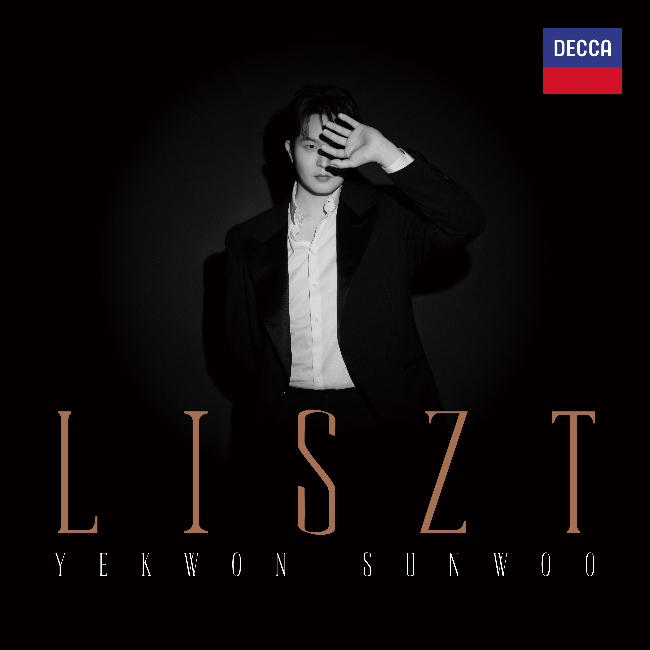
The album, recorded at Berlin's Jesus-Christus-Kirche — the church where Herbert von Karajan made many of his Berlin Philharmonic recordings — is built around a single idea: singing on the piano.
Sunwoo grouped the program into four moods, moving from reminiscence and meditation through intimate song transcriptions to seduction, and finally to operatic and demonic fantasies, before the Hungarian Rhapsody closes the album like a grand finale that contains everything that came before.
The same theme drives his upcoming recital, which pairs Liszt with Schubert — two composers Sunwoo readily acknowledged are sharply at odds with each other. The link, he said, is song.
Schubert is the unavoidable name when one thinks of the art song, and Liszt was among the composers who understood Schubert's lieder most deeply, transcribing them as colorful solo piano works.
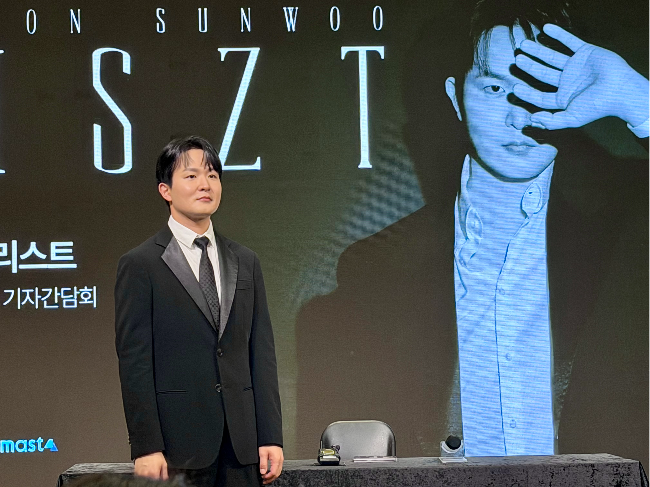
"If Schubert sings the pure inner emotions buried within a person," he said, "Liszt takes those same songs and unfolds them more dramatically, with a wider palette of colors."
It is precisely that contrast, he added, that makes placing the two side by side interesting: The common ground throws the differences into sharper relief, and each composer ends up standing out more vividly because of the other.
Pressed to describe what kind of sound makes Liszt feel right for him now, Sunwoo reached for visual metaphors. Rachmaninoff, he said, has an inner density, a weighted, almost foundational quality rooted in the Russian school. Liszt, by contrast, is lighter in mass — a sound that seems suspended in air.
"I tend to lift the sound a little when I play," he said. "What I'm reaching for is something like a soap bubble, or a clear glass marble, or a fine wine glass that might shatter at the lightest touch — that kind of transparency."
The recital tour opens May 15 in Iksan, North Jeolla Province, and travels through Daegu, Seongnam, Changwon, Ulsan and Yangsan before closing May 30 at the Seoul Arts Center Concert Hall.
As he looks toward his 40s, the pianist said he already has a number of composers in mind for the coming year — including a few choices, he added with a small smile, that audiences might not expect.

gypark@heraldcorp.com



![[Exclusive] Ateez to return in November](https://wimg.heraldcorp.com/news/cms/2026/09/02/news-p.v1.20260902.76162fb0ba55493aad1c076f240d0750_R.jpg?type=h&h=120)