
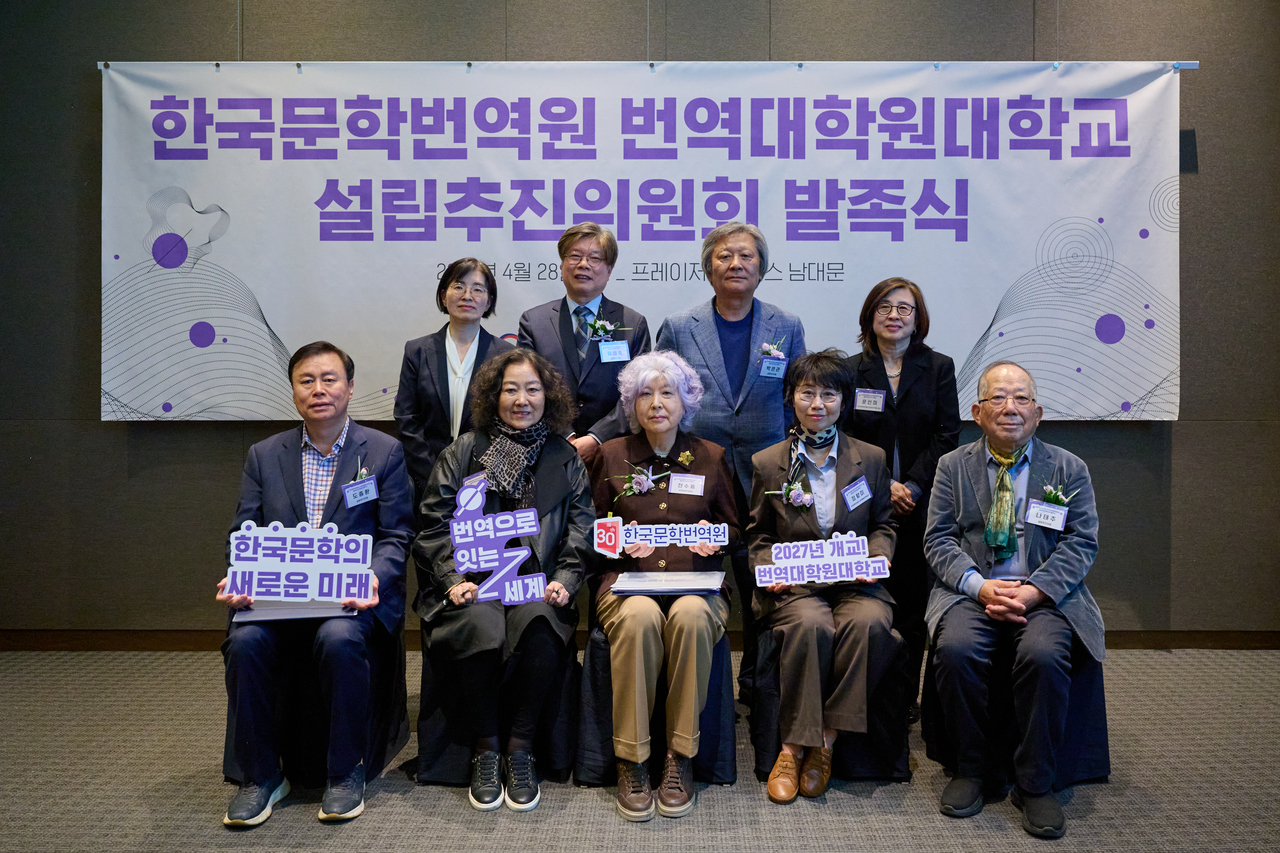
The Literature Translation Institute of Korea said Tuesday it is moving ahead with plans to establish a graduate school dedicated to training professional translators of Korean literature and cultural content. The LTI Korea Graduate School of Translation is set to open in 2027.
The government-funded institution specializing in literary translation training held a ceremony for its graduate school establishment committee on Tuesday in central Seoul, where it outlined its plans and vision for the new degree-granting school.
The nine-member founding committee includes poet and former culture minister Do Jong-hwan; poets Moon Chung-hee and Na Tae-joo; novelists Hwang Sok-yong and Eun Hee-kyung; literary critics Kwon Young-min and Yoo Sung-ho; and translator Darcy Paquet, known for translating the Oscar-winning film "Parasite." Kenny Park, also known as Park Eun-kwan, founder and CEO of Simone Accessory, has also joined.
Since 2008, LTI Korea has operated a Translation Academy, training about 89 translators a year and producing more than 1,600 graduates.
Because the program does not grant degrees, graduates face limits in building professional credentials, while international trainees encounter restrictions on work and career continuity. The non-degree status also makes it harder to attract top faculty and students and to collaborate with institutions at home and abroad, according to LTI Korea.
Chon Soo-young, president of LTI Korea, said the school would "provide advanced, forward-looking translation education suited to the digital era, with the aim of training high-level specialists capable of leading global exchanges in culture and the arts."
The graduate school will offer programs in seven languages — English, French, German, Spanish, Chinese, Japanese and Russian — with plans to introduce doctoral programs in the future. It is expected to admit 60 students annually, split evenly between Korean and international students.
Classes will be held at the institute’s building in Seoul’s Gangnam district. The institute plans to apply for government approval later this year, recruit its first cohort in the first half of 2027, and open in September.
Unlike existing graduate schools of interpretation and translation, which typically focus on translating into Korean and enroll primarily Korean students, the new graduate school will emphasize translation from Korean into foreign languages.
It will also incorporate both practical training — including collaboration with overseas publishers — and academic coursework, such as translation theory and digital and AI-related competencies.
“Graduates of the new school would grow not only into specialized translators but also into cultural planners and key figures in global networks promoting Korea,” said Jung Hyang-mi, deputy minister for cultural policy, who also pledged full government support for the school.
hwangdh@heraldcorp.com