South Korean government ministries are rolling out unusually large performance bonuses for civil servants following President Lee Jae Myung’s call to more aggressively reward results, a shift that is prompting debate over fairness and incentives within the bureaucracy.
According to government officials, the largest award so far — 30 million won ($22,000) — went to an 11-member task force at the Ministry of the Interior and Safety for its role in advancing the proposed administrative integration of South Jeolla Province and Gwangju. The ministry awarded a total of 80 million won to five teams comprising 29 officials in its first round of special performance bonuses this year.
Other ministries have followed with similar programs. The Fair Trade Commission granted 32 million won to 14 officials involved in uncovering a 3.2 trillion won sugar price-fixing scheme, while the Ministry of Trade, Industry and Energy distributed 68 million won across eight projects, including teams handling tariff negotiations with the United States.
The Environment Ministry — newly expanded to oversee climate and energy — also awarded bonuses of up to 20 million won per project to officials working on core policy initiatives such as greenhouse gas reduction targets and renewable energy expansion.
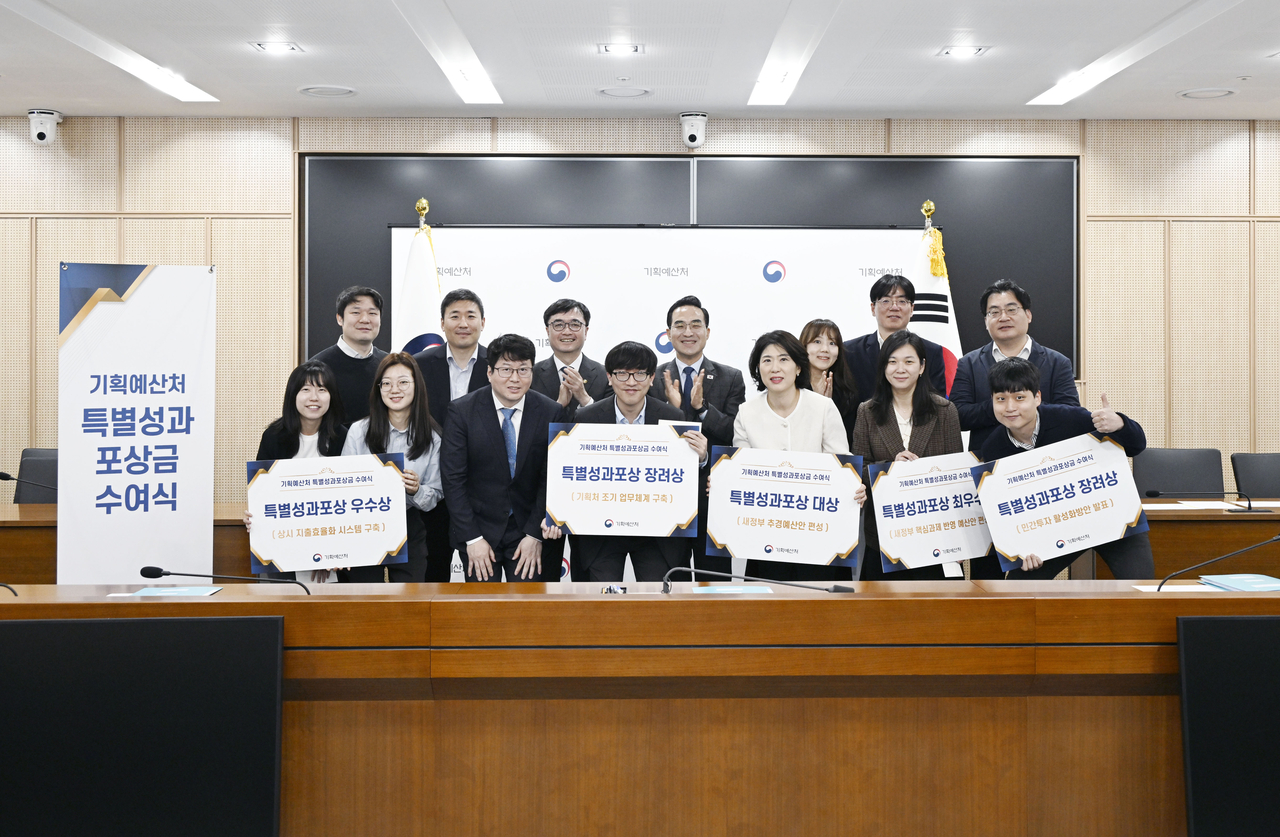
Even newly reorganized economic ministries are introducing similar incentives. The budget ministry has launched a performance-based bonus system with top awards of 10 million won, while the finance ministry is reviewing additional payouts, including smaller, recurring bonuses for junior staff.
The push is intended to encourage a more results-driven culture in a system often criticized for rigidity. President Lee, a former mayor of Seongnam and governor of Gyeonggi Province, has emphasized a stricter system of rewards and penalties in the public sector since taking office, calling for “special compensation” for exceptional dedication and performance.
But some officials say the scale and selectivity of the rewards risk deepening internal divisions.
“There is a growing sense of imbalance,” said one official working at Government Complex Sejong, who spoke on the condition of anonymity. “People question why certain contributions are singled out when many others are working under similar pressures.”
Others warn the approach could blur the line between performance evaluation and political alignment, particularly in a system where policy priorities can shift with each administration.
“Consistency in policy is already a challenge,” the official said. “It is not clear whether this kind of evaluation will strengthen the system or make it more dependent on short-term results.”
oskymoon@heraldcorp.com
This is a Herald Business article translated into English using AI and edited by The Korea Herald staff. For the original article, visit www.biz.heraldcorp.com -- Ed.
khnews@heraldcorp.com