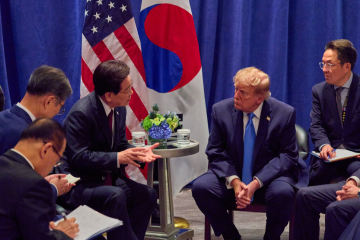
HANOI, Vietnam — South Korea and the United States are working to defuse tensions and find an off-ramp from the controversy over the unification minister’s remarks on North Korea’s uranium-enrichment facilities in Kusong, according to a senior official at Cheong Wa Dae.
Wi underlined that the allies were working to narrow “differences in understanding” over the source of Unification Minister Chung Dong-young’s remarks. The US side views them as a leak of intelligence shared between the allies, while South Korea maintains that the information was obtained from open sources.
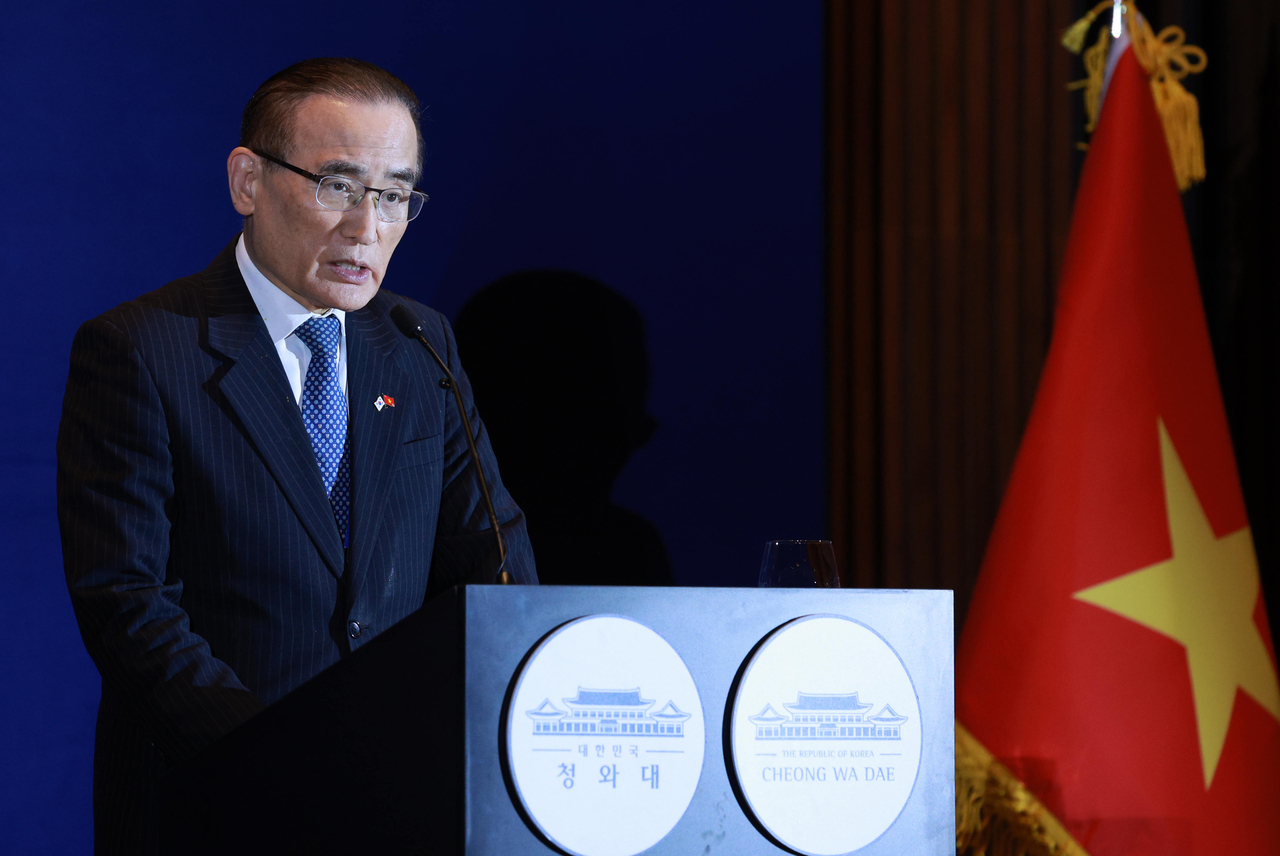
“Since this issue arose, there has been extensive communication between South Korea and the United States,” national security adviser Wi Sung-lac said Thursday during a press briefing in Hanoi. “Both sides are making efforts to find a kind of exit.”
The controversy was triggered after Chung said that North Korea operates uranium-enrichment facilities in Yongbyon, Kusong and Kangson during a March 6 session of the National Assembly’s Foreign Affairs and Unification Committee.
Chung’s remarks marked the first time a senior South Korean official had publicly identified Kusong alongside the North’s better-known enrichment sites.
Local media reported in mid-April that Washington had protested what it viewed as a leak of classified information provided by the US and had begun restricting some North Korea-related intelligence previously shared with Seoul.
Seoul denies US intel leak
“There has been extensive communication with the United States on this issue,” Wi.
Wi explained Chung himself had directly engaged with US counterparts, while the Foreign Ministry in Seoul, diplomatic channels and Wi himself had also been conveying Seoul’s position to Washington.
“It may take some time, but we believe the current situation arising from the Kusong remarks should be properly resolved through communication,” Wi said. “We believe we should return to a normal state of cooperation (between the allies) as soon as possible, and we are consulting with the US in that direction.”
Wi said the South Korean government’s position is that Unification Minister Chung Dong-young did not disclose intelligence received through information-sharing with the US.
“Our position is that what Minister Chung said was not a leak of information obtained through intelligence exchanges with the US,” Wi said.
Chung has argued that Kusong had already been publicly mentioned in a 2016 paper released by the Institute for Science and International Security, and that numerous media outlets, including KBS, reported it at the time.
Speaking at the National Assembly in March, Chung said, “The reason I described it as ongoing is because IAEA Director General Grossi referred in his report to uranium-enrichment facilities in Yongbyon, Kusong and Kangson.”
IAEA Director General Rafael Mariano Grossi said on March 2 that “the ongoing operation of enrichment facilities at Kangson and Yongbyon is of serious concern” during a Board of Governors meeting held at the agency’s headquarters in Vienna.
Perception gap, not rift
Wi also dismissed suggestions that the episode reflected deeper strains in the alliance.
“It is an excessive interpretation to say that some accumulated abnormal current in the relationship caused the current situation,” he said.
Wi said it appeared to be “a slight difference in perception” between Seoul and Washington.
According to Wi, Chung maintains that his remarks had nothing to do with intelligence provided by the US and that he had never been briefed on such information, insisting he merely referred to material obtained from open sources. Washington, by contrast, appears to believe that the information it had shared was disclosed, Wi said.
“We are trying to clarify the situation, sort out the way forward and resolve the matter in a short period of time,” Wi said. “It is a matter of slight differences in perception and understanding. What is important now is to consult, coordinate and find a way forward,” Wi added.
However, Wi warned against allowing the issue to become overly politicized at home, as tensions flared at the National Assembly with the main opposition People Power Party calling for Chung’s resignation.
“I do not believe excessive domestic controversy helps in finding that path,” Wi said. “If this issue becomes the subject of excessive controversy domestically and turns into a political flash point, it could create obstacles to resolving the situation quickly and returning to the previous state.”
Wi underlined that the South Korean and US governments were making efforts to work through the issue, saying, “I think it would be best to wait for those efforts to play out.”
dagyumji@heraldcorp.com