Conspiracy theories surround mysterious death of Kim Hyung-wook, intelligence chief-turned-whistleblower under Park Chung-hee dictatorship
"His Excellency doesn't allow his second-in-command to live."
In the 2020 movie "The Man Standing Next," the character Park Yong-gak, based on former Korean Central Intelligence Agency chief Kim Hyung-wook, utters the ominous line about then-President Park Chung-hee.
Kim, once at the pinnacle of power, went missing after last being seen at a hotel casino in Paris on Oct. 7, 1979.
The Park administration remained silent on what happened to the man who headed the KCIA for six years, longer than anyone else in history, and the news was overshadowed by Park's assassination later that month and subsequent military coup in December 1979, which led to yet another military dictatorship.
Kim was officially declared dead in 1984, and a government investigation in 2005 concluded that he was assassinated on the orders of his successor Kim Jae-gyu, another close aide of Park who ended up assassinating the dictator. But Kim's family and many members of the public have expressed doubts due to apparent holes in the state probe.
Well over four decades after Kim's disappearance halfway across the globe, what exactly happened in Paris remains a mystery. With both Kim Jae-gyu and Park Chung-hee dead shortly afterwards, no one exists to give a first-hand account of the details behind the supposed hit on Kim Hyung-wook, who had fallen out of favor with the strongman.
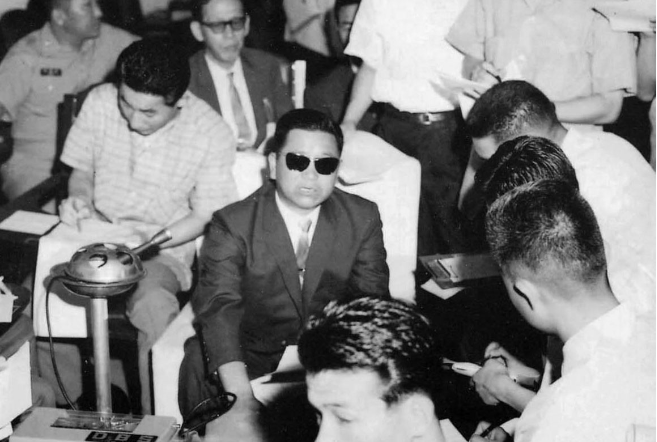
Longest-serving spy chief in history
Born in 1925 to a poor farming family, Kim joined the military after the country's liberation in 1945 and fought in the 1950-53 Korean War. As a lieutenant colonel in the Army, he was one of the military officials who participated in Park's 1961 military coup.
He was not known for his wits, but for being hard-nosed and simple-minded. Kim finished his military training at the bottom of his class, and there was a rumor that fellow officers in the 1961 coup said, "Why would we work with an idiot like that?"
His nicknames included "Boar in Namsan," a reference to both his chubby figure and the infamous domestic intelligence division of the KCIA's Namsan headquarters. Fiercely loyal to the dictator Park and notoriously hot-headed, Kim's spy agency spearheaded the fight against communist North Korea, and the oppression of dissidents in the South who resisted Park’s regime.
At that time, the KCIA chief held a deputy prime minister-level post, unlike today’s National Intelligence Service, which is ministerial-level — a lower rank. More importantly, heading anti-communism investigations meant it had the authority to spy on and interrogate just about anyone in the country, a power that was often abused during Park’s iron-fisted rule.
Kim and the KCIA were infamous even in the 1960s and 1970s, as the agency often manipulated facts to repress Park's political rivals and pro-democracy movements. Park's biggest rival, eventual President Kim Dae-jung, was among those tortured and wrongly accused of being a communist. A professor and an opposition lawmaker were executed as North Korean spies in 1970, based on what the Supreme Court in 2015 confirmed to be false accusations.
Kim Hyung-wook used coercion and force — literally, as there are multiple accounts of him actually punching lawmakers and other prominent figures to get his way — in support of the Constitutional amendment in 1969 that allowed Park to run for a third presidential term, which Park followed with another amendment in 1972 that paved the way for permanent dictatorship.
In October 1972, for reasons not entirely clear, Kim fell out of Park's inner circle.
Lee Man-sup, a lawmaker with Park's Democratic Republican Party at the time, wrote in his memoir that the ruling party proposed Kim's removal as a condition for the Constitutional amendment that would permit Park's third term. This was in response to negative public sentiment toward the administration due to Kim's torture of the president's rivals in the opposition parties.
"I gave my all and was loyal to the country and the president. My conscience is clear, even if some would brand me a traitor," Kim said in an Oct. 25, 1969, interview with Kyunghyang Shinmun, after stepping down as KCIA chief.
Once among the most trusted lieutenants in Park's military government, Kim was out of the loop. He briefly served as a National Assembly member, but never regained Park's trust.
He started receiving threatening phone calls from the moment he resigned from the KCIA, and was no longer under the protection of the South Korean dictator.
In exile, Kim speaks against his former boss
Kim left Korea for Taiwan in April 1973, before defecting to the United States. In 1977, he started to speak publicly about crimes against human rights and illegal lobbying in the US conducted by the Park administration.
At the center of the mayhem was the political scandal commonly called "Koreagate" in 1976, referring to the allegation that the KCIA funneled bribes and favors through South Korean businessman Park Tong-sun, in exchange for influence in American politics. Kim attended a 1977 hearing in the US Congress and testified to then-President Park's involvement, admitting that he himself was also involved in the early stages of the supposed bid to influence US policy.
"I acknowledge that I had extremely extensive powers at my disposal — more power than you can imagine — covering virtually every aspect of my country. My power extended into political, economic, cultural, religious, and even foreign propaganda activities," he was quoted in a June 23, 1977, New York Times article as saying in his testimony.
In a special statement made on July 11, 1973, he said that he "knows more about (President) Park than you can imagine," and vowed to reveal the secrets to the public if the Korean leader continued to attack him.
Park was reportedly infuriated by Kim's "betrayal," and sent his agents to the US to persuade him to stay quiet. One of Kim Jae-gyu's first missions as the new chief of KCIA was to persuade his predecessor to come back to South Korea, which commenced with a letter sent in January 1977.
But the effort apparently failed as Kim Hyung-wook continued to talk to the press and attend the US Congressional hearings.
Furthermore, the former spy chief was writing a memoir that would reveal extensive details about the Park administration's dark side. Officials of the KCIA continued to pressure Kim, and reportedly offered handsome financial compensation in exchange for his silence.
Yoon Il-kyun, a deputy of Kim Jae-gyu, said he was ordered by President Park himself to visit Kim Hyung-wook in New York and offer $500,000 in exchange for the memoir, but said Kim Hyung-wook did not honor their agreement and kept talking.
This “betrayal” left Yoon humiliated, he said. Testimonies suggest that Kim eventually agreed to a deal with the South Korean government, and was told to go to Paris.
What happened between his arrival in Paris on Oct. 1, 1979, and his disappearance six days later, is unclear.
Kim goes missing in France
On Oct. 12, 1979, a Paris-based hotel called the police when its guest Kim Hyung-wook failed to check out as scheduled. Four days later, the Korean-language daily Chosun Ilbo reported that Kim had been missing for a week during his trip in France.
The Paris police in January closed the case due to lack of evidence, according to a Jan. 25, 1980, report by JoongAng Ilbo. They cited difficulties in further investigation, saying Kim was simply passing through France and did not conduct any prominent activities in the country.
A new probe was launched by South Korea's National Intelligence Service in 2005, 26 years after his disappearance. On May 26 that year, the spy agency announced the results of their inquiry, based on the testimonies of 33 people it thought may have been involved. This is what they concluded had happened.
After Kim's attendance at the US Congressional hearings in 1977, Park Chung-hee ordered Yoon Il-kyun in 1978 to negotiate with Kim to stop him publishing the memoir. But part of the memoir was published in Japan in April 1979.
The Park administration felt threatened by Kim's actions, and the president felt personally betrayed by him, especially after discovering that Kim had amassed substantial wealth.
"It is certain that Kim's disappearance was conducted under orders from then-KCIA chief Kim Jae-gyu, and was led by Lee Sang-yull," the NIS report said. Lee was then the top KCIA delegate to the South Korean Embassy in France.
It is believed that Lee, two agents of the KCIA, and six trainee agents who were in France at the time, were related to the incident in some way. Lee did not deny his involvement but strongly refused to testify on the details, while one of the trainee agents with the alias Shin Hyeon-jin testified that Lee said he was given orders by the KCIA chief Kim Jae-gyu himself.
The agents testified that Lee returned to South Korea in secret to report to the chief, before and after the incident. It is believed that he submitted the report in person on Oct. 18, before boarding a plane back to France.
As Shin reported to Kim Jae-gyu, Kim said, "Well done. What kind of organization would we be if we just left a guy like that alone?" When Shin told him they lost the pistol used in the attack, Kim said it was all right because the gun was made in the Soviet Union, which meant North Korea would be suspected in the assassination.
Based on this, the NIS report assumed that Kim Jae-gyu ordered the hit on his predecessor sometime before September 1979, and Lee ordered his subordinates to carry out the assassination. It is believed that the killing occurred on Oct. 7, in the outskirts of Paris.
The related agents received financial awards and other benefits from the KCIA.
It is unclear if the orders came directly from President Park, although the report said it cannot be ruled out. Park at least gave orders to stop Kim Hyung-wook from attending the US Congressional hearings, and to stop his memoir from being published.
Testimonies by all those involved consistently indicate that Kim Jae-gyu ordered the hit on the former spy chief, meaning Kim Hyung-wook was assassinated by the agency he had headed.
Speculation on the details
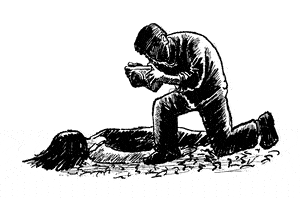
One thing on which the testimonies were unclear was how the dead body was handled. It was supposedly covered up by fallen leaves in a spot where the murder weapon was also lost.
Shin said that he did not remember where he discarded the body, while another trainee agent with the alias Lee Man-su said he was directly involved with the incident but refused to speak about the specifics. He said he paid two acquaintances from a third country $100,000 to carry out the assassination, and it was these individuals who struck Kim Hyung-wook unconscious and killed him.
He said the pair were the ones that left the body to be buried under leaves and lost the pistol.
Kim's family refused to believe the findings, taking issue with the claim that the agents lost the gun and just left the body. His daughter-in-law said that she was told by her husband — Kim's son — that the former KCIA head was taken to South Korea and killed in Seoul.
This is linked to a theory that Kim was not even killed in France. A Korean-language news outlet in New York reported in May 2005 that the US State Department's Weekly Status Report-Korea indicated that Kim left Paris on Oct. 9, 1979, and went to Saudi Arabia. This would mean he was alive two days after he was supposed to have been shot dead.
But an NIS official involved with the 2005 investigation said a month later that this was an error by the French investigators, who confused Kim with someone with the same name who left the country on that day. The supposedly mistaken record was reported by the Japanese embassy to the Tokyo government, which in turn alerted US officials. The NIS official said the romanized spelling of the person's name was different from Kim Hyung-wook, and the French investigators later retracted their initial claim.
Lawyers for Kim Jae-gyu, who assassinated Park Chung-hee on Oct. 26, 1979, denied that the then-KCIA chief was involved at all in Kim Hyung-wook's death. Kang Sin-Ok, who defended Kim Jae-gyu in his trial for Park's killing, said Kim always told him that he knew nothing about the incident.
Another lawyer for Kim Jae-gyu also said that Kim told him the assassination order came directly from the presidential office, indicating that the then-head of the presidential security service, Cha Ji-chul, gave the go-ahead. Kim supposedly told his lawyers that his intent had always been to persuade Kim Hyung-wook with money, not to kill him.
There is also a conspiracy theory around why Kim's body was never found. A person claiming to have been a former agent of the KCIA claimed in 2005 that he met Park directly and carried out the assassination order without the input of the KCIA, in an interview with the magazine Sisa Journal.
He claimed that he anesthetized Kim and put him in a grinder used to make chicken feed, while Kim was still unconscious but alive.
Politician Kim Gyung-jae quoted the same person in his book "The Last 20 Days of the Park Chung-hee Era," in which he said the agent’s code name was "Cheonbosan." Cheonbosan was supposedly a former North Korean spy who defected and spied for South Korea, and he worked under the order of Park’s head bodyguard Cha to take out Kim.
Local broadcasters MBC and SBS investigated the chicken feed theory and reached conflicting conclusions, with the former saying it was not possible and the latter saying it was.
Other theories include one saying that Kim was taken to Seoul, where he begged Park for mercy and was killed on his order. Another claim is that he was executed by Park himself, who supposedly put a bullet through Kim's head.
The movie "The Man Standing Next" depicted the assassination as being carried out by KCIA agents working under Kim Jae-gyu's orders, but added the aforementioned "chicken feed grinder" theory to explain how they got rid of the body. The highly-acclaimed movie describes the political tension surrounding the former and incumbent chiefs of the KCIA and dictator Park, but some of the personal relationship among the major figures in the incident are fictional — such as the two Kims being close friends.
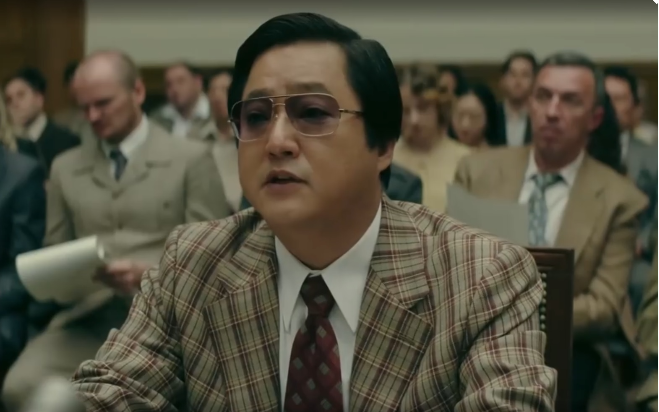
Today, there's almost no one left who knows exactly what happened to Kim Hyung-wook. Once considered the second most powerful man in South Korea, his life and legacy are entangled in infamy, just as his downfall and disappearance will remain linked with mystery.