
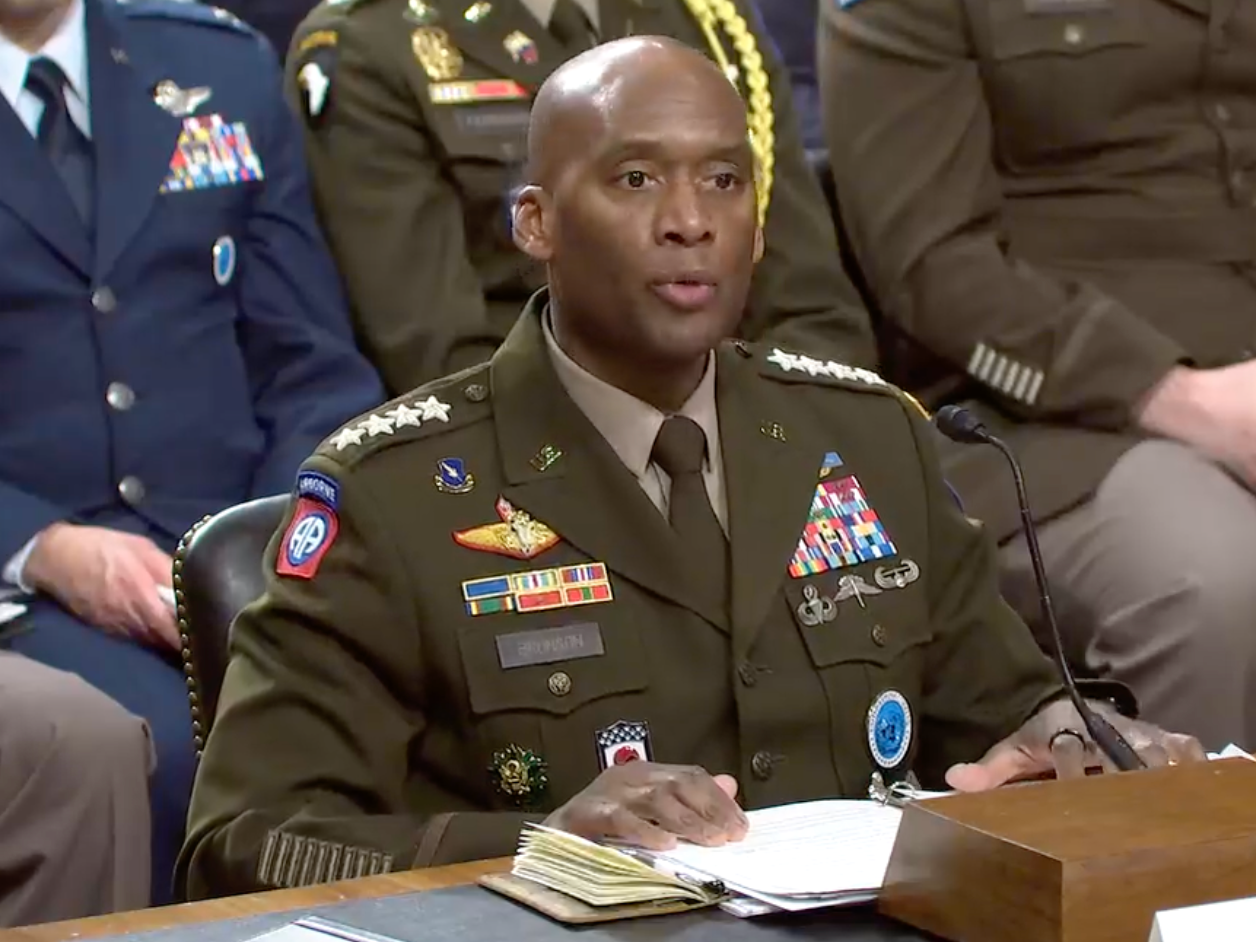
US Forces Korea Commander Gen. Xavier Brunson has confirmed that the Terminal High Altitude Area Defense system remains deployed on the Korean Peninsula, dismissing speculation that it had been moved to the Middle East.
“We've not moved any THAAD systems. So THAAD remains on the (Korean) peninsula,” Brunson said during a Senate Armed Services Committee hearing held in Washington on Tuesday.
He added that while the system itself has not been relocated, related munitions are being prepared for transfer.
“Currently, we are sending munitions forward, and those are sitting right now waiting to move,” he said, in an apparent reference to interceptor missiles.
The remarks mark his first public response to reports from March that the Pentagon was moving parts of a THAAD system from South Korea to the Middle East, raising concerns that such a move could weaken deterrence against North Korea.
He acknowledged that some equipment movements may have contributed to the confusion, noting that radar components had previously been repositioned in preparation for a US operation targeting Iranian nuclear facilities. However, he stressed that the THAAD system remains in place.
THAAD, first deployed in Seongju, North Gyeongsang Province, in 2017, plays a critical role in South Korea’s layered missile defense architecture, providing upper-tier interception of incoming ballistic missiles.
“South Korea’s indigenous systems, such as Patriot and Cheongung-II, are mainly focused on lower and mid-altitude interception, making THAAD an essential upper-tier defense asset against North Korea’s advancing missile capabilities,” said Yoo In-seok, a professor of military studies at Yeungnam University.
Brunson also underscored that the transfer of wartime operational control from the United States to South Korea must remain conditions-based, cautioning against political pressure to accelerate the process. OPCON has remained under US control since the 1950-53 Korean War.
He said it was important to ensure that “political expediency does not outpace the conditions” for the transition. The Lee Jae Myung administration seeks to complete the OPCON transition within its five-year term ending in 2030.
During the same hearing, Brunson also highlighted a broader shift in US Forces Korea’s posture, stressing a focus on strengthening capabilities rather than maintaining troop numbers, as part of efforts to address evolving security challenges on the Korean Peninsula and beyond.
Brunson, who commands 28,500 US troops in South Korea, is set to testify before the House Armed Services Committee on Wednesday.
flylikekite@heraldcorp.com