
Foreign arrivals top 5 million in first quarter, with regional airport entries up nearly 50%
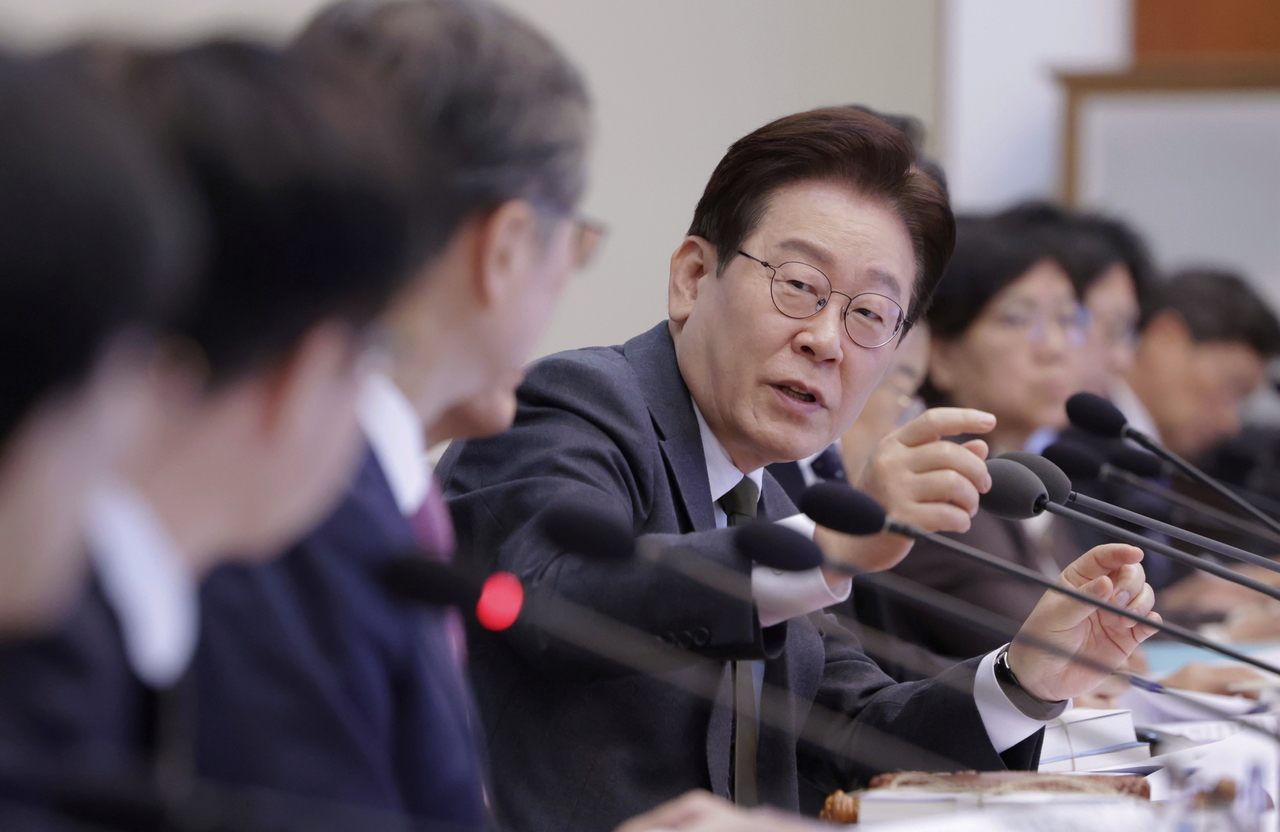
President Lee Jae Myung on Tuesday proposed a nationwide campaign to address tourism malpractices and revitalize regional tourism through coordinated local efforts, invoking the spirit of the New Village Movement launched in the 1970s.
“The biggest obstacle to regional or domestic tourism is, in a way, our everyday culture,” Lee said during a weekly Cabinet meeting at Cheong Wa Dae in Seoul.
“Overcharging, looking down on foreigners — that has improved a lot these days, but overcharging still seems to remain quite common. Unfriendliness also seems to have declined a lot.”
Lee suggested to Culture, Sports and Tourism Minister Chae Hwi-young that the government consider carrying out its own “Saemaul Undong.” Meaning the New Village Movement, Saemaul Undong was a nationwide, state-led campaign launched in 1970 under then-President Park Chung-hee and built on the principles of diligence, self-help and cooperation.
“But there may also be issues such as a lack of systematic tourism resources. So how about trying something like a tourism Saemaul movement?” Lee said.
“For example, in a given region, you could bring together people involved in attracting tourists — restaurant owners, operators of tourism-related facilities or self-employed business owners.”
Lee added that related local administrative agencies could also provide support to that end.
Interior and Safety Minister Yun Ho-jung pointed out that while public-private tourism councils have been formed at the provincial level, few exist at the city or county level.
“At the city and county level, there are hardly any such bodies. It would be good to create public-private tourism councils there and carry out the kind of Saemaul movement the President mentioned,” Yoon said.
Lee, in response, reiterated the idea, saying, “Please give it some thought.”
Lee underscored the importance of boosting the tourism industry as a key means of advancing his administration’s flagship goal of balanced regional growth and reducing overconcentration in the greater Seoul area.
“The tourism industry can have an enormous effect on revitalizing regional economies,” Lee said.
Speaking at the meeting, Chae said more than 5 million foreign tourists visited South Korea in the first quarter of this year, marking a 23 percent increase from a year earlier.
Chae noted that the full-year growth rate last year was around 8 to 9 percent, indicating a much sharper increase this year.
“What is particularly notable is that visits to regional areas are rising significantly,” Chae said. “The number of foreign tourists entering through regional airports in the first quarter jumped by nearly 50 percent from a year earlier.”
Chae furthermore explained that “foreigners’ rail travel also increased 46 percent from last year."
“This shows a growing trend of foreign visitors entering through regional airports and, even when arriving in the Seoul metropolitan area, traveling by rail to other parts of the country,” he added.
Regarding the trend, Lee instructed the Ministry of Land, Infrastructure and Transport and the Ministry of Culture, Sports and Tourism to expand regular inbound flights to regional airports.
Chae stressed that developing stronger regional tourism content and products should come first. “Once those offerings are promoted and begin attracting more visitors, regular routes will naturally follow,” he said.
Chae explained that the "recent increase in regional tourism appears to reflect growing demand among foreign visitors for more authentic, firsthand experiences of K-culture."
“To sustain this trend, we are developing a range of tourism products and consulting with the Ministry of Land, Infrastructure and Transport on ways to expand such routes.”
Vice Minister for Transport Hong Jee-sun said the ministry “will take a closer look at which routes are needed and proceed with air service negotiations with foreign counterparts to secure the necessary traffic rights.”
dagyumji@heraldcorp.com
![[World Class] Dongguk looks to Buddhism, Hallyu and AI to shape global identity](https://wimg.heraldcorp.com/news/cms/2026/10/25/news-p.v1.20261001.4f5f085cfb5d48e7a6af0848b0d5089c_R.jpg?type=h&h=120)