
President Lee Jae Myung on Wednesday ordered a review of additional measures to ease pressure on South Korea’s freight and logistics sector, hit by soaring fuel costs and falling cargo volumes amid the Middle East oil crisis.
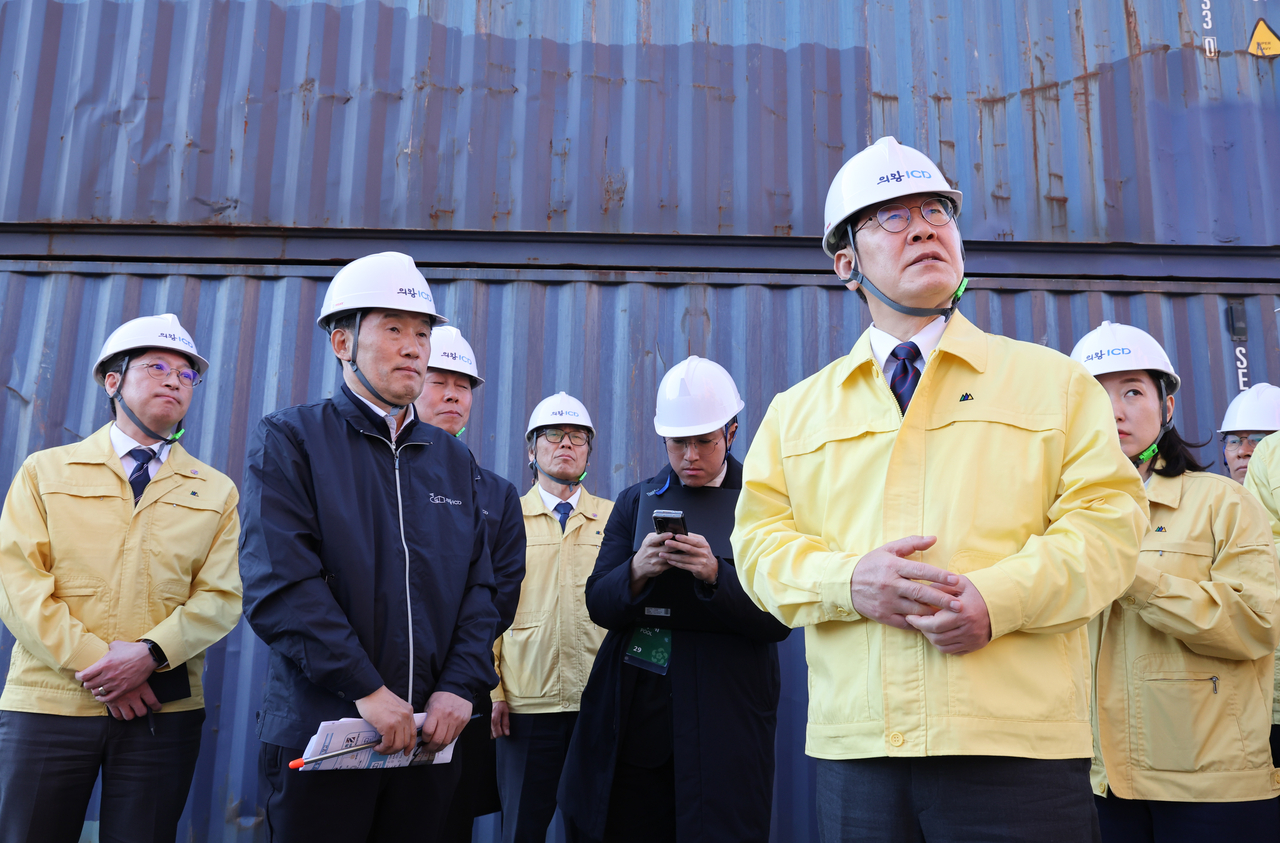
After hearing firsthand about the difficulties faced by transport and logistics workers at the Uiwang Inland Container Depot in Gyeonggi Province, Lee instructed officials to promptly review concerns raised at the site, Cheong Wa Dae spokesperson Jeon Eun-su said in a statement.
Lee ordered the Ministry of Land, Infrastructure and Transport and the Ministry of SMEs and Startups to consult on and improve loan support schemes for truck drivers in response to a truck driver’s concern that access to small business loans is restricted when the value of a vehicle exceeds 300 million won ($203,000).
Lee instructed the Land Ministry to closely examine transport costs by cargo type as well as overseas cases regarding calls to expand the scope of the safe freight rate system. The system sets minimum freight rates to help prevent overwork and unsafe driving.
In his opening remarks, Lee acknowledged the growing strain on the transport and logistics sectors.
“The Middle East war has driven up oil prices significantly, and as a result, the transportation sector — especially freight transport — appears to be facing serious difficulties. You’re all having a tough time, right? You don’t look well — is that the reason?” Lee said to participants.
“Not only companies, but also truck drivers who are directly engaged in transport must be facing considerable hardship.”
Lee explained that “the government has introduced measures such as a fuel price cap and other steps,” acknowledging that the difficulties on the ground may not have been fully resolved.
“If you have any suggestions, I’d like to hear them and review together whether there are additional measures we can take,” Lee said.
During the meeting, Lee also responded cautiously after a freight business representative voiced hope that the US-Iran agreement on a two-week ceasefire could pave the way for an end to the war. Lee said: “There’s no knowing what will happen.”
Before the meeting, Vice Minister of Transport Hong Jee-sun said the government was rolling out a range of support measures.
Hong said the government had raised the payout rate for fuel-cost-linked subsidies from 50 percent to 70 percent and was pursuing reforms to allow support to continue even when diesel prices exceed 1,961 won per liter.
Hong added that late-night tolls on expressways in the Daejeon region would be fully waived from April 16, and that freight truck installment payments would be deferred for three months.
“As the President said, even in a worst-case scenario, the government will ensure that logistics do not come to a halt by giving priority to the supply of fuel and diesel exhaust fluid, while discussing supply measures with relevant ministries,” Hong said. “We will actively support you so that you can get through the crisis without major concern.”
After the meeting, Lee toured the Uiwang ICD logistics complex, closely inspecting facility operations and changes in cargo volumes stemming from rising fuel costs.
The on-site visit followed Lee’s March 26 trip to the state-run Korea National Oil Corporation’s Seosan storage facility, where he reviewed strategic oil reserves and met with petrochemical industry leaders to assess supply conditions and contingency plans.
dagyumji@heraldcorp.com