Lee Jong-gyu, reelected for a third term, says passing the industry promotion legislation and building public musical-dedicated theaters are critical to the industry's sustained growth
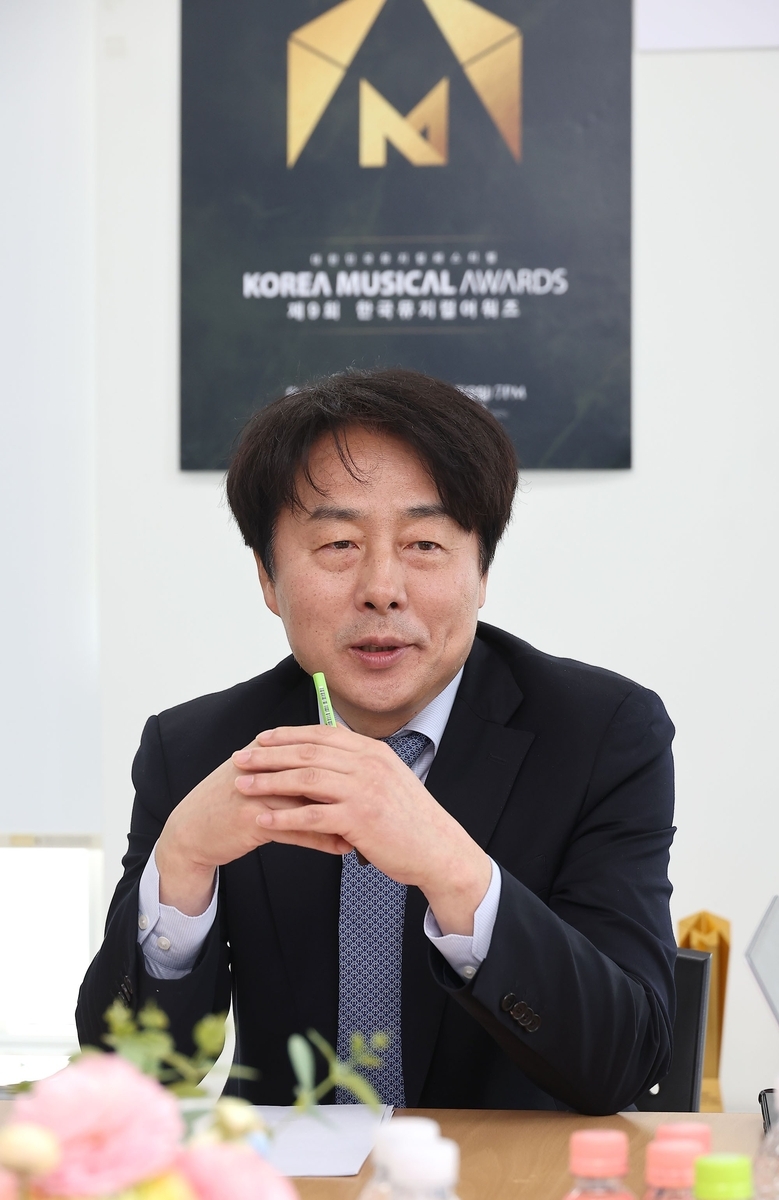
Lee Jong-gyu, who was recently reelected to a third term as chairman of the Korea Musical Theater Association, describes the Korean musical industry as being at a critical juncture.
While Korean musical revenue last year reached approximately 498.8 billion won ($330 billion) — just shy of the 500 billion won milestone — that success masks structural problems demanding immediate policy support.
“Korean musicals are growing dynamically, driven by the talent and effort of our private producers, creators and performers,” Lee said in a recent interview. “But that growth now demands matching policy support: legal and institutional improvements, content funding and infrastructure expansion."
Lee, who previously served as the CEO of Interpark Theater and New Contents Company, said his main motivation for seeking reelection was his desire to secure passage of the Musical Industry Promotion Act, which was submitted to the National Assembly last year.
The legislation’s fundamental premise is to make the development of the musical industry a formal responsibility of the state. The bill addresses nearly every industry request, from talent development and copyright protection to export support, and crucially, it would create a dedicated industry agency and a Musical Industry Promotion Committee.
Lee notes that while components of the art form — music, acting and choreography — already qualify for public support, consolidating that support under a single law is essential for broader institutional reform.
The urgency for policy intervention stems from a core tension within the market: Despite record revenue, per-production profitability is declining. Last year, the number of productions grew by roughly 14 percent year-over-year, while total revenue grew by only 7 percent.
This is due to interconnected reasons: rising production costs and resource scarcity. Competition is intense for venue bookings, star casting and technical crew, which forces costs up.
Producers are not raising prices arbitrarily, Lee explained, adding that "when they run the numbers, the math leaves no choice." While he acknowledges that ticket prices are a burden, particularly for younger audiences, he argues they have not risen disproportionately compared to other goods and services or to ticket prices abroad.
To ease the financial pressure, Lee is pushing for two key policy changes — production cost tax credits and public theaters dedicated to musicals.
Lee argues that musicals should benefit from provisions similar to those already granted to the film and sports industries under the Special Tax Treatment Control Act.
"A public venue that prioritizes original Korean musicals would meaningfully reduce staging costs, which in turn feed into ticket prices," Lee added.
The industry did hit a major milestone last year: For the first time in 30 years, original Korean musicals outpaced licensed productions in revenue based on a preliminary date, Lee noted. Original productions generated 229.6 billion won ($152 million), compared with 222.1 billion won for licensed shows.
“The creator development pipeline has been enormously productive, but it feeds almost exclusively into small-theater work,” Lee said. “The infrastructure and financing simply do not exist to move a new original work into a 1,000-plus seat theater."
This lack of staging space means young creators often face 18-month waiting periods for available venues, causing some to leave the industry. This structural problem, according to Lee, makes the push for public, dedicated theaters essential.
Looking ahead, Lee hopes to see the Promotional Act passed and the association evolve from a "loose policy coalition" into a coordinating body for specialized groups such as producers and performers.
Ultimately, he envisions Korean musicals becoming a leading force in the global IP market and a key pillar of the national economy. By producing large-scale original works, Lee aims to "reverse the situation" from a consumer of foreign culture to a global trendsetter that generates high added value through creative exports.
"There is no reason K-pop should be the only industry to demonstrate this," he noted. "That is the future I ultimately desire."
gypark@heraldcorp.com