
Detailed broadcast of drug types thought to be used in 'Gangbuk motel murder' sparks debate
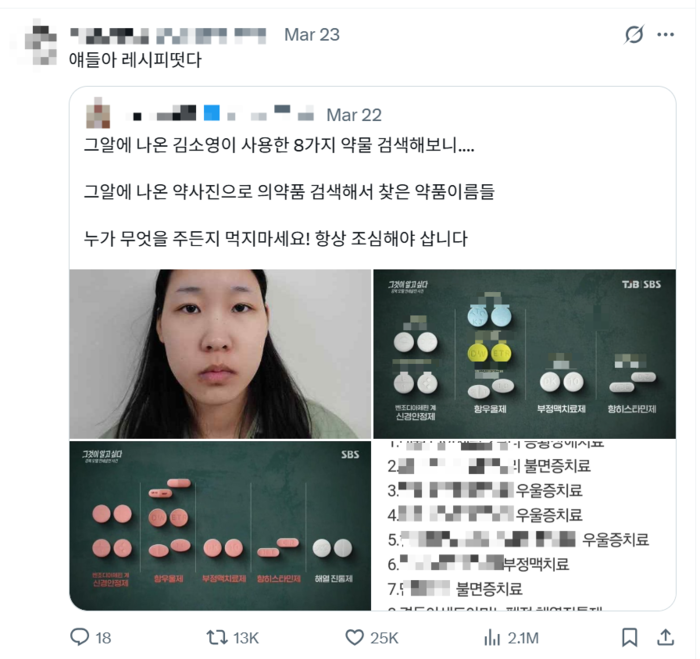
A Korean investigative program that examined how the suspect in a high profile murder case may have carried out her crimes, including details on drug types and dosages, has set off a debate over how detailed crime reports should be.
Critics say the information could be used to commit similar crimes,
Kim So-young is accused of killing two men and injuring four more with drug-laced drinks at motels in Seoul in what became known as the “Gangbuk motel murder case.” She is alleged to have used a combination of drugs to incapacitate her victims, resulting in multiple deaths and injuries.
After the broadcast of SBS' "Unanswered Questions," online attention turned to the specific drugs involved, as detailed information spread and morphed into what users have dubbed a “murder recipe.”
Social media users compiled lists of the drugs mentioned, sometimes adding brand names, dosages, and even purchasing methods. One post reportedly reached millions of views.
The author of the post insisted that it was intended as a warning.
“Do not consume anything given by others. You have to stay cautious to survive,” the user wrote.
Despite this stated intent, critics argued that the information could be misused for criminal purposes.
Some reposts included troubling captions such as, “Guys, the recipe is out,” while comments like “I’ll share this” and “I’ll learn this well” suggested that the content was not always being received as intended.
Concern over accessibility of substances in 'murder recipe'
The controversy has been further intensified by the accessibility of the drugs concerned. Several of them are either available over the counter or can be obtained on prescription with relative ease.
Reports have also pointed to overseas online platforms where psychiatric medications can be purchased without strict identity verification.
A total of eight drugs were identified, including sleep aids and common painkillers, with two available without prescription.
Several are classified as psychotropic substances, though it is reportedly not particularly difficult to obtain presciptions for them.
A practicing pharmacist surnamed Chung noted the structural limitations of the system, in which medical records are scattered across different institutions.
“While a single individual may not be able to obtain multiple psychotropic drugs from one doctor at the same time, it is still possible to acquire them through multiple prescriptions from different providers,” Chung said.
“From the perspective of those dispensing the medication, it is virtually impossible to determine criminal intent, which makes prevention extremely difficult.”
Fears of copycat crimes
Lee Yoon-ho, professor of police administration department at Dongguk University pointed to the unregulated nature of online platforms as a key concern.
“On social media, there is effectively no real-time oversight,” he said. “Once this kind of information spreads, there is nothing to stop someone from attempting to replicate it. We cannot rule out the emergence of new forms of crime based on this.”
He also questioned whether the level of detail shown in the broadcast was necessary.
“It inevitably becomes material for those seeking attention or notoriety,” he added. “That is why the degree of exposure matters.”
The production team of Unanswered Questions has defended its approach. In a statement, they emphasized that the intent was not to provide a guide to making the drugs, but to illustrate how ordinary medications can become lethal when abused.
“A single pill may be a treatment, but dozens combined with alcohol can become a poison,” the producers explained. “Our goal was to reveal that even commonly prescribed drugs can turn into deadly weapons when misused.”
They also noted that certain sensitive details had been deliberately obscured to reduce the risk of misuse.
Still, critics argue that even partial disclosure can be enough in the digital age, where audiences actively fill in the gaps.
Forensic psychology experts have raised additional concerns about the societal impact of such reporting. Lee Soo-jung, professor of criminal psychology at Kyonggi University, warned that the combination of detailed methods and accessible supply chains could have far-reaching consequences.
“When lethal methods are publicly described and simultaneously easy to obtain, the risk extends beyond crime to self-harm and other social harms,” she said. “This is not just about one case, it is about how information interacts with vulnerability.”
Media experts warn that the way crime is reported can unintentionally amplify risk.
“Journalists have a duty to inform the public, but that responsibility comes with boundaries,” said Sung Dong-kyu, a media professor at Chungang University. “Broadcasting operational details, such as exact drug types, dosages, or methods, crosses into instruction. It may inadvertently provide a road map for someone to imitate the crime.”
In cases of suicide, reporting guidelines advise against giving details of the methods used — such as the drugs involved — to prevent further deaths.
And research shows that some killers are motivated by a desire for attention, even notoriety.
“Online platforms reward shocking content. When investigative programs show graphic or detailed procedures, those elements are the ones most likely to be clipped, shared, and stripped of context. That’s how ‘recipes’ get spread,” Sung explained.
Even when the intent is to raise awareness, experts say the framing matters. “Focus should be on consequences, the investigative process, and the social impact of the crime, rather than step-by-step methods. That is what preserves public knowledge without fueling imitation,” Sung added.
Recognizing the risk, the Korea Communications Standards Commission announced it would take strict action against illegal posts.
“Materials distributed online that violate relevant laws are classified as illegal content and are subject to review. Content intended to facilitate crimes or assist in their execution will be evaluated in strict cooperation with the Ministry of Food and Drug Safety, the National Police Agency, and other relevant authorities,” the official said.
jychoi@heraldcorp.com



![[Exclusive] Ateez to return in November](https://wimg.heraldcorp.com/news/cms/2026/09/02/news-p.v1.20260902.76162fb0ba55493aad1c076f240d0750_R.jpg?type=h&h=120)