

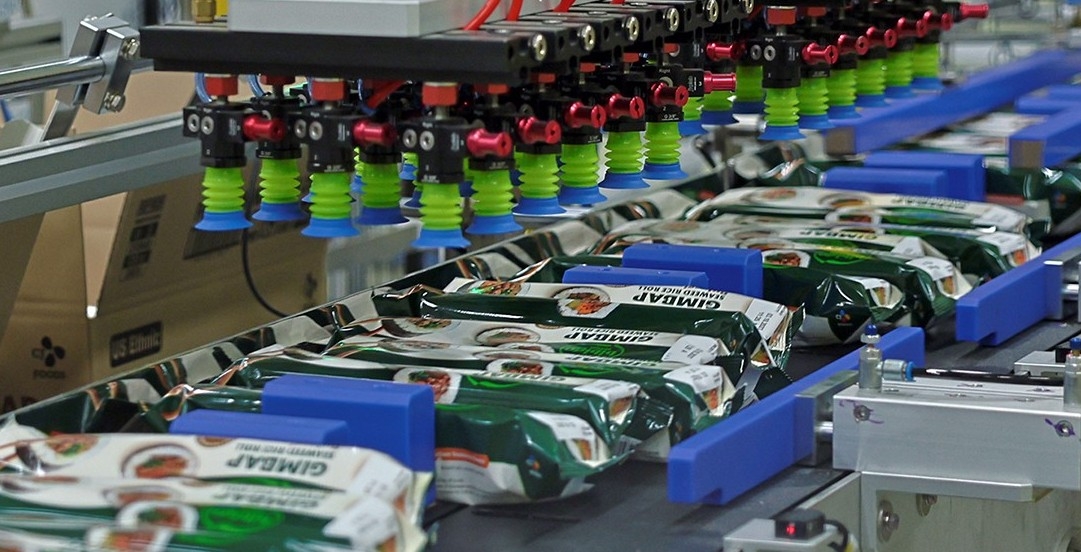
South Korean food giant CJ CheilJedang said Wednesday it has opened the industry's first fully automated production line for frozen gimbap, in a preemptive bid to meet rising global demand for the beloved Korean rice roll.
The facility, located on the company's campus in Jincheon, North Chungcheong Province, is the result of an 18-month effort to develop proprietary equipment that automates every stage of manufacturing from loading fillings into rice to slicing and tray-packing finished rolls.
The company explained that the automated system, built to meet international hygiene standards, is designed to increase throughput and minimize weight variation between rolls. The line optimizes the texture and bite of each ingredient through precise heat-treatment controls, while rapid-freezing technology maintains quality through distribution and storage.
The investment targets surging demand for the company's frozen gimbap under its flagship Bibigo brand, launched in 2023 as part of its Korean food globalization strategy. Six gimbap varieties are currently sold across 25 countries.
Cumulative global sales have exceeded 8 million units since launch, with annual revenue growing at roughly 130 percent on average. The company said further export drives are underway into the American, European and Australian markets.
"This is a strategic investment to accelerate K-food's global reach, not merely an expansion of capacity," a company official said. "We plan to establish Bibigo gimbap as the definitive K-gimbap brand.”
The automated facility comes amid a broader milestone for CJ CheilJedang, with overseas food sales surpassing domestic revenue for the first time at 5.92 trillion won ($4 billion) of the food unit's 11.52 trillion won in annual revenue. The divergence was sharpest in the fourth quarter, when overseas food sales hit a record 1.61 trillion won, while domestic revenue fell 3.8 percent.
minmin@heraldcorp.com