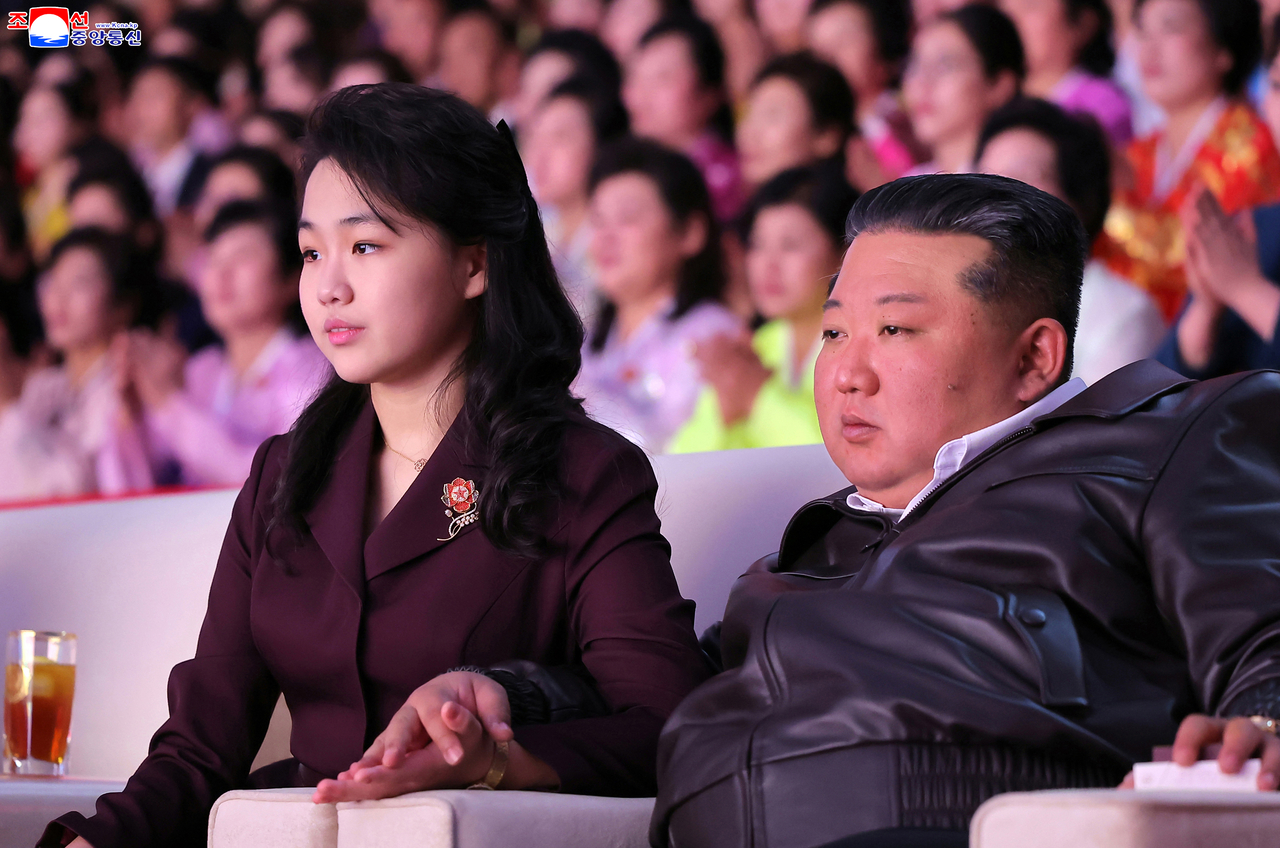
South Korea’s spy agency said last month that North Korean leader Kim Jong-un’s daughter, known as Ju-ae, appears to have entered the stage of being groomed as a successor — a striking assessment in a country long defined by rigid patriarchy and deeply entrenched gender inequality.
The National Intelligence Service’s latest evaluation marked a shift from its earlier description of Ju-ae as the “most likely successor,” suggesting that Pyongyang may now be actively moving toward formalizing her status.
Lawmakers briefed by the agency cited signs that the teenage daughter has begun expressing views on state policies and expanding her public presence — developments the NIS interprets as part of a broader succession process.
From symbolism to succession?
The North Korean regime has recently placed unusual emphasis on women’s roles. Kim Jong-un’s speech at International Women’s Day this year — his first ever — highlighted the importance of women in socialist development, while Ju-ae appeared alongside both parents for the first time at the event.
Some analysts see this as part of a broader effort to normalize female leadership in advance, softening resistance within a traditionally male-dominated system.
“In a patriarchal society like North Korea, this kind of messaging is essential,” Lim Eul-chul, a professor at Kyungnam University’s Institute for Far Eastern Studies, said. “It prepares the ground for the possibility of a woman inheriting power.”
Ju-ae’s increasingly choreographed public appearances — from attending major military anniversaries to visiting the Kumsusan Palace of the Sun — are also being closely scrutinized by analysts. Experts say the most telling shift lies not just in her visibility, but in how she is portrayed.
According to Lim, recent imagery of Ju-ae embracing citizens in a photo released by Rodong Sinmun, the North's main newspaper for domestic audiences, is far from incidental. The photo was taken when Ju-ae accompanied her father and mother, Ri Sol-ju, to a completion ceremony of housing units in Pyongyang, a project set during the 8th Workers' Party Congress in 2021.
“These scenes are designed to show that she is loved and endorsed by the people,” Lim said. “It is part of a process to construct the narrative that the successor is chosen by popular will.”
Since making her public debut in November 2022 at the launch site of the Hwasong-17 intercontinental ballistic missile, Ju-ae has accompanied Kim at a range of events, from military and economic events to those related to diplomacy and culture.
At the same time, her lack of political experience — inevitable given her age — appears to be compensated through imagery emphasizing “love for the people” and emotional connection, rather than governance credentials, Lim pointed out.
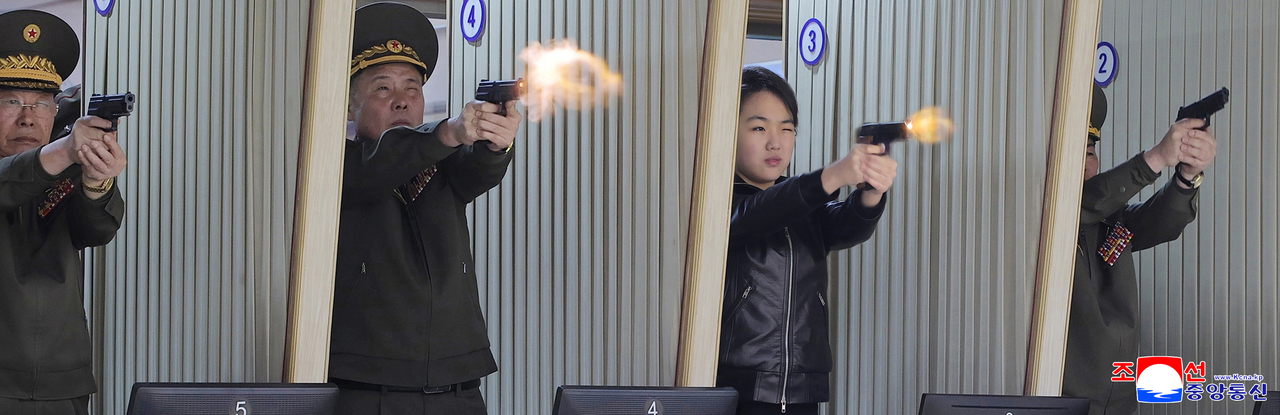
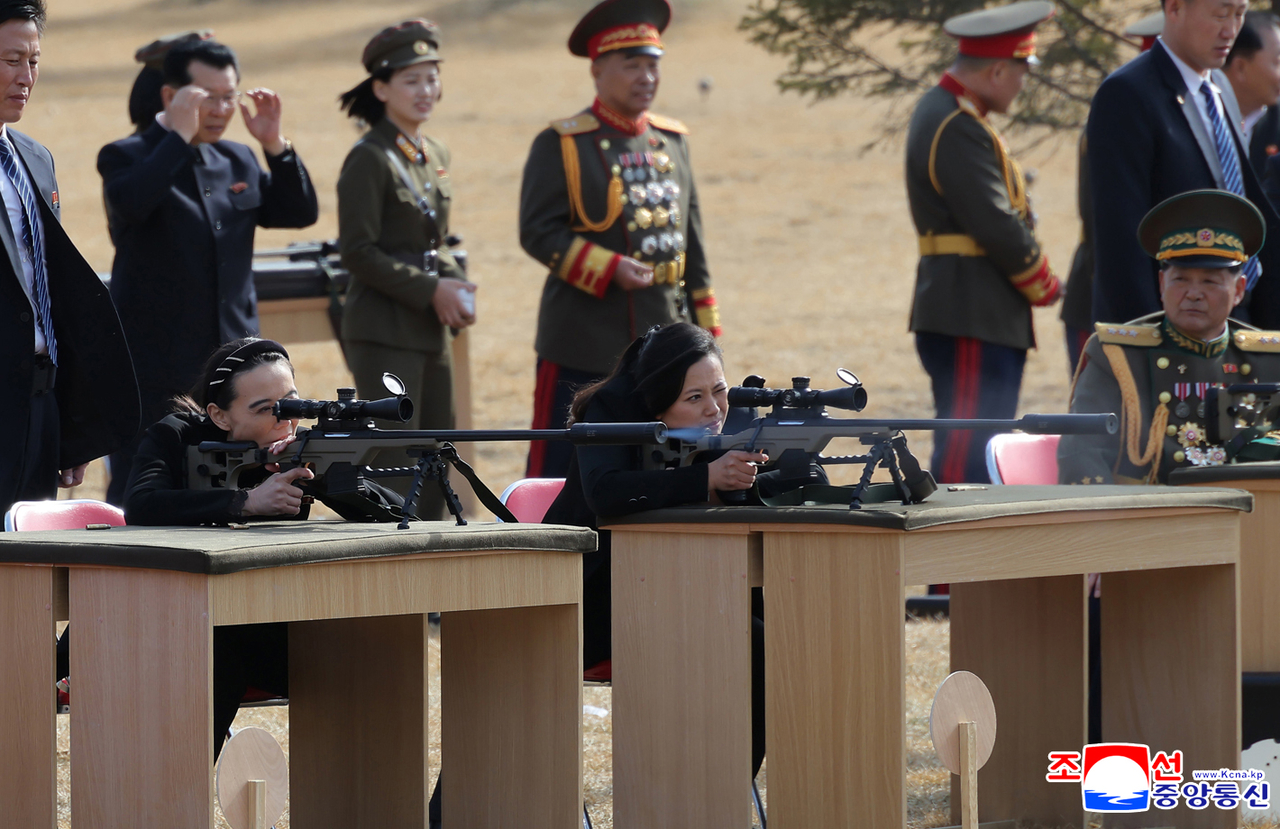
One of the most striking moments came with the release of a photograph showing Ju-ae aiming a rifle — an unusual and deliberate image in a system where authority is closely tied to military power. The image was published by the Korean Central News Agency last week, showing Kim inspecting a local arms factory alongside his teenage daughter, where the two were seen test-firing pistols.
Lim interprets the image as an attempt to project strength and leadership capability, signaling that she embodies not only the future of the Kim family but also that of North Korea’s military.
“The message is clear: the country’s future defense and Ju-ae’s leadership are intertwined,” Lim said.
But is Pyongyang really ready?
Despite the growing symbolism, many experts remain cautious.
Yang Moo-jin, a distinguished professor at the University of North Korean Studies, argues that there is little institutional evidence to support claims that Ju-ae has entered the formal designation stage, despite NIS observations.
Unlike her grandfather Kim Jong-il — who followed a clear path through party positions and official announcements — Ju-ae holds no formal role within the Workers’ Party at the moment, and there are no signs of a party congress decision endorsing her succession.
“Public appearances and protocol upgrades alone are not enough to conclude that succession has been decided,” Yang said.
Others point to a more traditional alternative: a reportedly younger son, who could follow the established pattern of male hereditary succession once he reaches political maturity.
Hong Min, a senior researcher at the Korea Institute for National Unification, urged caution in interpreting Ju-ae’s rise, pointing to the broader family structure. “Kim Jong-un is believed to have three children — an eldest born around 2010, Ju-ae in 2013, and a third child born in 2017 whose gender has not been officially confirmed,” he said, reflecting assessments shared by South Korean intelligence.
“Publicly designating a 13-year-old as successor before even joining the Workers’ Party is highly unrealistic and would require enormous political resources,” Hong said. “From a traditional succession standpoint, a male heir — if one exists — would represent a far more natural and stable path.”
He added that the timeline also works against an early designation. “A younger son, if confirmed, would reach party-eligible age within about a decade, at a time when Kim Jong-un would still be relatively young. That makes a delayed, more conventional succession scenario entirely plausible,” he said.
Beyond the question of succession lies a deeper structural reality. North Korea presents a paradox: women are essential to the country’s survival — running households and informal markets — yet remain structurally excluded from political power and subject to entrenched discrimination.
Researchers estimate that women serve as the primary breadwinners in as many as 80 to 90 percent of households, driven by their dominance in the country’s informal market economy. Yet this economic role has not translated into political influence.
Women hold just 17.6 percent of seats in the Supreme People’s Assembly, according to United Nations Women, and remain largely absent from the upper echelons of power. Even where legal equality is formally guaranteed, international assessments point to a persistent gap between rhetoric and reality, with women underrepresented in leadership and facing systemic constraints rooted in a deeply patriarchal social order.
The other female candidate?
Another layer of uncertainty surrounds the role of Kim Yo-jong, the North Korean leader’s influential sister, who has built a reputation as one of the regime’s most experienced political operators. Kim Yo-jong was recently promoted to a department head within the ruling party during the 9th Congress of the Workers’ Party of Korea held last month.
Lim of Kyungnam University said the biggest variable in any succession scenario remains Kim Jong-un’s health.
“In the event of a sudden contingency, a power struggle between an unprepared Ju-ae and the more experienced Kim Yo-jong is an easily conceivable scenario,” Lim said.
He noted that while Kim Ju-ae derives symbolic authority from her status as part of the ruling “Paektu bloodline” — the Kim family’s hereditary lineage that underpins the regime’s legitimacy — her actual power base remains limited. By contrast, Kim Yo-jong has accumulated years of governing experience, particularly in inter-Korean relations and foreign policy.
“If elite opinion within the leadership leans toward a proven figure rather than a child, Kim Yo-jong could have the advantage,” Lim said.
Still, most analysts view an outright power struggle as unlikely. The North Korean system derives its legitimacy from direct hereditary succession, a lineage that runs from Kim Il-sung to Kim Jong-il to Kim Jong-un.
Although Kim Yo-jong shares the same bloodline, she is considered part of a collateral line, rather than the direct line of succession — a distinction that carries significant weight in the regime’s political structure.
“Collateral figures can serve as powerful aides under the current leader, but they are often sidelined when power transitions to the next generation,” Lim said.
Given Kim Jong-un’s tightly controlled leadership style, Lim said it is more likely that he would establish mechanisms to ensure Kim Yo-jong acts as a guardian or regent figure, supporting Ju-ae rather than competing with her.
Kim Yo-jong herself may also find such an arrangement advantageous, preserving her influence as a powerful second-in-command while avoiding the risks associated with directly challenging the hereditary system.
Ultimately, the relationship between Ju-ae and her aunt may hinge on timing if a scenario unfolds in which Ju-ae emerges as the designated successor.
“If Kim Jong-un remains in power long enough, Ju-ae will have time to mature and build her own political base,” Lim said. “But in the event of an early absence, her future would inevitably become far more uncertain.”
mkjung@heraldcorp.com