South Korea’s main opposition People Power Party has formally moved to distance itself from former President Yoon Suk Yeol, but doubts and criticism remain.
The conservative party adopted a resolution Monday apologizing for Yoon's Dec. 3, 2024, martial law declaration and formally rejecting the “Yoon Again” slogan used by some supporters advocating for the former president's political comeback.
The resolution was read by Floor Leader Rep. Song Eon-seok, who said the party must acknowledge public concerns and take responsibility for the political turmoil triggered by the martial law episode, which played a critical part in the conservatives' presidential election defeat.
The move is the party’s clearest attempt yet to distance itself from Yoon, who now faces life imprisonment.
The decision comes less than three months ahead of the June 3 local elections, in which party faces mounting concern over its prospects, particularly in the Seoul metropolitan area.
According to a survey conducted by pollster Realmeter from March 3-6, the People Power Party recorded an approval rating of 32.4 percent, 15.7 percentage points lower than the ruling Democratic Party of Korea’s 48.1 percent. This was also the party’s lowest rating since the current leadership took office.
Against this backdrop, several prominent conservative figures, including fourth-term Seoul Mayor Oh Se-hoon and five-term lawmaker Rep. Na Kyung-won, have shown reluctance to enter key races such as the Seoul mayoral race, while urging the party leadership to change course.
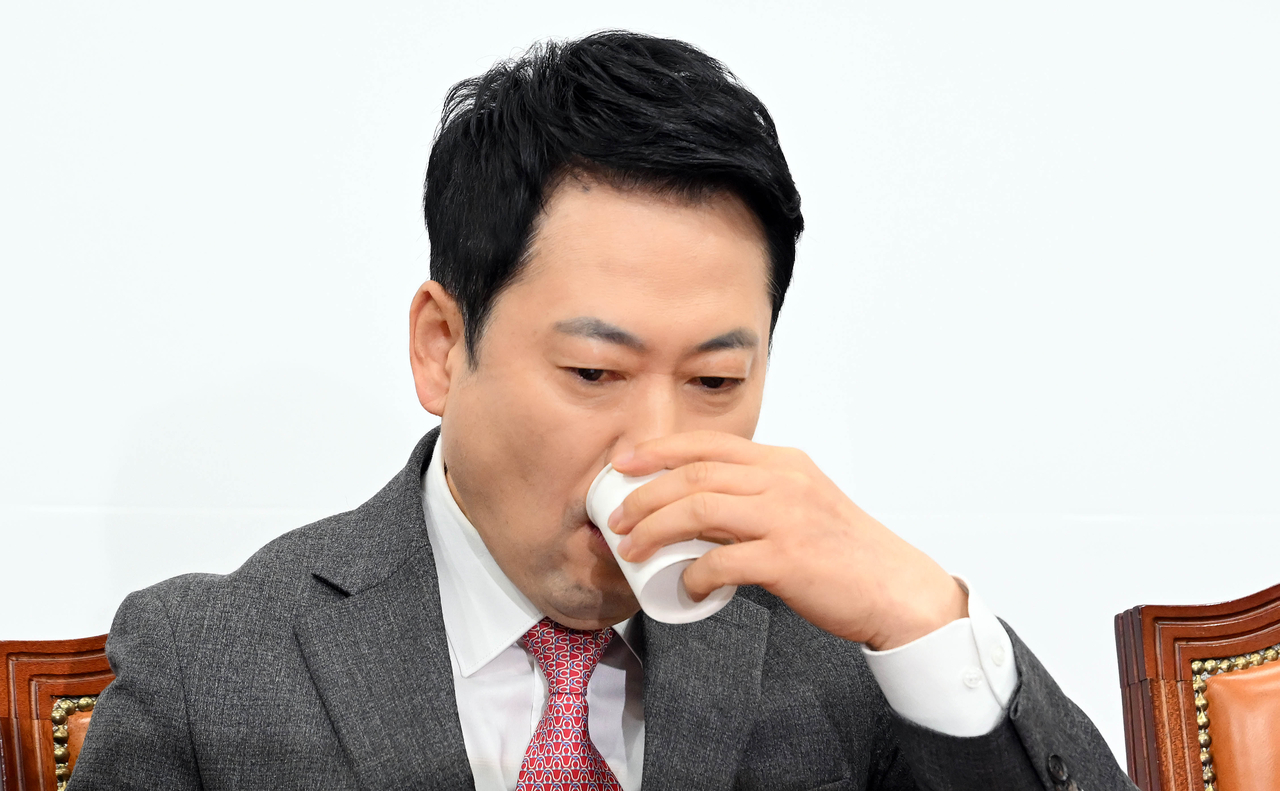
The resolution also exposed tensions surrounding party leader Rep. Jang Dong-hyeok, who rose to the position last August largely with support from Yoon loyalists.
Jang had previously resisted calls from People Power Party lawmakers to distance the party from Yoon, and did not directly address the resolution during Monday’s meeting, fueling criticism that the leadership had been reluctant to take a clear stance.
A People Power Party official said the decision was the result of growing consensus among lawmakers that the party needed to respond to public sentiment ahead of the elections.
“Many lawmakers felt the party could no longer avoid addressing the issue,” the official said on condition of anonymity. “There was a sense that without a clear message to voters, the party would struggle in the upcoming elections.”
“With local elections approaching, the People Power Party had little choice but to signal a break from Yoon,” another party official said on condition of anonymity. “But voters are likely to question why it took so long.”
Another challenge facing the party is how to manage relations with other conservative forces ahead of the elections.
In early January, Jang suggested the possibility of broader conservative unity, raising the prospect of cooperation with smaller conservative parties. But Reform Party leader Rep. Lee Jun-seok rejected the idea, saying he would not join forces with politicians associated with Yoon.
The party is also grappling with internal divisions following the expulsion of former party leader Han Dong-hoon in January over allegations that he defamed Yoon and the party leadership.
Political commentator Choi Yo-han said that resolving internal divisions within the People Power Party may be a more immediate task than building a broader conservative alliance.
“Before talking about uniting the conservative camp, the party first needs to settle its internal disputes,” Choi said. “If internal conflicts persist, any attempt at broader political cooperation will have limited impact.”
Choi also suggested that Oh’s hesitation to enter the Seoul mayoral race could serve as a trigger for a leadership challenge against Jang.
“Oh delaying his decision beyond the party’s deadline could be seen as an implicit rebuke of Jang Dong-hyeok,” Choi said. “Some may interpret it as a move positioning himself for future party leadership.”
He added that broader conservative unity may only become possible after the party resolves its leadership issues.
“If Jang eventually steps down and a figure from the party’s traditional mainstream, such as Oh, emerges as leader, only then could discussions about broader conservative unity realistically take place,” Choi said.
flylikekite@heraldcorp.com