
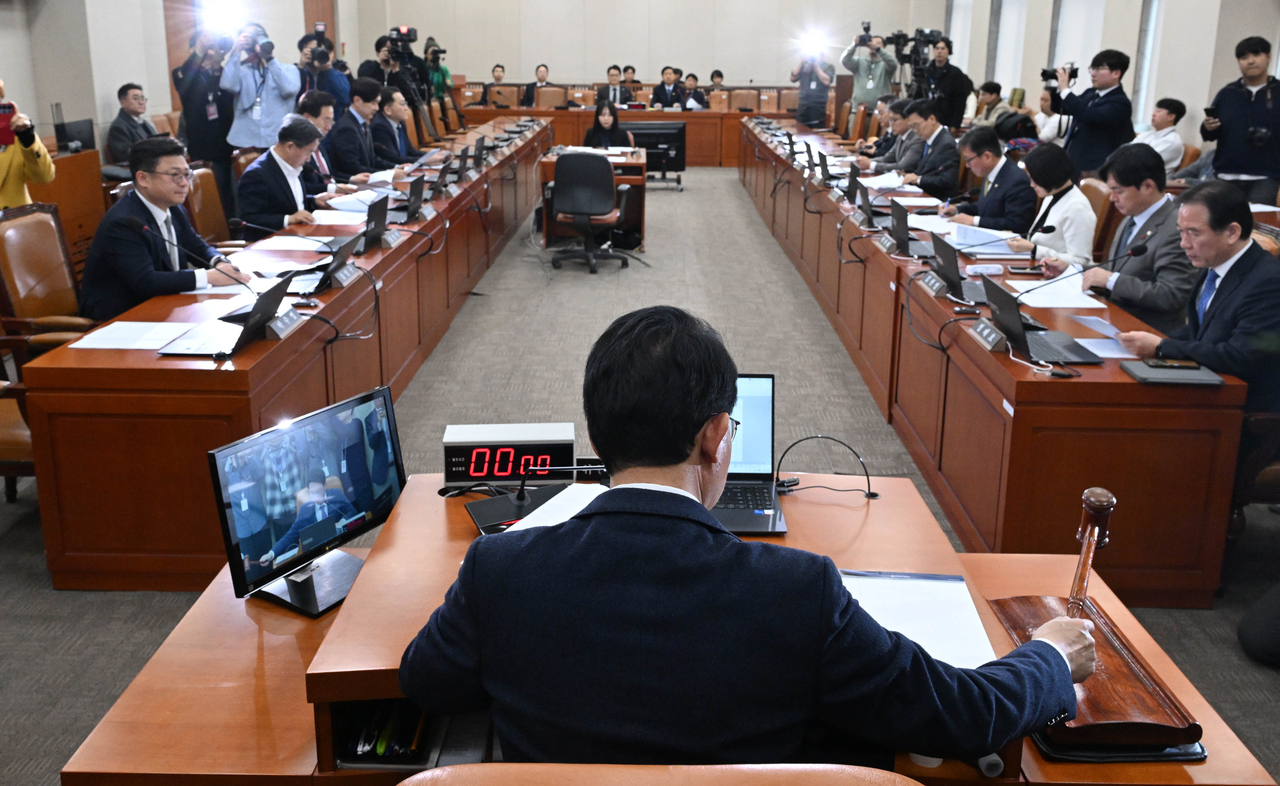
The National Assembly's special committee on US investment bills reached a bipartisan consensus Monday, the deadline to conclude its monthlong deliberations on a bill outlining South Korea's plans to implement its $350 billion investment pledge in US projects.
The bill, drafted in accordance with the joint fact sheet on trade and security issued by Seoul and Washington in November, was granted unanimous approval by the 16-member special committee and is likely set for passage in the National Assembly plenary session on Thursday.
The bill maps out plans to establish a public institution with 2 trillion won ($1.34 billion) of state capital to oversee South Korea's US investments, hire up to 50 employees there and have a board composed of three directors with at least 10 years of experience in either finance or strategic industries.
The fund that the institution is to manage would come from state-backed contributions, foreign exchange equalization funds, assets entrusted by the Bank of Korea and a government guarantee bond, according to Rep. Jung Tae-ho of the Democratic Party.
The rival parties also agreed to remove a clause in the bill that could prompt South Korean private-sector companies to contribute to the fund, which would have "contradicted the legislation's intention," according to Rep. Park Soo-young of the main opposition People Power Party on Monday.
The bill seeks to hold the government — not the newly launched public institution — responsible for presenting an annual report to the National Assembly and obtaining the relevant committee's approval before proceeding with the investment plan. It will also mandate the disclosure of information related to US investments except in cases that involve national security or critical business secrets.
The institution's investments will mostly be for greenfield projects in the US, potentially in gas development, power grids, shipbuilding and other areas, as well as loan guarantees.
The special committee resumed operations last week and has since worked to smooth out differences over nine similar bills, after it halted its activities due to the main opposition party's decision to boycott the sessions amid political wrangling.
The bill next requires approval in the Legislative and Judiciary Committee and in a National Assembly plenary session later this week.
Rep. Han Byung-do, floor leader of the Democratic Party of Korea, said in the ruling party's supreme council meeting on Monday that the party will lead "the passage of the special bill at all costs to safeguard the national interest and avert the US reciprocal tariff (on South Korean goods)," suggesting the plenary session would be held Thursday.
The legislative move comes a day after Industry Minister Kim Jung-kwan said his US counterpart, Secretary of Commerce Howard Lutnick, had played down the possibility of a US tariff hike on South Korean goods, including cars, from 15 percent to 25 percent, once South Korea implements the conditions for the deal, such as passing the special bill.
The tariff hike was announced in January by US President Donald Trump, who accused South Korea's legislature of "not living up to" the overarching deal between Seoul and Washington.
Lutnick had "expressed appreciation" over the South Korean legislature's move to pass the US investment bill later this week, Kim told reporters upon his arrival following his trip to Canada and the US on Sunday. Kim added that, according to Lutnick, Trump's pledge to raise tariffs is unlikely to be published in the Federal Register if the bill passes as planned.
consnow@heraldcorp.com