South Korea's central bank kept its benchmark interest rate steady Thursday, citing stronger-than-expected growth momentum, as it sought to safeguard financial stability amid a weak local currency and an unstable housing market.
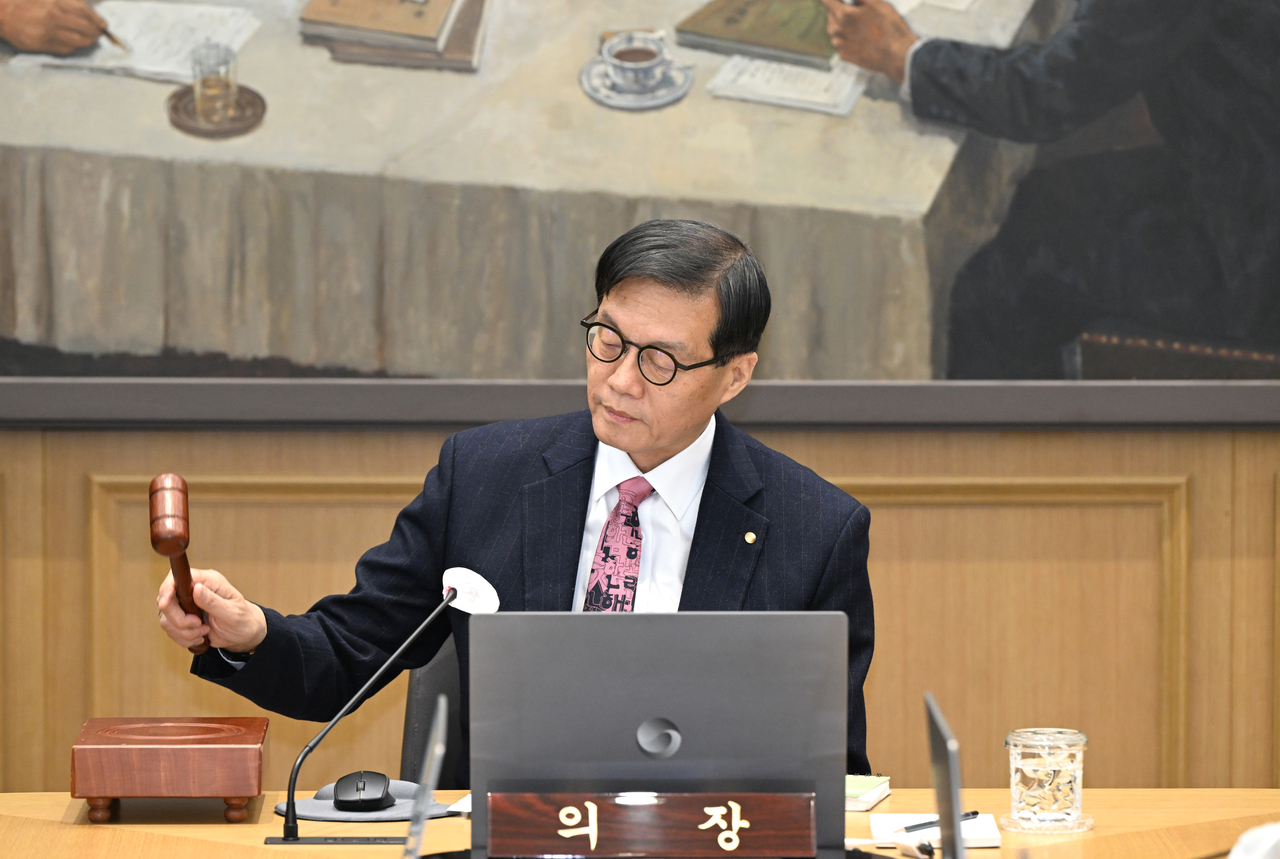
In a widely expected decision, the Monetary Policy Board of the Bank of Korea held the key rate unchanged at 2.5 percent in its latest rate-setting meeting in Seoul.
It marked the sixth consecutive on-hold decision, even as the central bank remains in an easing cycle.
Since October 2024, the Bank of Korea has cut the benchmark interest rate by a cumulative 100 basis points from 3.5 percent in a bid to bolster economic growth while keeping the level unchanged since May 2025.
Thursday's rate freeze decision was unanimous, the BOK noted.
"With inflation expected to remain stable near the target level, economic growth is projected to continue improving at a stronger-than-expected pace, and risks to financial stability also remain," the BOK said in a released statement. "The Board, therefore, judged that it is appropriate to maintain the current level of the Base Rate while assessing developments in the domestic and external policy environments."
The central bank presented an upbeat outlook for the local economy on the day, raising its 2026 growth forecast by 0.2 percentage point to 2 percent.
"Going forward, the domestic economy is expected to continue a recovery in consumption, while growth in exports and facilities investment is projected to accelerate more than previously expected, supported by a strong semiconductor sector and sound global growth," the statement said.
A key concern behind Thursday's decision was the unstable property market and rising household debt.
According to earlier data from the Korea Real Estate Board, apartment sale prices in Seoul rose 8.98 percent on-year in 2025, marking the highest growth since 2013, when the board began compiling the relevant data.
Despite the authorities' strengthened regulations to cool the overheated housing market, the average selling price of Seoul apartments has continued to climb, rising 0.15 percent in the second week of February from a week earlier.
President Lee Jae Myung has reiterated his strong commitment to stabilizing the real estate market and issued verbal warnings against multi-home owners, saying, "the root of all problems in this country lies in real estate."
The BOK also prioritized the stability of the foreign exchange market amid the won's continued weakness.
The local currency has rebounded somewhat from a multi-year low of near 1,500 won per US dollar late last year, following authorities' verbal interventions and various policy measures, but it still remains below the closely watched 1,400 won level amid supply-demand imbalances.
Concerns about further weakness persist amid tensions between the United States and Iran, as well as continued net selling of domestic stocks by foreign investors.
Experts say a rate cut could trigger capital outflows, which in turn may further weaken the local currency.
On Thursday, the Korean won opened at 1,426.3 won against the dollar, up 3.1 won from the previous session.
Another key focus for the BOK is the widening interest rate gap with the US, as a larger gap could prompt foreign capital outflows and place additional downward pressure on the won.
Currently, the policy rate gap between the two countries stands at 1.25 percentage points. (Yonhap)