

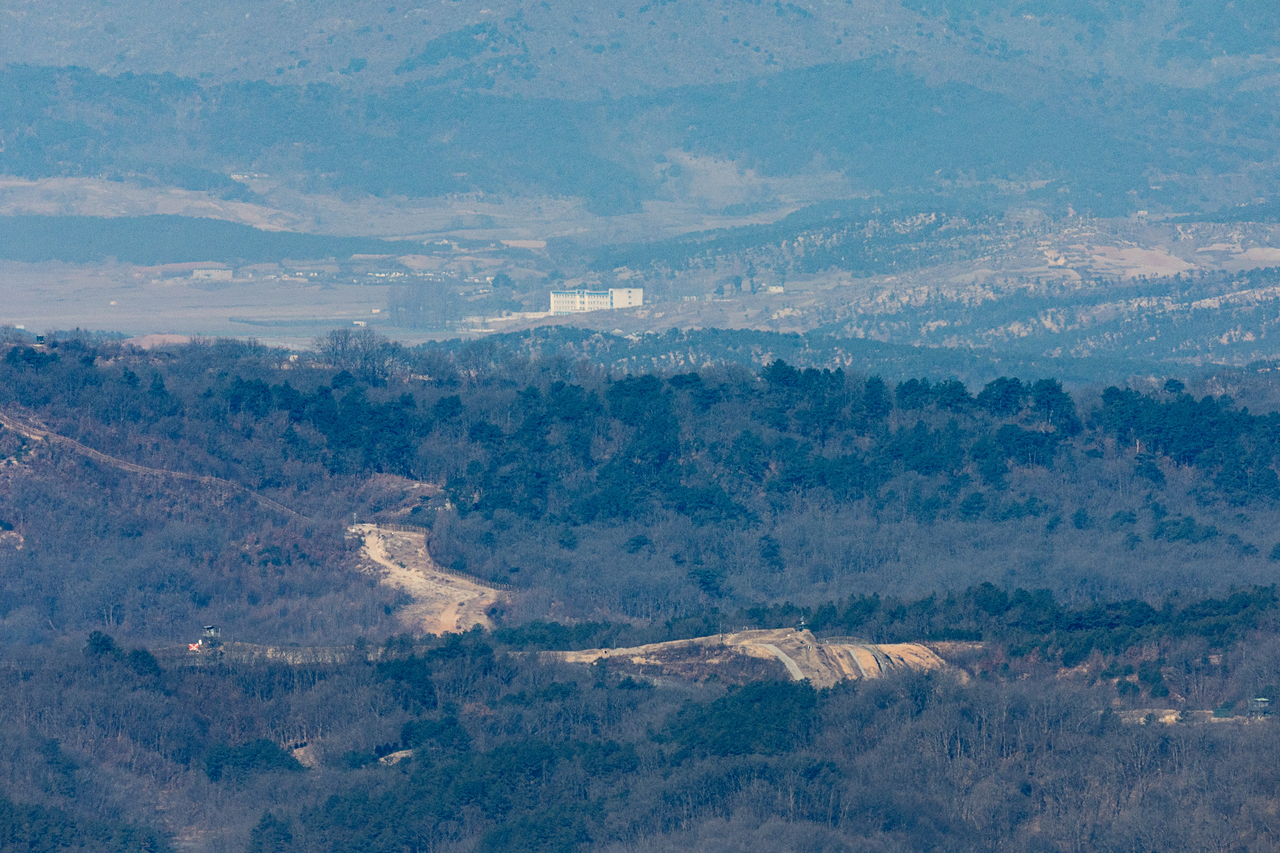
The United States has not yet agreed to South Korea’s proposal to reinstate a no-fly zone near the inter-Korean border under the suspended Sept. 19 military agreement, a high-ranking official at Seoul's Foreign Ministry said Monday, adding that consultations are ongoing.
A ministry official, requesting anonymity, told reporters at the Government Complex Seoul that restoring the 2018 inter-Korean military pact has been a firm policy objective of the Lee Jae Myung administration from the outset, and that Seoul has been in close coordination with Washington throughout the process.
“While consultations are underway, the US has not yet expressed agreement,” the official said, noting that technical concerns could arise, though declining to elaborate, as the matter falls under the Defense Ministry’s jurisdiction.
The remarks came as Seoul's Defense Ministry announced last week that it is reviewing a partial restoration of the pact — including reinstating the no-fly zone — in a way that does not undermine military readiness. The remarks came shortly after Unification Minister Chung Dong-young revealed the proposal for the no-fly zone as part of efforts to prevent further drone incursions into North Korea.
The no-fly zone, established under the 2018 accord, prohibits aircraft and drones from operating within 15 kilometers of the Demilitarized Zone in the eastern sector and 10 kilometers in the western sector.
The agreement was suspended in full in 2024 under the previous Yoon Suk Yeol administration, citing North Korea’s repeated launches of trash-carrying balloons. Pyongyang had scrapped the pact in 2023 following Seoul’s partial suspension in response to the North’s military spy satellite launch.
Since taking office in June 2025, Lee has pledged to restore the agreement to reduce tensions and prevent unintended clashes along the heavily fortified border.
Meanwhile, discussions on broader bilateral security issues — including nuclear-powered submarines and nuclear cooperation — have also faced scheduling delays.
The Foreign Ministry official dismissed speculation that the dispatch of a US delegation for negotiations on security-related issues had been put on hold due to a recent US Supreme Court ruling, describing the delay as a matter of schedule coordination. Seoul and Washington currently aim to carry out the joint summit agreement, which includes US backing for South Korea’s plan to develop nuclear-powered submarines, as well as efforts to secure rights to civilian uranium enrichment and spent fuel reprocessing.
The US delegation was initially expected to visit Seoul in January to discuss follow-up measures tied to the Korea-US joint fact sheet, which outlines summit agreements in the security field. The timeline was later pushed to February and then to early-to-mid March. The realistic timeline seems to be mid-to-late March at the moment, according to government sources.
“The State Department is effectively at a standstill due to the Iran issue,” the official said, citing Washington’s heavy diplomatic agenda — including talks concerning Iran, Gaza and Ukraine — as contributing factors. He stressed that there are no unexpected obstacles in bilateral security negotiations.
“At least in the security field, there are no major issues in implementing the joint fact sheet,” the official said.
The senior official added that if the US delegation’s visit is further delayed, Seoul may consider sending its own team to Washington.
“If it is further delayed, we are leaving open the possibility of going first,” the official said.
He emphasized that the delay is not related to either domestic legislative matters in South Korea or the US Supreme Court ruling, and instead reflects the need for coordination among multiple US agencies, including the White House National Security Council, the State Department, the Defense Department and the Energy Department.
Despite the slower pace, Seoul and Washington remain in close communication, officials said, and additional high-level US visits to South Korea are expected in the coming weeks.
Last week, the US Supreme Court invalidated US President Donald Trump’s use of the 1977 International Emergency Economic Powers Act as the legal basis for imposing tariffs on South Korea and other trading partners, including “reciprocal” duties. In response to the ruling, Trump introduced a temporary 15 percent global tariff and said he would roll out “new and legally permissible” duties to replace the invalidated reciprocal tariffs.
mkjung@heraldcorp.com

![[World Class] HUFS bets on Songdo, AI to redefine what a global university can do](https://wimg.heraldcorp.com/news/cms/2026/10/18/news-p.v1.20260930.7e4dbeacfc1d4d16848c0e2a441c04e6_R.jpg?type=h&h=120)
